
Glossary of PV terms from documentation Growatt — from AFCI to zero export
PV glossary of terms built exclusively from documents Growatt: the AFCI definition comes from chapter 3.8 of the manual WIT, RoCoF and LFSM-O descriptions — from the NC RfG certificate issued in Polish, and security thresholds 27/59/81 — from the EN 50549-1 certificate. Each entry has a page address in the document and a link to an article that expands on the topic.
Data sheets and certificates use the abbreviations AFCI, RoCoF, LFSM-O, THDi, 3P4W, and SOC. This PV glossary explains them as they appear in the documentation. Growatt — and a PV glossary written from documents differs from an encyclopedia in that each entry can be checked at its source—not encyclopedically, but with a definition taken from a specific document and the page where you can find it (editorial translations from English documents; two certificates are quoted from the Polish originals). We've grouped the entries according to the installer's workflow: first, the grid and connection standards, then battery, operating modes, and backup, and finally, protection, diagnostics, and communication. For entries that have a separate article in our database, you'll find a link to further details.
Glossary of PV terms: grid and connection standards
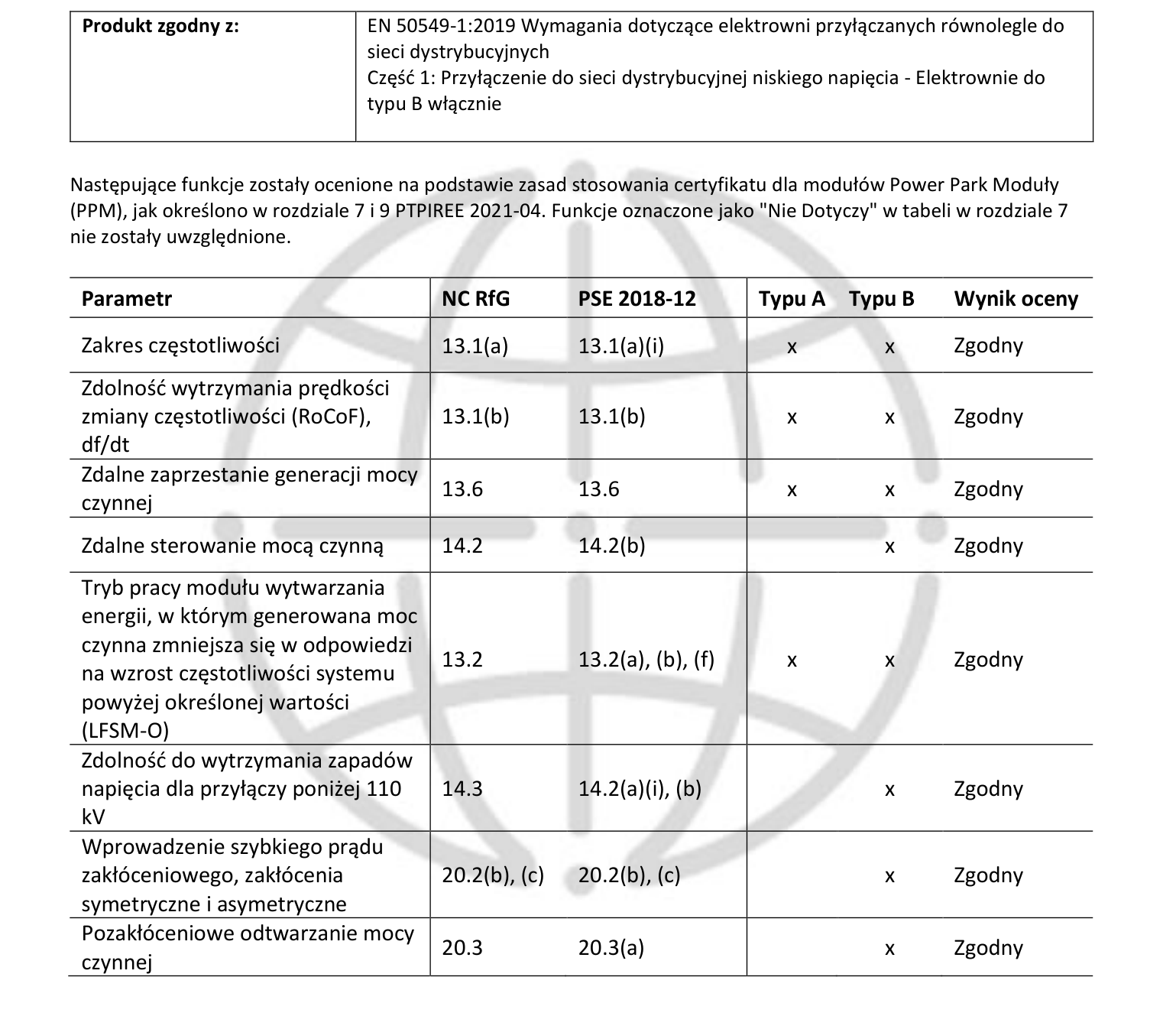
NC RfG — Commission Regulation (EU) 2016/631 of 14 April 2016, "establishing a network code on requirements for grid connection of generating units." This is the document referenced in inverter certificates when reporting to the operator. PTPIREE 2021-04 — the "conditions and procedures for the use of certificates in the process of connecting energy generating modules to power grids" referred to in the certificate, with type approval for PPM types A and B. PPM (Power Park Module) — power generating module within the meaning of the code; types A and B are the classes for which the certificate is issued WIT includes assessment. IN 50549-1: 2019 — standard "Requirements for power plants connected in parallel to distribution networks, Part 1: Connection to the low-voltage distribution network — power plants up to and including type B." Which certificate with which number matches your model is the topic of the article about certificates for DSO notification.
RoCoF (Rate of Change of Frequency) — the ability to withstand the rate of change of frequency df/dt; in the certificate, a function assessed under Article 13.1(b) of the Code. LFSM-O — an operating mode "in which the generated active power reduces in response to an increase in system frequency above a specified value" (Article 13.2) — i.e., the inverter outputs less when the grid is overloaded with generation. Remote Generation Stoppage (Article 13.6) and Remote Active Power Control (Article 14.2, Type B) — functions that allow the operator to reduce production remotely. Voltage Dips / LVRT — the ability to withstand voltage dips below 110 kV (Article 14.3, Type B): the inverter does not disconnect during a short voltage dip.
Interface Security Codes 27, 59, and 81
Every PV dictionary sooner or later encounters numerical codes from setting tables—these designate protection functions. 27 is undervoltage protection, 59 is overvoltage protection, 81 is frequency protection; a single character (27<) indicates stage 1 with a long disconnection time, a double character (27<<) indicates stage 2, fast. Un is the rated grid voltage—thresholds are expressed as multiples of it, e.g., setting 59> is in the range 1,0-1,2 Un. A separate function is protection against the 10-minute average voltage (threshold 1,0-1,15 Un, tripping ≤3 s)—this responds to prolonged elevated voltage, a classic symptom of a weak grid with high PV generation. You can find the full table of setting ranges in the EN 50549-1 certificate and in our article on certificates.
| Code | Feature | Max. disconnection time (st. 1 / st. 2) | Threshold setting range |
|---|---|---|---|
| 27< / 27< | undervoltage | 100 s / 5 s | 0,2-1,0 Un |
| 59> / 59>> | overvoltage | 100 s / 5 s | 1,0-1,2 Un / 1,0-1,3 Un |
| Wed 10 min | overvoltage from average | ≤3 s (not adjustable) | 1,0-1,15 Un |
| 81< / 81> | under-/overfrequency | 100 s / 5 s | 47,0-50,0Hz / 50,0-52,0Hz |
Glossary of terms PV: battery and BMS — SOC, LV, HV and voltage windows
The battery section opens with the concept that comes up most often in conversations. SOC (state of charge) — battery charge status; in Battery First mode, solar energy charges the storage "until the battery SOC reaches a pre-set upper threshold." BMS — battery management system with which the inverter communicates via RS485 or CAN; when BMS reports a fault, the code on the inverter tells you to look for the cause in the error code on the battery side - more information in the article about error codes. LV (low voltage) battery — operating in a window of 40-60 V at high current: WIT The 17-25K-HU allows continuous current up to 420 A. HV (high voltage) battery — window 120-800 V at 55 A current in WIT 4-25K-XHU. This difference defines the selection of cross-sections and DC protection—and explains why the HU/XHU suffix in the inverter name changes the entire battery system; for a comparison of LV batteries from our range, see the article on LV batteries Growatt.
Battery voltage window — operating range of the inverter battery input; below the lower limit the device switches off (WIT 4-15K-HU: automatic shutdown when battery voltage is below 40V). Discharge cutoff threshold (SOC cutoff) — the charge level below which the inverter stops discharging the storage and goes into shutdown mode, waiting for conditions to return.
Operation modes and backups - from Load First to EPS
This part of the dictionary acts as a map to the article on work modes—entries in the order you encounter them in the app. Load First / Battery First / Grid First — three basic priorities of hybrid operation: powering loads (PV → battery → grid), loading the storage to the specified SOC, sales — in Grid First, excess energy from the battery is fed into the grid. Zero exports — operation without energy output: meter variant (the meter regulates generation; the meter arrow must point to the inverter) and port variant (no power on the GRID port, only powering loads on the LOAD port). PTO (permission to operate) — waiting for connection consent mode: PV only charges the battery, loads are supplied to the grid via bypass, zero DC-AC interaction. TOU (time of use) — schedule of modes according to price zones, with a separate decision on charging from the network (AC Charging) in each range. Peak Shaving — Peak shearing with thresholds A (consumption) and B (distribution). All modes with parameters are described in the article on operating modes. WIT.
EPS / backup / stand-alone — backup output supplying power to loads in the event of a mains outage; for WIT 4-15K-HU with an overload capacity of 2× rated power for 10 seconds and a switching time of ≤10 ms. Switching time (switch time) — break between mains and backup operation. Smart Load — “comfortable” loads on the GEN port, cut off in island operation below the set SOC (default 10%). AC Couple — connecting a grid inverter to the hybrid's GEN port; with four manufacturer conditions, including inverter only Growatt with a certificate identical to PCS. PCS — in this documentation: hybrid inverter as a storage system converter. Dry contact / DI / DRMS — Control input: When the DI port is activated, the inverter performs active power and power factor according to the signal; user dry contact and DRMS share the same port.
PV Glossary: DC Page - MPPT, thongs and tension windows
MPPT (maximum power point tracker) — maximum power point tracking system; in the cards described by the number of trackers and the voltage window, e.g. WIT The 4-15K-HU has 1-2 trackers and an MPP range of 150-850 V. String — a series of modules connected to one tracker input; the card provides the number of strings per tracker and the maximum input currents. MPP voltage window — the range in which the tracker can track a power point; when designing a string, you make sure that the operating voltage is within the window and the open circuit voltage does not exceed the maximum DC voltage of the inverter (for WIT 4-15K-HU: 1000V).
Starting point — PV voltage from which the inverter wakes up at all: WIT 4-15K-HU enters standby mode above 150 V, and full start occurs from 165 V. This slogan explains the classic winter question "why the inverter takes a long time to start in the morning" - with low sunlight, the string simply does not reach the threshold. 3P3W / 3P4W — three-phase connection types: three phase conductors without neutral or with neutral; the manual lists both in the supported 380/400 V network types.
Power Protection and Quality - AFCI, GFCI, THDi and Co.
AFCI (Arc-Fault Circuit Interrupter) — a system that "detects and limits the risk of an electric arc in the PV system, supported by an intelligent arc detection algorithm"; an arc can be created by breaking down the insulation or contacting conductive materials and poses a risk of fire, so AFCI continuously monitors the circuit and interrupts it when an event is detected. GFCI — leakage current monitoring; the code "GFCI High" indicates that too high a leakage current has been detected. Anti-islanding — protection against unintentional islanding, shown in the card as standard. SPD type II — AC/DC overvoltage protection built into the inverter; its warning codes (DC/AC SPD Warning) are described in Table 9.1 of the manual. THDi / THDv — current and voltage harmonic distortion factors; the card declares <3% at full load. Transformerless topology — design without isolation transformer. IP66K — degree of tightness of the housing WIT; importantly, it does not exempt from protection against sun and precipitation - details in the article on maintenance. Derating — automatic power reduction, e.g. in case of excessive temperature caused by direct sunlight (mechanism described in the installation requirements of the manual).
Diagnostics and Communication - Warning, Error, LED and Port 7006
The last group of entries is the language of the service - the PV dictionary of terms ends where the customer's call begins. Warning — abnormal situation leading to power limitation; disappears after removing the cause, restarting or reconfiguring. Error — Device damage or incorrect configuration; removal only by qualified electricians. PV Isolation Low — Low insulation resistance alarm; the DANGER section prohibits touching the device as a ground fault may have occurred. A map of all codes by number range can be found in the error codes article. WIT.
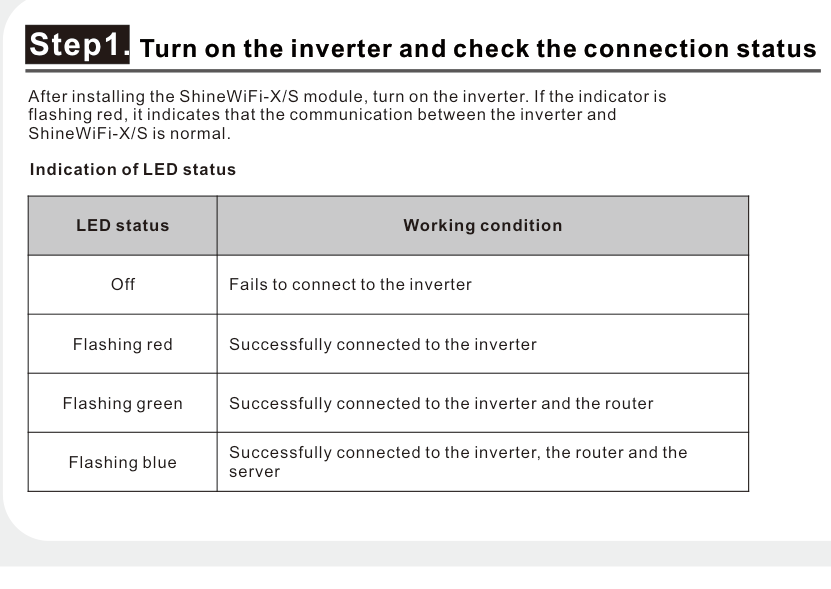
Data Logger — a module reporting the inverter's operation to the monitoring server; its LED tells about the connection chain: no light — no connection with the inverter, flashing red — inverter OK, green — router connected, blue — complete with server. Hotspot / service mode — Wi-Fi network issued by the module, with a name equal to the serial number and default password 12345678. Port 7006 — the port through which ShineWiLan-X2 communicates with the server; blocked on the firewall, it gives a perpetual flashing green LED. SN (serial number) — the identity of the datalogger; it survives even a factory reset, so taking over the installation requires releasing the module from the old account, not resetting. The configuration procedures for both generations of modules are described in the article about ShineWiFi-X i ShineWiLan-X2.
PV Glossary in Numbers - Quick Cheat
| number | Which means | Source |
|---|---|---|
| 150 V / V 165 | standby and full start threshold WIT 4-15K-HU from the PV side | manual, chapter 7.2 |
| 40-60V vs 120-800V | LV (HU) and HV (XHU) battery voltage windows | certificate CN-PVES-250504 |
| 2× / 10 sec | backup output overload | instructions, table 10.1 |
| ≤10 ms | switchover time to backup operation | instructions, table 10.1 |
| 47,0 52,0-Hz | extreme ranges of frequency protection settings 81 | certificate CN-PVES-250394 |
| 10 % | default SOC threshold for cutting off smart loads in island mode | manual, chapter 7.2 |
| 7006 | monitoring server port ShineWiLan-X2 | Configuration Guide |
| 12345678 | default hotspot password ShineWiFi-X/S | Configuration Guide |
From the installer's practice
- This PV glossary works best when read in conjunction with the document: open a certificate or card from our documentation database and look up the terms where they appear – the website addresses next to the definitions are there for exactly that purpose.
- When talking to the operator, use the code article numbers (13.2, 14.3), not just the abbreviations - then both parties are looking at the same row of the certificate.
- Explain to the customer through effects, not abbreviations: LFSM-O means "the inverter will slow down when the grid is overloaded," zero export means "nothing will flow past the meter." Leave the abbreviations for documentation.
- If you find different values for the same concept in two documents, the newer document wins - and report any discrepancies to us: we update the articles with each card revision.
Frequently asked questions about documentation concepts (FAQ)
Does the PV glossary include LFSM-O - what is it?
A power generating module operating mode "in which the active power output is reduced in response to an increase in system frequency above a specified value" - a function assessed in a certificate under Article 13.2 of the NC RfG, for Type A and B.
How does the PV glossary distinguish between an LV and HV battery with inverters? WIT?
By voltage and current window: HU versions operate with a 40-60 V battery at a continuous current of up to 420 A, XHU versions — with a 120-800 V battery at 55 A. These are two different DC wiring architectures, not substitutes.
What does code 59>> mean in the security settings?
Overvoltage protection stage 2 - fast: maximum disconnection time 5 s, threshold adjustable in the range 1,0-1,3 Un. A single character (59>) is stage 1 with a 100-second time and a threshold up to 1,2 Un.
Are AFCI and GFCI the same protection?
No. AFCI detects arcing (risk of fire due to insulation breakdown), GFCI detects excessive leakage current. In error codes WIT appear as separate items "AFCI Fault" and "GFCI High".
How to use this dictionary - checklist
- Find the entry in the section corresponding to the work stage - the PV glossary is arranged in the following order: standards → DC side → battery → modes → protection → diagnostics.
- Open the source document from the page given in the definition - each is in documentation database.
- Go to the in-depth article if the entry has a link - there are matrices and procedures there.
- Missing a password? Contact us—we're expanding our PV glossary with each new knowledge base article.
In terms of equipment, the dictionary topics meet in the specifics of our offer: Growatt WIT 30K-XHU (HV battery, NC RfG certificate in Polish) and Growatt ALP 5.0L (next generation LV battery) are good examples of both architectures; full offer in the category inverters. Selecting a set of counts inverter + battery configurator, and the original documents can also be found in download center Growatt.
Sources
- Growatt WIT 4-15K - User Manual (HU) — instructions WIT 4-15K-HU: AFCI (p. 12 of the print), modes (49-55), codes (121-131), spec (132-135)
- Growatt WIT 29.9-50K-XHU NC RfG - Certificate — Certificate CN-PVES-250176: NC RfG/PTPIREE (p. 1), LFSM-O/RoCoF functions (p. 2)
- Growatt WIT 4-25K-XHU EN50549 - Certificate — Certificate CN-PVES-250394: security settings 27/59/81 (p. 5)
- Growatt WIT 4-25K-XHU&WIT 17-25K- Poland - Certificate — Certificate CN-PVES-250504: LV/HV battery voltage windows (pp. 3, 5)
- Growatt Energy system WIT 50-100K-+AXE 75.0-H-1HR-S1 2025 - Document — system card WIT 50-100K-HU: anti-islanding, THDi, topology (p. 2)
- Growatt ShineWiFi-X(S) Configuration Guide - Quick Start Guide (EN) ShineWiFi-X/S Configuration Guide: LED states (p. 1)
- Growatt ShineWiLan-X2 Configuration Guide - Quick Reference (EN) ShineWiLan-X2 Configuration Guide: port 7006 (p. 2)