
Balcony energy storage Growatt NOAH 2000 Compatible Microinverters and Expansion
Balcony energy storage Growatt NOAH The 2000 has a capacity of 2048 Wh and can be expanded by adding additional units—up to four, or 8192 Wh. It accepts 2×900 W from the panels, outputs a maximum of 800 W to the microinverter, and the manufacturer has confirmed in writing compatibility with 27 microinverter models from eight brands. Below is the full list, terms of cooperation, and selection guidelines.
Balcony energy storage is the fastest-growing photovoltaic segment in Europe—installation requires no permits, requires no intervention in the building's wiring, and is plugged into a power outlet via a microinverter. The challenge arises when selecting the right one: the storage unit must "match" with the microinverter, and manufacturers rarely publish strict compatibility lists. Growatt issued such a list for NOAH 2000 in the form of a letter dated June 16, 2025—and this is the heart of this article, alongside data from the catalog card (rev. 2025-09) and the short manual. All with the website address next to each number, editorial translation from English documents.
Who is the balcony energy storage system for?
A balcony installation addresses situations where traditional rooftop photovoltaics are out of the question: apartment building, rent, someone else's roof, or simply a budget disproportionate to your needs. However, the panel set with the microinverter generates power when the residents are not home—and that's where the storage comes in. Datasheet NOAH 2000 describes it in one sentence: the system stores all excess energy during the day and releases it when needed, improving the use of solar energy.
Before we get to the parameters, however, there are two limitations that need to be discussed honestly with the client. First, a balcony energy storage system of this class will not power the home during a grid outage: energy returns to the apartment through a microinverter connected to the system, and the microinverters disconnect when the grid voltage is off (the principle of operation of parallel-connected devices – see the term anti-islanding in our glossary). Second, formal issues of connecting micro-installations in Poland are determined by the grid operator and national regulations, not the manufacturer's data sheet – before installation, check the current requirements of your DSO. Below, we stick only to what is confirmed by the documents. Growatt.
How does a balcony energy storage system work? NOAH 2000?
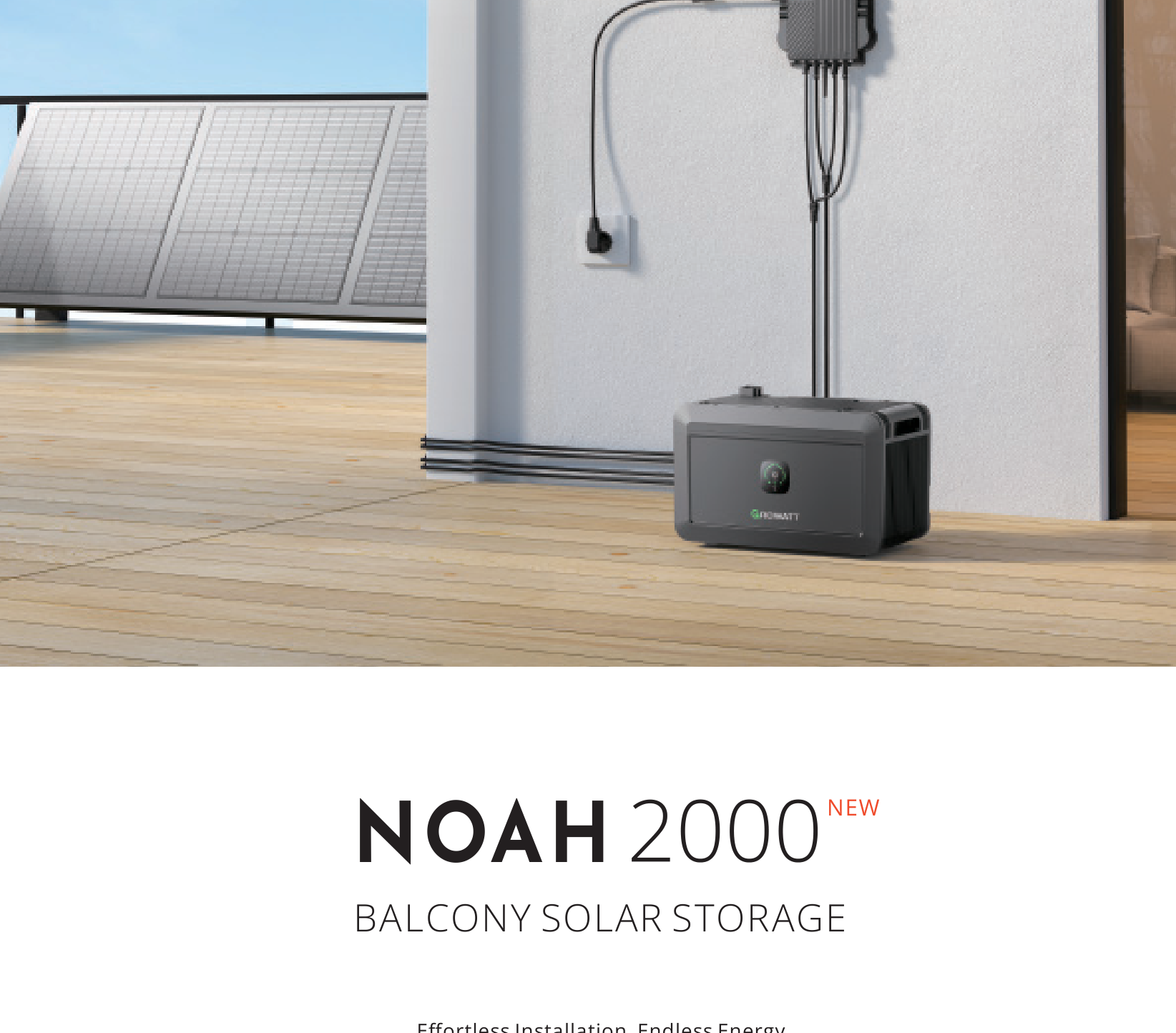
The setup is simple: you plug the panels into the storage unit, the storage unit into the microinverter, and the microinverter into the socket. NOAH 2000 sits between the panels and the microinverter, deciding whether the energy goes directly to the house or to the battery. The card describes this as maximizing self-consumption: the daily surplus goes to storage and returns when needed. On the input side, we have two channels. MPPT 900 W each (i.e. 1800 W in total), voltage window 16-60 V and current 26 A per channel; the manufacturer states that up to four modules can be connected to the warehouse using a Y-splitter.
On the output side, there's a limitation that determines the overall system's economics: the storage unit delivers a maximum of 800 W to the microinverter at a voltage of 40-50 V and a current of 20 A. This is no coincidence—800 W corresponds to the threshold for simplified balcony installations in many EU countries (a market interpretation; confirm requirements in Poland with your operator, as the data sheet doesn't specify this). The storage unit can charge at up to 1800 W at a current of 40 A, so the battery fills faster than it delivers power.
| Parameter | Value from the catalog card |
|---|---|
| Capacity / expansion | 2048 Wh, up to 8192 Wh (4 pieces) |
| PV input | 2×900 W, 16-60 V, 26 A + 26 A, 2 channels MPPT |
| Output to microinverter | 800W max, 40-50V, 20A |
| Landing | 1800 W, 40 A, rated voltage 51,2 V |
| Cells and durability | LiFePO4, over 6000 cycles |
| Working conditions | charging -10 to +55°C, discharging -20 to +60°C, start from -30°C with self-heating |
| Housing and weight | IP66, 406×235×270 mm, approx. 21 kg |
| Warranty and certificates | 10 years; CE, RoHS, REACH, WEEE |
Expansion of the balcony energy storage to 8 kWh — how many pieces and why
One unit is 2048 Wh. Additional units are added through the expansion port, and the card shows four levels: 2048, 4096, 6144, and 8192 Wh—a maximum of four units in a single system. The manufacturer emphasizes simplicity: connection via H4 connectors and "expansion by simply stacking one unit on top of the other," claiming installation in 5 minutes. A single unit weighs approximately 21 kg, so a stack of four adds up to 84 kg—if mounting on a balcony, it's worth checking where it's standing (practical note).
How much do you actually need? The arithmetic is simple and comes from the parameters, not the datasheet: since output is limited to 800 W, one unit will provide that 800 W for about 2,5 hours before running out. Two units provide about 5 hours of evening backup for the house's base load (fridge, router, lighting, standby), four – overnight with a spare. Above this level, a balcony storage unit is no longer an appropriate tool, and it's better to consider a rooftop installation with a hybrid inverter (a practical recommendation).
Compatible Microinverters - Full List of 27 Models
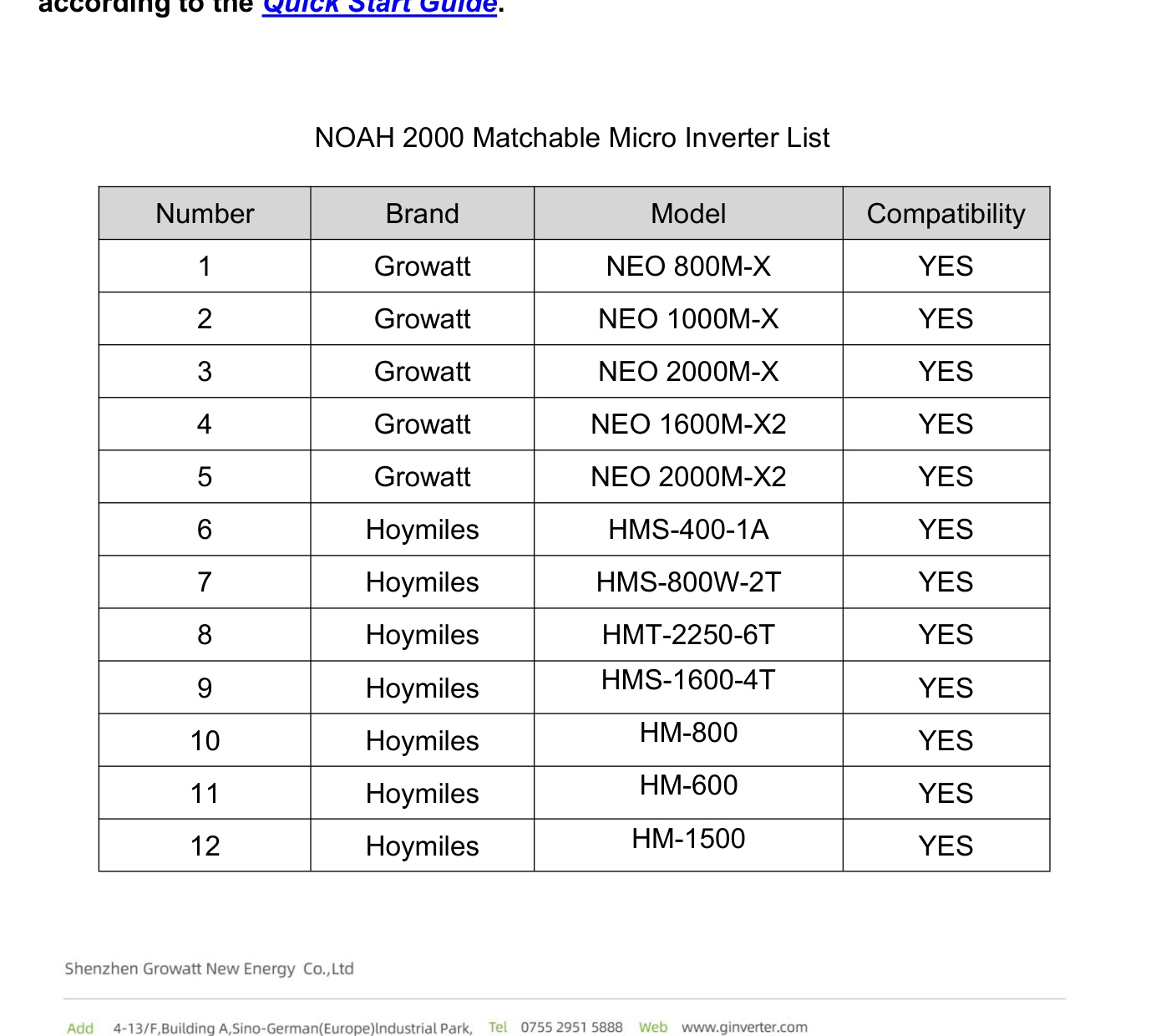
A balcony energy storage unit is only as good as its microinverter compatibility - this is the most common question about this product and the only document that resolves it is the letter Growatt from June 16, 2025. The manufacturer begins with the recommendation: "we suggest using a microinverter Growatt do NOAH 2000 for better system performance" and only then provides a list of third-party models that can be used. All 27 items have a compatibility status of "YES":
| Brand | Models confirmed as compatible | number |
|---|---|---|
| Growatt | NEO 800M-X, NEO 1000M-X, NEO 2000M-X, NEO 1600M-X2, NEO 2000M-X2 | 5 - manufacturer's recommendation |
| Hoymiles | HMS-400-1A, HMS-800W-2T, HMT-2250-6T, HMS-1600-4T, HM-800, HM-600, HM-1500, HMS-800W-C, HMS-1800-4T, HMS-2000-4T | 10 |
| Deye | SUN1000G3-EU-230, SUN-M80G4-EU-Q0, SUN-M80G3-EU-Q0, SUN-M160G4-EU-Q0, SUN-M200G4-EU-Q0, SUN1600G3-EU-230, SUN600G3-EU-230 | 7 |
| APsystems | EZ1-M | 1 |
| ENVERTECH | EVT800 | 1 |
| NEP | BDM-800 | 1 |
| TSUN | TSOL-MS800 | 1 |
| FoxEss | M1-800-E | 1 |
The list includes two conditions without which compliance does not apply. First: NOAH 2000 must have the latest software which is updated in the app ShinePhoneSecond, the storage output must be connected to the two microinverter inputs, according to the quick start guide—this isn't an assembly option, but a requirement for proper operation. The manufacturer also emphasizes that the list is open: they are working on additional models, and compatibility inquiries are accepted at their service address. If your microinverter isn't on the list, the lack of an entry doesn't mean "it won't work"—it means "the manufacturer hasn't confirmed it," and this is a crucial difference when filing a complaint.
Smart meter - how a balcony energy storage facility avoids losses
The warehouse itself does not know how much electricity the house consumes - that is why the card describes a mode of intelligent self-consumption with a wireless meter: the Shelly or GroPlug-X device measures the current consumption, and NOAH dynamically adjusts output power to meet needs. The manufacturer lists compatible meters: Shelly 3em, Shelly Pro 3em, EverHome EcoTracker, and Chargee Sparky P1, with the latter listed as "in the process of compatibility adjustment"—meaning it shouldn't be included in the offer at this time.
The difference is shown in the chart on the card: in standard mode, the storage device delivers constant power, and any excess power exceeding the home's demand is lost; in smart mode, the output follows the consumption, eliminating any losses. Practical conclusion: no meter needed NOAH 2000 is still operating, but some of the energy from the storage facility is escaping into the grid without any compensation – with a typical tariff, the meter pays for itself faster than it appears on the cost estimate (own assessment, depending on the customer’s tariff).
The storage unit's operation is controlled and monitored via an app and an LED display on the housing; the device supports WiFi and Bluetooth. The app is also the only channel for software updates, which—as we'll see in the microinverter list—can be a requirement for compatibility.
Balcony energy storage installation and operating conditions
The balcony energy storage unit is delivered ready for assembly - the quick instructions list the contents of the kit: NOAH 2000, an instruction manual, a PV input extension cable, a DC output cable, a mounting bracket, and a H4 connector disconnection tool. The document is bilingual—English and German—so it's a good idea to rely on this article and our documentation when training your team. The included bracket allows you to securely mount the device, and the H4 connector disconnection tool means that removal during a move takes just as long as installation.
Environmental conditions are a strong point of this product: the IP66 housing is designed for operation "in homes, on balconies, in gardens, and apartments, regardless of the weather," charging from -10°C and discharging from -20°C, and in temperatures as low as -30°C, the device starts and automatically warms up to a temperature suitable for charging. This addresses the main concern of customers regarding outdoor storage facilities in the Polish climate—with the caveat that the heating itself consumes energy from the storage, so the actual available capacity in winter is lower (a practical conclusion, not a datasheet parameter).
Balcony energy storage vs. rooftop installation – when and which?
It's worth making an honest comparison, because customers ask directly if "it's even worth it compared to standard photovoltaics." The differences stem from parameters, not opinions. The balcony system operates with an input power of up to 1800 W and outputs up to 800 W, thus covering the apartment's base load: refrigerator, routers, lighting, and standby electronics. A rooftop system with a hybrid inverter operates with a power of several, or even a dozen, kilowatts and supports a heat pump, induction cooktop, or car charger—and with the right equipment, also provides backup power during a grid outage, something a balcony system doesn't offer.
Balcony energy storage wins where rooftop installation is impossible or uneconomical: in apartments, rental properties, summer houses, and anywhere where minimal interference with building installations is important. It has another advantage worth mentioning: moving. The four 21 kg units and the panels on the balustrade can be dismantled and taken with you—something you can't do with a rooftop installation. The final choice is usually not a binary one: some customers start with a balcony system as a test, then switch to a rooftop installation after moving home (market observation, not manufacturer data).
What NOT to do with a balcony energy storage system
- Don't assume microinverter compatibility "because the plug fits." The manufacturer's list includes 27 models; the absence of a model on the list indicates a lack of confirmation of compliance, not presumption of compliance.
- Don't skip software updates. Compatibility requirement is the latest firmware of the warehouse, updated in ShinePhone.
- Do not connect the output to one input of the microinverter. The letter requires connection to two inputs, according to the quick instructions.
- Do not exceed 900 W per PV channel. The card delivers 2×900 W and 26 A per channel; oversizing one channel will not increase the gain because the limit is set per channel.
From the installer's practice
- Sell the balcony energy storage unit as a complete set: the storage unit, the microinverter from the list, and the meter – three elements whose compliance is confirmed by a document, instead of being assembled from random parts.
- The balcony energy storage is sold by time, not power: explain the 800 W limit to the customer by backup time, not by watts: "that's about 2,5 hours of backup from one unit" says more than the number on the card (own calculation from parameters).
- When installing in winter, warn about self-heating - a customer who notices a drop in available energy in frosty weather will report it as a fault otherwise.
- A stack of four units is approximately 84 kg - on the balcony, check the load-bearing capacity of the ground and the method of attachment with the bracket from the set.
Frequently asked questions (FAQ)
Czy NOAH 2000 will work with a Hoymiles microinverter or Deye?
Yes, if it is a specific model from the list: Growatt confirmed 10 Hoymiles models and 7 models DeyeThe condition remains the latest warehouse firmware and connecting the output to the two microinverter inputs.
How many panels can I connect to one balcony energy storage unit?
The card provides two channels MPPT 900 W, one string per channel, and with a Y-splitter — up to four modules. The total input power should not exceed 1800 W.
Will the warehouse survive winter on the balcony?
The housing is IP66 rated and is designed for outdoor use; charging works from -10°C, discharging from -20°C, and starting is possible from -30°C thanks to the device's self-heating.
Does the balcony energy storage have a warranty and what standards does it meet?
The data sheet lists a 10-year warranty and includes CE, RoHS, REACH, and WEEE markings. Our documentation database also includes a complete set of specific certificates for this model, including RED, RoHS, UKCA, UN 38.3, and an MSDS (Material Safety Data Sheet)—the latter of which may be required for the transportation and storage of lithium cells.
Is a Shelly meter needed for balcony energy storage?
It is not required for operation, but without it the storage does not match the output power to the home's consumption - the smart self-consumption mode card is described specifically for operation with a Shelly 3em, Shelly Pro 3em, EverHome EcoTracker or GroPlug-X meter.
Checklist for selecting a balcony set
- Check out the microinverter from our list of 27 models - or choose NEO 800M-X, recommended by the manufacturer.
- Select the power of the panels up to the limit of 2×900 W.
- Determine how long the balcony energy storage unit will maintain the load and count the number of units (2048 Wh per unit, max. 4).
- Schedule your timer for smart mode.
- Before starting: update firmware in ShinePhone and connecting the output to the two inputs of the microinverter.
- Check the load-bearing capacity of the mounting location and secure it with the bracket from the kit.
Documents in our database: catalog card NOAH 2000, list of compatible microinverters, user manual i quick start guide; originals also in download center Growatt. On offer: Growatt NOAH 2000, recommended microinverter NEO 800M-X and connection cable 5 mThe abbreviations and terms in this article are explained. PV glossary.
Sources
- Growatt NOAH 2000 - Catalog Card (EN) — catalog card NOAH 2000, pp. 1-2
- Growatt NOAH 2000 Matchable Micro Inverter List - Document — list of compatible microinverters (letter Growatt 16/06/2025), pp. 1-2
- Growatt NOAH 2000 Guide - User Manual — quick guide NOAH 2000
- Growatt NOAH 2000 - User Manual — user manual NOAH 2000
- Growatt NOAH 2000 RED - Certificate — RED certificate
- Growatt NOAH 2000 ROHS Certificate — RoHS certificate