
Energy storage Growatt — ARK, AXE, ALP i HOPE: selection for the inverter
Energy storage Growatt is selected in the following order: inverter voltage class, battery family from the compatibility matrix, and finally capacity and current. 51,2 V LV modules have from 2,56 kWh (ARK) up to 16 kWh (HOPE), clusters AXE scales up to 400 kWh, and HV towers ARK 2.5H-A2 build 7,68–25,6 kWh.
A well-chosen energy storage facility Growatt It starts not with capacity, but with the inverter voltage class—it determines which battery families even come into play. This guide organizes the entire range of storage modules: low-voltage modules AXE, ALP, ARK i HOPE, high-voltage towers ARK HV and family APX for three-phase inverters. Here you will find a selection matrix for battery families → compatible inverters, a table of expansion limits from 2,56 kWh to 400 kWh, a list of prohibited calls and a pre-order checklist.
What energy storage Growatt choose - where to start?
The selection process is a three-step process: first, the voltage class dictated by the inverter, then the battery family consistent with the manufacturer's matrix, and finally, capacity and current. SPF and single-phase SPH work with low voltage 51,2 V batteries and three-phase SPH TL3 BH-UP, MIN TL-XH, MOD and MID require high-voltage towers — ARK 2.5H-A2 with a 90-585 V controller or battery APXReversing this order is the most common selection error: capacity can always be added with a module, but the voltage class cannot be changed.
The second parameter that is often ignored is the charging and discharging current. The same capacity 5 kWh in different families means completely different currents: a single module ARK 2.5L-A2 operates nominally at 25 A, single ALP 5.0L-E2 at 75A, a HOPE 5.0L-B1 allows a maximum of 100 A. Too little bank current limits the inverter's power, regardless of how many kilowatt-hours it stands on the floor.
| Selection step | Question | Where to find the answer |
|---|---|---|
| 1. Voltage class | LV 51,2V or HV 90–585V tower? | inverter datasheet, compatibility matrix |
| 2. Battery family | which family is on the matrix for this inverter? | manufacturer's compatibility table |
| 3. Capacity and current | how many modules, what is the nominal current of the DC track? | battery catalog card, matrix below |
What battery families make up the energy storage? Growatt?
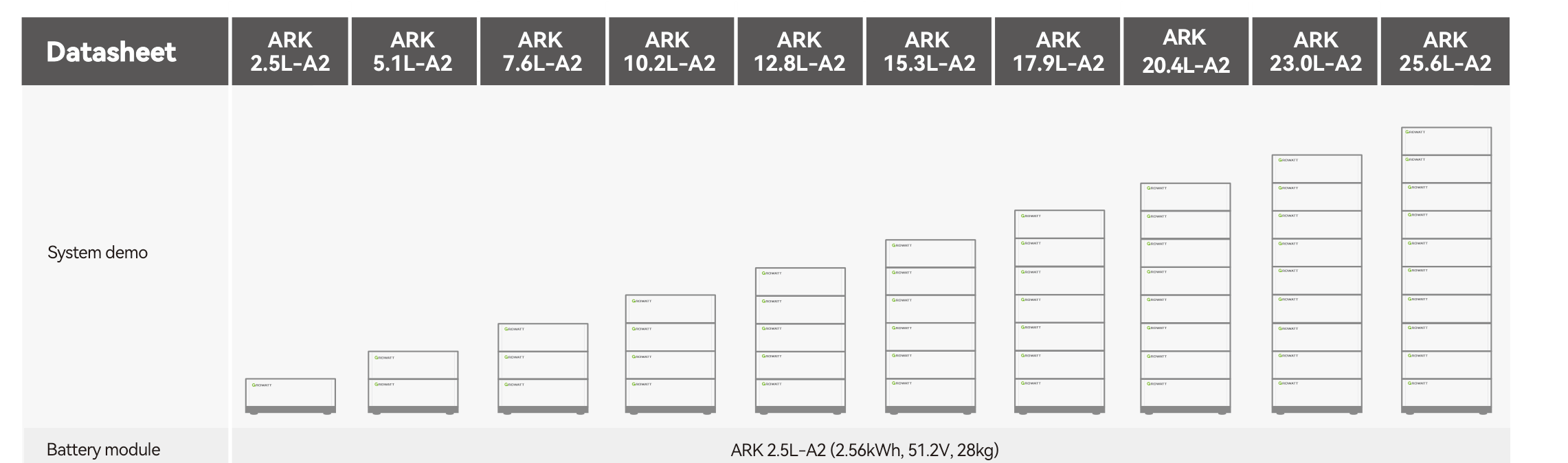
Energy storage Growatt in practice, this is six families. On the low-voltage side: AXE 5.0L-C1 with clusters of 1–10 modules of 5 kWh and multi-cluster operation up to 400 kWh, newer ALP 5.0L-E2 with IP66 housing, heating foil and extinguishing aerosol, modular ARK 2.5L-A2 placed in a tower of 1–10 modules of 2,56 kWh and the rack family HOPE — from package 5,12 kWh for units 14, 3 and 16 kWh, combined in groups of up to 48 pieces.
Two families work on the high-voltage side. ARK 2.5H-A2 builds towers of 3–10 modules (7,68–25,6 kWh) topped with a controller BMS HVC 60050-C2 and supports three-phase SPH TL3 BH-UP and single-phase MIN TL-XH with module BDC 95045-A1. Family APX comes in variants depending on the inverter: APX 5.0P-B1 with BMS APX 98034-P2 for MOD TL3-XH BP and MID TL3-XH and APX Gen 2.0 (modules APX 5.0M-B3 + APX 5.0P-B3, with control integrated in the master module) for MOD HU. Variants APX cannot be treated interchangeably - each is assigned to its own line of inverters.
Families also differ in their expansion philosophy. ARK i AXE they grow vertically - subsequent modules are plugged into the tower without any wiring between them; HOPE i ALP grow horizontally—successive bundles are connected in parallel. This distinction determines the location in the boiler room faster than any electrical parameter: tower ARK with 10 modules it is 1814 mm high and eight packages ALP occupies a wall over two meters wide with a total vertical height of 2360 mm.
If the customer expects emergency power, check the required equipment immediately - energy storage Growatt It won't keep your home running in the event of a power outage. Single-phase MIN TL-XH require a backup box SYN 50-XH-10, three-phase MID — EU units SYN-100-XH-30, while the MOD TL3-XH BP has a built-in backup function and the MOD HU has an integrated SYN in the Master module. Omission SYN-a in the offer is a classic reason for purchasing the "other half" of the system after the first winter network failure.
Selection matrix - which energy storage Growatt to which inverter?
The matrix matches battery families with inverters confirmed in the compatibility matrix. Compatibility of the set is confirmed only by the manufacturer's or distributor's matrix—items marked "—" require confirmation from the technical department before bidding.
| Family | The class | Module / package | System scope | Compatible inverters | Typical use |
|---|---|---|---|---|---|
| AXE 5.0L-C1 | LV 51,2 V | 5,0 kWh, 160 A per cluster | 5–50 kWh per cluster, up to 8 clusters = 400 kWh | SPF, SPH 1-phase, WIT 8-15K-HU | large banks off-grid and C&I on LV, high currents |
| ALP 5.0L-E2 | LV 51,2 V | 5 kWh nominally (4,6 kWh rated), 75–130 A | 1–8 packets = 5–40 kWh per cluster | —* | successor AXE in the current offer; also suitable for outdoor installation (IP66) |
| ARK 2.5L-A2 | LV 51,2 V | 2,56 kWh, 25 A/module | 1–10 modules = 2,56–25,6 kWh | SPF, SPH 1-phase | precise scaling every 2,56 kWh at home |
| HOPE 5.0L-B1 | LV 51,2 V | 5,12 kWh (5,0 usable), 100 A | up to 48 packages in parallel | SPF, SPH 1-phase | high current from one package, rack-mounted |
| ARK 2.5H-A2 | HV, 90–585 V controller | 2,56 kWh, 25 A nominal | 3–10 modules = 7,68–25,6 kWh | SPH TL3 BH-UP (HVC 60050-C2), MIN TL-XH/XH2 (BDC 95045-A1) | three-phase hybrids and MIN XH at home |
| APX (5.0P-B1 / Gen 2.0) | HV | variant depending on the inverter | according to the inverter line | MOD TL3-XH BP and MID (APX 5.0P-B1 + APX 98034-P2); MOD HU (APX Gen 2.0) | new three-phase installations MOD/MID |
* Catalog card ALP does not list compatible inverters, and our compatibility table notes the lack of manufacturer data in this field - confirm the compatibility list for a specific project with the technical department PVGroup.pl.
Energy storage Growatt in three object scenarios
In a single-phase house with an inverter SPH TL-HU or off-gridthat SPF is a natural energy store Growatt LV class: the matrix allows here AXE 5.0L-C1, ARK 2.5L-A2 and HOPE 5.0L-B1. If budget and space allow for modules of 5 kWh, ALP i HOPE they provide fewer connections with the same capacity; ARK with a module of 2,56 kWh wins where the client wants to start with a small bank and add money every season.
In a three-phase house the choice is narrowed down to HV towers. For SPH TL3 BH-UP energy storage Growatt it's a tower ARK 2.5H-A2 with controller HVC 60050-C2 - minimum 3 modules, i.e. 7,68 kWh for starters. For new MOD installations and MID a family was planned APX in a variant adapted to the inverter line - here the configuration is determined by the selection of the inverter, not the other way around.
In a company or farm with a demand of several dozen kilowatt-hours, cluster scalability is important: AXE grows to 400 kWh in eight clusters, HOPE 14.3L and 16LM build banks to 686–768 kWh, and on the inverter side they work WIT HU / 8-15K-HU. Energy storage Growatt at this scale, design is based on the power balance, not on the catalog - but the expansion limits in the table below set a hard ceiling that no design can exceed.
How much capacity can you build? Configurations and expansion limits
The table below summarizes the expansion limits for all families in one place. Note the difference between nominal and usable capacity: HOPE 5.0L-B1 has 5,12 kWh nominally and 5,0 kWh usable capacity at DoD 98%, ALP declares 5 kWh nominally and 4,6 kWh rated - always compare the same size in offers.
| Family | Module | Max units | Max system | DoD | Nominal current / max. |
|---|---|---|---|---|---|
| AXE 5.0L-C1 | 5,0 kWh | 10 modules × 8 clusters | 400 kWh | 92 % | 160 A per cluster |
| ALP 5.0L-E2 | 5 kWh (4,6 rated) | 8 packages, up to 8 clusters | 40 kWh per cluster | 92 % | 75–130 A / 90–150 A |
| ARK 2.5L-A2 | 2,56 kWh, 28 kg | 10 modules in the tower | 25,6 kWh | 90 % | 25–100 A / 48–110 A |
| HOPE 5.0L-B1 | 5,12 kWh, 43±2 kg | 48 packages in parallel | approx. 245 kWh (calculation: 48 × 5,12 kWh) | 98 % | 100 A max, peak 250 A/150 ms |
| HOPE 14.3L / 16LM | 14,3 kWh (13,3 users) / 16 kWh (15,3 users) | 48 pieces | 686 / 768 kWh | —** | —** |
| ARK 2.5H-A2 | 2,56 kWh, 27 kg | 10 modules in the tower | 25,6 kWh | 90 % | 25 A / 48 A |
** Row HOPE 14.3L/16LM is from our compatibility table; DoD and currents are not given in this extract - confirm electrical parameters in the datasheet of the specific model. Value "approx. 245 kWh" For HOPE 5.0L-B1 is a request calculated from the 48-pack limit, not the number on the card.
The power that the energy storage will actually provide Growatt, is always limited by the weaker link of the battery-inverter pair. Cards AXE i ARK repeat the same point: the nominal power depends on the maximum charge/discharge power of the inverter, and the current derating occurs as a function of temperature and SOC. In practice, this means that single-module configurations ARK (25 A nominal) will not utilize the power of larger inverters SPF — at least 4 modules are needed, at which the nominal current increases to 100 A.
The practical calculation path looks like this (the example is an editorial request, not a record from the card): inverter SPF The 5000 ES charges from PV at up to 100A, so the bank must accept this current. One tower ARK reaches 100 A nominally only from 4 modules - so a reasonable minimum is 10,24 kWh. Single package HOPE 5.0L-B1 accepts 100A straight away, and a single ALP only 75A nominal - two packages ALP raise the limit to 130 A. Same capacity, three different minimum configurations.
What NOT to combine when building a warehouse Growatt
- Do not connect 51,2V LV batteries to inverters requiring HV towers - three phase SPH TL3 BH-UP and MIN TL-XH only work with ARK 2.5H-A2 or APX; voltage class cannot be bypassed by any configuration.
- Don't offer ALP 5.0L-E2 for a specific inverter without confirmation of compatibility - card ALP does not list inverters, and the compatibility table notes the lack of manufacturer data.
- Don't mix variants APX between inverter lines: APX 5.0P-B1 belongs to MOD BP and MID, APX Gen 2.0 to MOD HU.
- Don't order batteries AXE in the General version for European installation - the manufacturer stipulates that storage inverters sold in Europe only work with the EU version.
- Do not plan the inverter power for a single-module tower ARK — 25A nominal at 51,2V is not enough for the full power of larger SPF; current increases with the number of modules.
- Do not place the battery IP20 (AXE, HOPE 5.0L) outside a dry room - outdoors and in damp boiler rooms ALP with IP66; ARK has IP65.
Working conditions - where can which warehouse be located?
The degree of protection and temperature range determine the installation location. ALP The 5.0L-E2 with IP66, heating foil and built-in extinguishing aerosol is the only family designed for more difficult conditions; the manufacturer stipulates that performance is limited below 0°C and above 45°C. ARK in both voltage classes it operates in the range from −10 to 50°C at IP65, AXE requires temperatures from 0 to 50°C at IP20, and HOPE The 5.0L-B1 only charges in the range from 0 to +55°C, although it can discharge down to -20°C.
The weight of the system is often overlooked until it is brought in. Full tower ARK The LV weighs 280 kg, and a single module weighs 28 kg – the modularity makes it easy to transport to the site. The ten-module cluster AXE is 458 kg, which makes a logistical difference when installed on a floor above. ARK requires additional base 650/260/80 mm.
A complete set of certificates is also required for design documentation and submissions. All families are based on cobalt-free LiFePO4 cells; ARK LV declares IEC 62619, IEC 62040, CE, RoHS and UN 38.3, HV version adds IEC 62477, and ALP has the most extensive list: IEC 62619, IEC 63056, IEC 62040, UL1973, CE+FCC, UKCA, UN 38.3, ROHS and AU-CEC. Declared Cyclic Life ARK i AXE is 6000+ cycles, HOPE provides over 6000 cycles at 25°C and 0,2°C. Keep your card versions with the offer - energy storage Growatt is updated more often than the inverters and it is the card revision date that settles disputes about parameters.
Transport and storage have their own rules: ALP tolerates storage from -20 to 40°C for a maximum of 6 months, and the UN 38.3 certificate present in all families is a condition for the legal transport of lithium cells - a document that the carrier may ask for when delivering to the construction site.
From the installer's practice
Four observations from real-world selections – practical tips, not manufacturer requirements.
- In practice: start your selection with the inverter's charging power, not the "round" capacity. The customer buys 10 kWhand then asks why the inverter is charging at half power - the answer is almost always the bank current, not a fault.
- From practice: leave physical space for expanding the tower by 1-2 modules. Adding a module to ARK AXE is cheap, moving the entire tower to a new location is not.
- In practice, when offering a quote, list the usable and nominal capacities side by side. The difference is 5,12 vs. 5,0 kWh it looks cosmetic, but with 48 packages it's already a few kilowatt-hours discrepancy in the promise.
- From experience: when storing in an unheated garage, ask about minimum winter temperatures before choosing a family – charging ranges vary more between families than prices.
- In practice: when receiving a delivery, compare the version number on the plate with the order number before bringing the modules to the site - a battery version error discovered after assembly means dismantling the entire tower, not replacing a single box.
FAQ - Frequently asked questions about energy storage Growatt
How many years of warranty does the energy storage have? Growatt?
It depends on the family and the variant - and the sources are not unanimous, which we note directly. ARK (LV and HV) and ALP They have 10 years in the cards. Card AXE gives the record "(5/10 years) Yes/Opt" - 5 years standard, 10 optional. For HOPE The 5.0L-B1 datasheet from batch 2509 states 5 years, while our compatibility table notes "5 or 10 years." Please confirm the terms for your specific delivery before bidding.
Can I mix battery families in one system?
No. Every family has its own BMS, its own cabling and its own position on the compatibility matrix; the documents do not provide for systems combined from modules of different families. Even within one family ARK There are restrictions when combining A1 and A2 versions - we describe them in a separate article about the ARK series.
Which energy storage Growatt can you hang it on the wall?
ARK LV allows for wall or floor mounting, ALP — floor and wall-mounted, HOPE The 14.3L-A1 is a wall-mounted unit and HOPE 16LM freestanding. Clusters AXE they stand on the floor on a dedicated base.
Is it an energy storage facility? Growatt Can it be expanded after a year?
Yes, that's the main advantage of modular structures. Tower ARK accepts 1 to 10 modules, cluster AXE from 1 to 10 modules with further expansion with additional clusters, ALP from 1 to 8 packages. Two practical restrictions: the added module must come from the same family and version (for ARK the rules for mixing A1/A2 versions apply - see the article about the ARK series), and after the expansion the system takes over the parameters of the weakest link in the set.
Will the warehouse automatically select the inverter I already have?
The path is always the same: check your inverter's voltage class in its datasheet, then check the compatible families in the matrix above. Our configurator, linked in the checklist, allows you to quickly verify the inverter-battery pairing—and cases outside the matrix are decided by the technical department, not by intuition.
Checklist before ordering a warehouse
- Inverter voltage class confirmed: LV 51,2 V or HV tower.
- Battery family present on the compatibility matrix for this inverter.
- The nominal current of the bank covers the charging current of the inverter (ARK: increases with the number of modules).
- Capacity calculated based on useful value, not nominal value.
- Installation location in accordance with the IP and temperature range of the family.
- For AXE: EU version ordered.
- Planned space and budget for future tower or cluster expansion.
- The “—” positions from the matrix confirmed in the technical department.
- Warranty terms (5 or 10 years, optional) confirmed in writing for a specific delivery batch.
You can verify the inverter-battery pair in configurator Growatt inverter + batteryFrom the current warehouse offer: Growatt ALP 5.0L (LiFePO4 5 kWh, IP66) for LV systems and Growatt HOPE 16.0LM-A1 (16 kWh) for larger banks; full list in category Energy storageCurrent catalog cards are published by download center Growatt.
Sources
- Growatt ARK 2.5L-A2 Battery - Datasheet — card ARK 2.5L-A2 (202412), p. 2
- Growatt AXE 5.0L Modular Battery New - Datasheet (EN) — card AXE 5.0L New (202506), p. 2
- Growatt ALP LV Battery System - Datasheet (EN) — card ALP LV (202408), p. 2
- Growatt HOPE 5.0L-B1 -2509 - Datasheet — card HOPE 5.0L-B1 (2509), p. 2 — transcription
- Growatt ARK 2.5H-A2 Battery - Datasheet — card ARK 2.5H-A2 (202506), p. 2