
Energy storage for WIT 29.9-50K-XHU - wardrobe AXE 5.0H-E1 from 30 to 180 kWh
Energy storage for WIT 29.9-50K-XHU is a rack cabinet AXE: controller AXE 1000100-C1 and modules AXE 5.0H-E1 EU in 30, 35, 40 or 50 configurations kWhThe inverter has three 55A battery inputs, and the entire system grows from 30 to 180 kWh.
Energy storage for WIT The 29.9-50K-XHU is selected differently than in home installations: here, it's not a single tower that counts, but the architecture - how many cabinets, for which of the three inverter battery inputs and in what module configuration. The manufacturer's system data sheet describes a complete hybrid set from 29,9 to 50 kW of power and from 30 to 180 kWh capacity. A well-chosen energy storage for WIT determines the profitability of the entire C&I system. This article goes through the selection process step by step: inverter parameters, cabinet configurations AXE, summary matrix, system components and limitations that are worth knowing about before the offer.
What energy storage is suitable for inverters? WIT 29.9-50K-XHU?
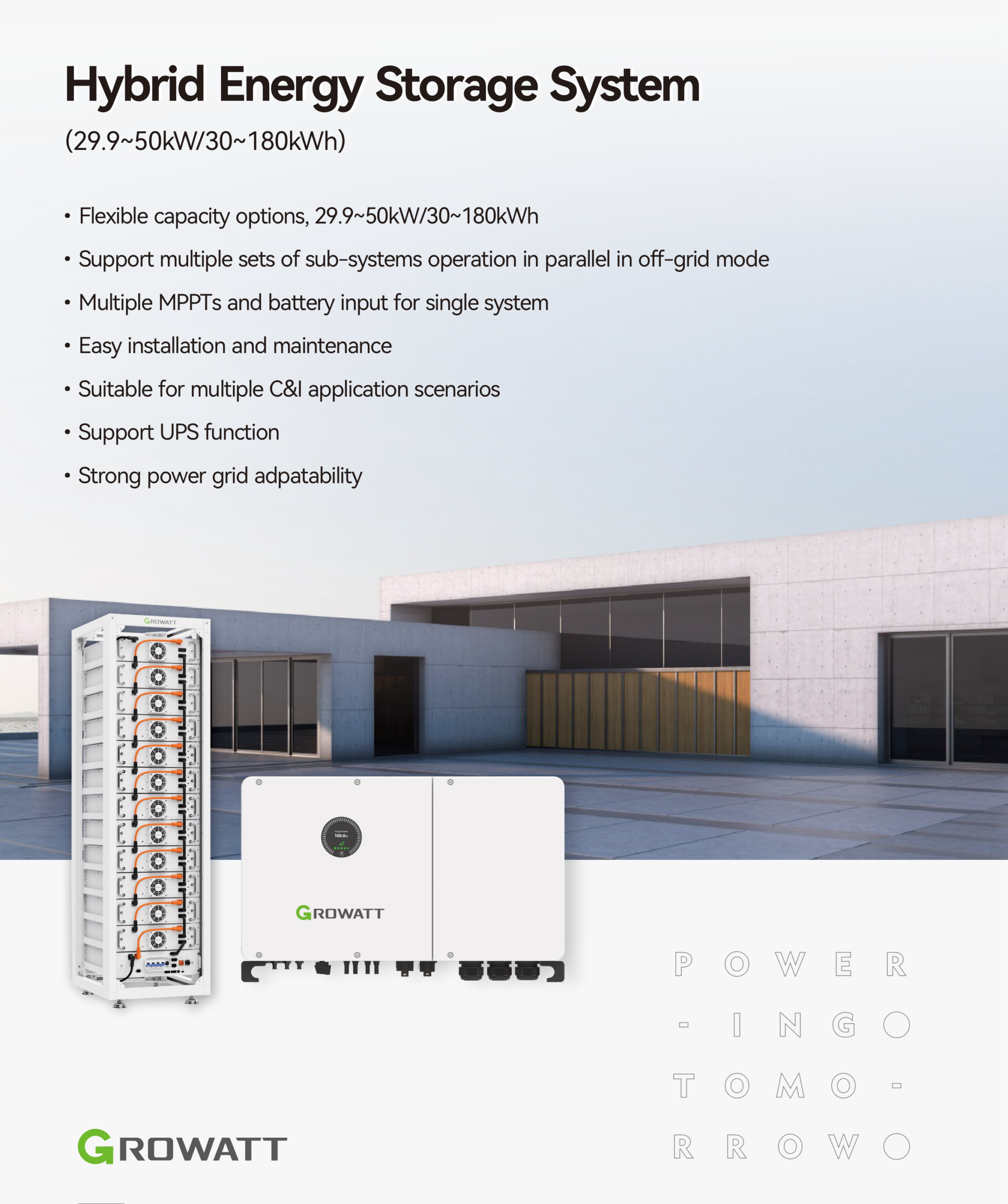
Compatible energy storage for WIT from this series is a rack system AXE: one cabinet contains a high voltage controller AXE 1000100-C1 and 6 to 10 modules AXE 5.0H-E1 EU after 5 kWh and 51,2V each. Distributor compatibility matrix confirms pair WIT 30-50K-XHU + AXE 5.0H-E1 for the entire series. The inverter accepts batteries in the 200-900V window with a recommended voltage of 512V and communicates with BMS via RS485/CAN.
| Element | Value |
|---|---|
| Inverter Battery Voltage Window | 200-900 V, 512 V recommended |
| Battery inputs | 3, 55A charge/discharge each |
| Wardrobe Controller | AXE 1000100-C1 - 120-1000 V DC, 100 A, CAN/RS485/USB, 482/131/580 mm, up to 15 kg |
| Battery module | AXE 5.0H-E1 EU — 5 kWh, 51,2 V, range 46,4-56,8 V, up to 47 kg |
| System scope | 29,9-50 kW / 30-180 kWh |
| Features | UPS, parallel operation of multiple sets as well off-grid; UPS + black start according to matrix |
How many wardrobes AXE for a 30-50 kW inverter? Selection matrix
The starting point is the inverter power and the number of battery inputs. Each of the three inputs accepts 55 A, and the cabinet outputs a maximum of 100 A through its controller. In practice, one inverter input limits the current of one cabinet, so the full system power is built up by the number of cabinets, not the current of a single one. The "recommended start" column is our conclusion: capacity close to the inverter power in kWh provides a sensible starting point for self-consumption, and the expansion to 180 kWh is opened.
| inverter | Nominal power | MPPT | Recommended start (application) | Max. usable energy of 1 cabinet |
|---|---|---|---|---|
| WIT 30K-XHU | 30 kW | 4 | 1 wardrobe 30 kWh (6 modules) | 27 kWh |
| WIT 36K-XHU | 36 kW | 4 | 1 wardrobe 35-40 kWh (7-8 modules) | 31,5-36 kWh |
| WIT 40K-XHU | 40 kW | 4 | 1 wardrobe 40 kWh (8 modules) | 36 kWh |
| WIT 50K-XHU | 50 kW | 4 | 1 wardrobe 50 kWh (10 modules) | 45 kWh |
The maximum output power of the rack increases with the number of modules: 30, 35, 40, and 50 kW for 6, 7, 8, and 10-module configurations, respectively. This means that a single, fully populated rack can power even the largest inverter in the series. When backup time is a priority, you add additional racks to fill available battery inputs.
Cabinet Configurations - Voltages, Grounds, Operating Conditions
Each energy storage unit WIT in this architecture it consists of the same blocks - they differ only in the number of modules in the cabinet.
| Modules | Capacity / usable | Max power | Nominal voltage | Working range | Mass |
|---|---|---|---|---|---|
| 6 | 30 / 27 kWh | 30 kW | 307,2 V | 278,4 340,8-V | up to 0,38 t |
| 7 | 35 / 31,5 kWh | 35 kW | 358,4 V | 324,8 397,6-V | up to 0,43 t |
| 8 | 40 / 36 kWh | 40 kW | 409,6 V | 371,2 454,4-V | up to 0,48 t |
| 10 | 50 / 45 kWh | 50 kW | 512 V | 464 568-V | up to 0,59 t |
Common conditions: the cabinet has an IP20 protection rating, sits on the floor, operates in the -10 to +50°C range with air cooling, emits less than 60 dB, and can be used up to 2000 m above sea level. The charge and discharge current of one cabinet is 100 A, and the warranty is 5 years with the option to extend to 10. All operating voltages are within the inverter's 200-900 V window - this is the conclusion from a direct comparison of the ranges in both tables of the same system card.
PV Page - Common Series Parameters
The inverters accept up to 1100 V DC voltage with a starting voltage of 195 V and a nominal voltage of 620 V; operating range MPPT is 180-1000 V, and each tracker can handle 40 A with two strings. The maximum recommended PV generator power increases from 59,8 kW at WIT 29.9K-XHU up to 100 kW at WIT 50K-XHU. Mains parameters: 380/400 V, power factor above 0,99 with -1…+1 regulation, THDi below 3%. Full documentation can be found in download center Growatt.
Architecture: one, two or three wardrobes?
Three 55A battery inputs and a 100A cabinet controller form a simple expansion logic. One cabinet per input is the starting configuration – energy storage for WIT This covers self-consumption and short backup. The second cabinet on the next input doubles the energy, with no changes on the inverter side. The third cabinet fills the last input and completes the catalog capacity range.
Two and three rack configurations (70, 90 and 100 kWh) with current prices and inverter selection WIT-XHU we show in the article energy storage 100 kWh.
The conclusion from the current breakdown: a single 55A input won't utilize the full 100A of the cabinet—the system only delivers its full dynamics when the cabinets are separated into separate inputs. Therefore, with two cabinets, they aren't connected to a common bus to a single input, but are routed separately; the junction box on the component list organizes this arrangement precisely. The system card also allows for parallel operation of entire inverter+storage sets—a scaling path beyond 50 kW, again with a limit of 6 units without consultation.
Mains currents - what the distribution board must accept
When selecting an energy storage device WIT, immediately calculate the AC side: each model has different limit currents, and the system card gives them in pairs - the maximum input/output current from the mains.
| inverter | Max input/output current (mains) |
|---|---|
| WIT 29.9K-XHU | 90,6 / 45,3 A |
| WIT 30K-XHU | 100 / 50 A |
| WIT 36K-XHU | 120 / 60 A |
| WIT 40K-XHU | 133,3 / 66,7 A |
| WIT 50K-XHU | 166,7 / 83,3 A |
The input current being twice as high as the output current is a feature of the hybrid architecture – the inverter can simultaneously power the facility and charge the storage. The lesson for designers: select grid-side protection and cross-sections based on the input current, not the rated output power; otherwise, charging from the grid on the night tariff will overwhelm the protection.
PV Generator - Power and Voltage at Full Load
The maximum recommended generator power increases to 72 kW at WIT 36K-XHU, 80 kW at WIT 40K-XHU and 100 kW at WIT 50K-XHU; for a 29,9/30 kW pair, the data sheet states 59,8-60 kW. Full load voltage range MPPT moves with power: 375-850 V for 29,9-30 kW models, 450-850 V for 36 kW, 500-850 V for 40 kW and 620-850 V for 50 kW. This is a value that is easy to miss: a string designed for low voltage will maintain MPPT in the operating range of 180-1000 V, but at full power of the largest models it will fall below the lower limit of full load - the inverter will limit the power, although formally everything will be "in the range". When designing strings for WIT 50K-XHU, aim for operating voltages above 620V.
The network frequency is 50/60 Hz with ranges of 45-55/55-65 Hz and the connection type is 3P3W+PE or 3P4W+PE – both industrial network topologies are supported without an intermediate transformer.
What not to combine in the system WIT XHU?
List of limitations that a properly selected energy storage facility must meet WIT must respect:
- Low voltage batteries. 200-900V window excludes 51,2V LV magazines — AXE 5.0L, HOPE ARK 2.5L is a different class of device for the series WIT-HU.
- Rack modules without controller AXE 1000100-C1. A cabinet without a controller has no CAN/RS485 communication or security.
- More than 6 sets in parallel without consultation. The system card clearly states: if you need more than 6 units, please contact the technical team Growatt.
- Wardrobes outside and in the cold. IP20 and a lower limit of -10°C indicate a technical room, not a shelter.
- AC-coupled system without proper PV inverters. In the AC-coupled variant, the card replaces the series inverters on the PV side. MAX i MID — not every grid inverter will fit into this system.
System Components - Beyond the Inverter and Cabinet
The system card lists the complete set per scenario. In the on/off-grid with one system: WIT 29.9-50K-XHU, wardrobe AXE 30.0-60.0H-1HR-E1, communication module ShineWiLAN-X2 and transformer TPM-CT-E/C-EU; for many systems, the SEM-XA-RM with CTs is included, and a Battery Terminal Junction Box is an option. The same components return in both generator and pure island scenarios—the difference is the configuration, not the shopping list. When pricing, consider the SEM/CT and communication module as mandatory items, not accessories.
From the installer's practice
- The 200-900 V range provides a margin for aging. The inverter's battery window is much wider than the operating ranges of the cabinets - based on real installations: this is a margin that prevents the system from failing to operate at extreme charge states in winter.
- Junction box take advantage of the offer right away. The Battery Terminal Junction Box is listed as an option on the datasheet, but with two and three cabinets on one inverter, it tidies up the DC cabling – from experience: adding it after the fact costs downtime.
- Three battery inputs are three independent buses. From experience: plan the cabinets near the inverter so that the DC routes to the individual inputs are similar - length asymmetry makes servicing and diagnostics difficult.
- The weight of the cabinet dictates the floor design. The full configuration is close to 0,59 t on the base surface - based on real installations: check the load-bearing capacity of the ceiling before the pallet enters.
- Air cooling requires service space. The cabinet cools actively and emits up to 60 dB; a common mistake is to squeeze it into a tight recess without circulation.
- Modules of 47 kg each are carried separately. The controller weighs up to 15 kg, the module up to 47 kg - plan to assemble the cabinet on site, not transport it assembled.
Frequently asked questions - energy storage for WIT
Is the energy storage for WIT can it work in an island mode?
Yes. The system card declares parallel operation of multiple sets also in mode off-grid and UPS function, and the matrix adds a black start for WIT 30K-XHU. The island scenario has a separate component list in the card.
How far can the system be expanded?
The catalog range is 30-180 kWh at the cabinets 30-50 kWh; many complete sets can work in parallel, and for more than 6 units, the manufacturer requires consultation.
Czy AXE Will 5.0H-E1 work with a home HV inverter?
The compatibility matrix binds the module AXE 5.0H-E1 with series WIT 30-50K-XHU. Cabinet voltages start at 278,4V - these are industrial levels, not household; for residential installations Growatt he has a family ARK i APX.
What does system monitoring and communication look like?
The rack controller outputs CAN, RS485, and USB and reports SOC, system and cell voltages, currents, and temperatures. A single system connects to the cloud via ShineWiLAN-X2, and in many systems, the management is taken over by the SEM-XA-RM with CT transformers. From the service perspective, the energy storage for WIT can be seen in the same application as PV production - one login, full image of the facility.
How much space should be allocated for energy storage? WIT?
The controller has dimensions of 482/131/580 mm and each module has 5 kWh weighs up to 47 kg - a fully configured cabinet weighs close to 0,59 t. In addition, there is service space for air circulation with active cooling. In practice, reserve the technical area with a reserve for a second cabinet, even if you start with one - expansion up to 180 kWh is the natural second stage of the investment.
What is the warranty on the wardrobe?
5 years with the option to extend to 10 years; the inverter matrix states 5 years. European manufacturer's service warranty applies.
Selection checklist
- Energy storage for WIT starts with the facility balance: the inverter power (30-50 kW) and the assumed backup time determine the number of cabinets.
- Select the cabinet configuration (6/8/10 modules) so that the usable power covers critical circuits.
- Lay out the components: controller, ShineWiLAN-X2 or SEM-XA-RM with CT, TPM-CT, optional junction box.
- Check the room: IP20, -10 to +50°C, floor load capacity under 0,6 t, ventilation.
- Plan for service lead time for assembly: the controller up to 15 kg and modules up to 47 kg are mounted in the rack on site, and the controller-inverter communication chain is activated on the DC side before the first start.
- Verify the work scenario with the list of components from the card: on/off-grid, generator or purely island operation have separate statements - a missing CT transformer or communication module can stop the load.
- For more than 6 sets - consultation with Growatt; you can check the initial selection in inverter + battery configurator.
Complete energy storage for WIT you will find in our offer: inverter Growatt WIT 30K-XHU, rack cabinet AXE 60H-1HR-E1 and module AXE 5.0H-E1 EU — Net prices for installers after logging in. Our technical team also helps design a complete set of components for a specific facility operation scenario, from a single cabinet to parallel systems, taking into account the facility's installation realities and the schedule for the phased expansion of the warehouse.
Sources
- Growatt Energy system WIT 29.9 50K-XHU+AXE-1HR 30 180kWh 2025 - Document — system card WIT 29.9-50K-XHU + AXE-1HR (2025), pp. 1-4
- Growatt AXE 30.0 60.0H-1HR-E1 EU - Catalogue Card (EN) — catalog card AXE 30.0-60.0H-1HR-E1 EU
- Growatt WIT 4-15K-XHU - Catalog Card (EN) — catalog card WIT 4-15K-XHU (EN)