
compatibility HOPE 5.0L-B1 - Inverters Growatt, assembly limits and expansion up to 48 pieces
compatibility HOPE 5.0L includes inverters according to the compatibility matrix off-grid SPF and single-phase SPH hybrids. This is a 51,2V low voltage battery with a capacity of 5,12 kWh (5,0 useful), currents of 100 A and a discharge peak of 250 A for 150 ms. Two hard limits: IP20 housing and charging only from 0°C.
compatibility HOPE 5.0L is a question that comes up every time you price a small storage unit: the battery is light for its capacity, cheap to upgrade, and scales in parallel up to 48 units — but it doesn't fit every inverter Growatt and not for every room. This article collects in one place: the compatibility matrix, full parameters from the catalog card, comparison with a class-compliant twin ARK 2.5L-A2, list of prohibited connections and practical rules for expansion.
What inverters does it work with? HOPE 5.0L-B1?
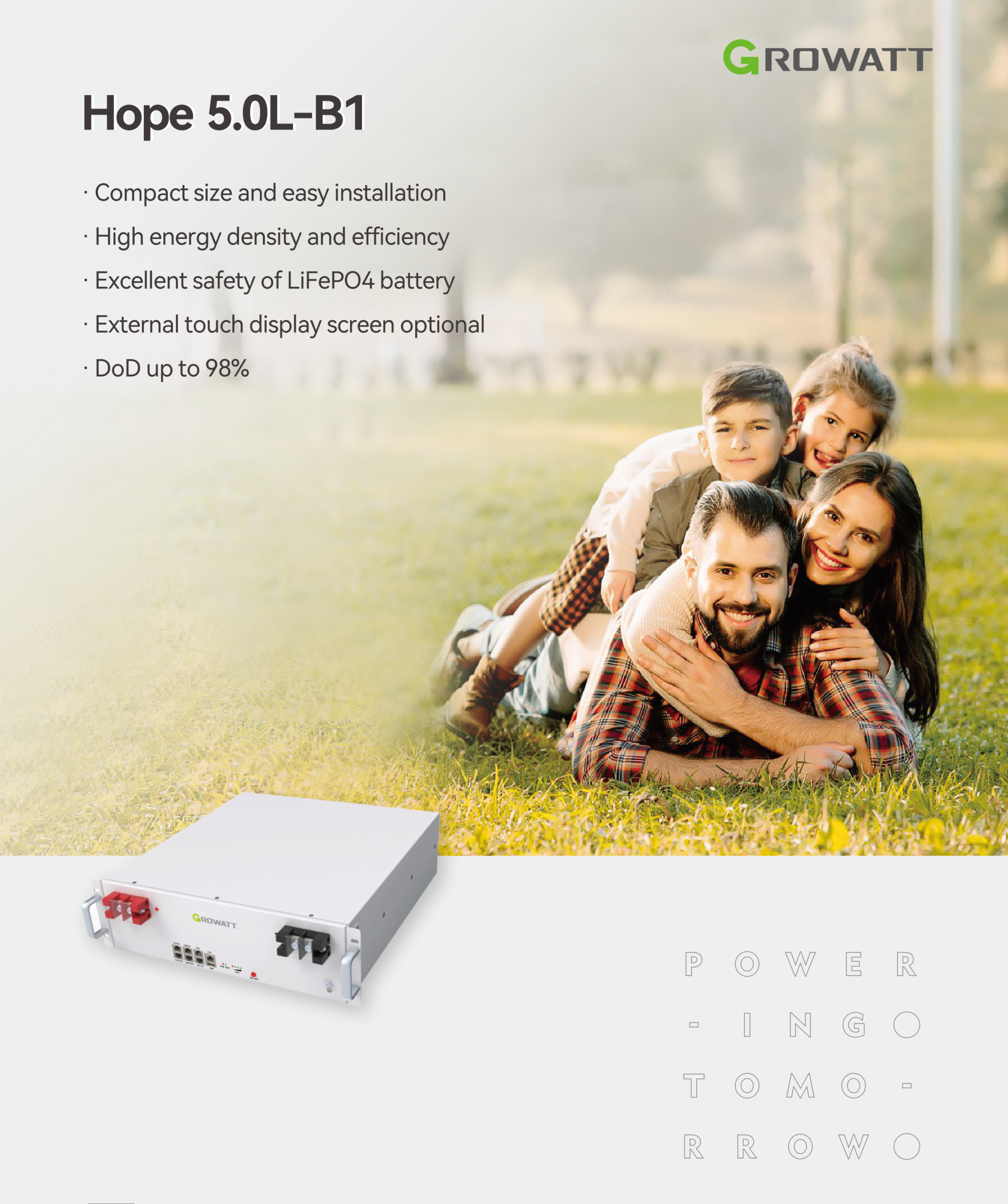
compatibility HOPE 5.0L starts with a matrix: distributor compatibility matrix ties HOPE 5.0L-B1 with two families: island inverters SPF and single-phase SPH hybrids. This is a consequence of the voltage class - the battery operates at 51,2 V in the 40-58,4 V window, i.e. within the range of a 48 V battery of these series. Three-phase high-voltage hybrids (SPH TL3 BH-UP, WIT-XHU) and the series WIT 4-15K-HU have different batteries in the matrix.
| Element | Value |
|---|---|
| Compatible inverters (matrix) | SPF / SPH single-phase |
| Nominal voltage / operating window | 51,2V / 40-58,4V |
| Nominal/usable capacity | 5,12 kWh / 5,0 kWh |
| Charging/discharging current | 100 A / 100 A |
| Peak discharge | 250 A for 150 ms |
| Communication | CAN/RS485 |
| Development | up to 48 pieces in parallel |
compatibility HOPE 5.0L with inverters SPF — current matrix
In island systems, the selection is determined by the inverter charging current. SPF ES gives a maximum solar charging current of 60 A at SPF 3000 ES up to 100 A at SPF 5000 ES - single HOPE with a current of 100 A, it covers the full range of the series. The "coverage" column is our conclusion from the comparison of both cards.
| inverter | Max solar charging current | AC charging current | Coverage by 1× HOPE 5.0L-B1 (application) |
|---|---|---|---|
| SPF 3000 ES | 60 A | 60 A | full (100 A ≥ 60 A) |
| SPF 3500 ES | 80 A | 60 A | full (100 A ≥ 80 A) |
| SPF 5000 ES | 100 A | 80 A | full (100 A = 100 A) |
| SPF 6000 ES Plus | — (PV up to 8000 W, MPPT 120-450V) | 80 A | full for AC circuit (100 A ≥ 80 A) |
With two or more batteries in parallel, the currents add up - the reserve increases, and each subsequent unit adds 5 kWh usable capacity. The card reserves the right to derating current as a function of temperature and state of charge - when designing for the full 100 A, leave a margin.
SPF 6000 ES Plus - A pair for a larger bank
The most powerful single-phase island inverter in this family has a power of 6000 VA/6000 W with a peak of 12000 VA, two trackers MPPT in a 2/1 configuration and accepts a PV generator up to 8000 W in the 120-450 V range. The charging current from the grid is 80 A, source switching typically takes 10 ms (maximum 20 ms), and peak efficiency is 93%. The inverter weighs 13,5 kg with dimensions of 460/395/132 mm, is IP20 and operates in 0-55°C - the same environmental requirements as the battery, so both devices will live in the same room.
Parallel operation of up to 6 units opens the way to single and multi-inverter systems, where compatibility HOPE The 5.0L with CAN/RS485 bus allows you to build a shared battery bank for the entire group. A pure sinewave output ensures safe power for the electronics and motors.
How many units per day of island work?
A simple calculation based on catalogue values (conclusion from multiplying the useful energy by 5,0 kWh per unit):
| Bank | Useful energy | Typical scenario (practice) |
|---|---|---|
| 1 × HOPE 5.0L-B1 | 5,0 kWh | lighting, refrigerator, router and central heating pump in the evening |
| 2 × HOPE 5.0L-B1 | 10,0 kWh — conclusion from 2 × 5,0 kWh | the era of the economical summer house |
| 4 × HOPE 5.0L-B1 | 20,0 kWh — conclusion from 4 × 5,0 kWh | day of a year-round house without electric heating |
The scenarios in the third column represent installer practice, not manufacturer data—actual consumption should be calculated from the facility's profile. The economics of expansion stem from modularity: you start with a single unit, and the bank grows without replacing the inverter, up to a maximum of 48 units.
HOPE 5.0L-B1 or ARK 2.5L-A2 - Two Philosophies in the Same Class
Both families are low voltage and both from the matrix for SPF/SPH single-phase, but they differ in construction at points that determine the installation location.
| Parameter | HOPE 5.0L-B1 | ARK 2.5L-A2 |
|---|---|---|
| Module | 5,12 kWh / 43kg | 2,56 kWh / 28kg |
| Level of security | IP20K | IP65K |
| Charging temperature | from 0°C | from -10°C |
| Discharge depth | 98 % | 90 % |
| graduation | up to 48 pcs. in parallel | tower 1-10 modules, 2,56-25,6 kWh |
| Nominal current | 100 A | 25-100 A depending on the number of modules |
| Durability | over 6000 cycles | 10 years warranty |
Wniosek praktyczny: HOPE wins in energy density per kilogram and depth of discharge, ARK — environmental resistance. Where the warehouse is to be located in an unheated garage or in a room with high humidity, IP65 and charging from -10°C speak for the ARK. In a dry, heated boiler room, compatibility HOPE 5.0L with the same pair of inverters makes it a cheaper upgrade choice — 5 kWh per 43-kilogram unit.
What not to combine with HOPE 5.0L-B1?
List of limitations set out in the catalog card and compatibility matrix:
- High-voltage inverters. SPH TL3 BH-UP, MIN TL-XH or WIT-XHU work with HV storage - the 51,2V battery does not fit into their voltage windows and the matrix does not replace it there.
- series WIT 4-15K-HU. It's an LV hybrid, but the matrix assigns it AXE 5.0L-C1 and HOPE 14.3L-A1 - no HOPE 5.0L-B1.
- Installation outdoors and in damp conditions. IP20 is a housing for dry interiors; a shed, facade or uninsulated annex is out of the question.
- Charging below 0°C. The lower charging limit is 0°C, discharging works from -20°C - in a frosty room the storage will release energy but will not accept new energy.
- Mixing with other battery models. The card describes parallel expansion only within HOPE 5.0L-B1 (up to 48 pieces); connecting with ARK AXE in one bank is not provided for in any of the documents.
Dimensions, assembly and operating conditions
Full compatibility HOPE The 5.0L with room is not just an inverter—it's also an environment. The unit measures 440/480/130,5 mm and weighs 43 kg (±2 kg)—a flat module format that stacks into a small column in a rack configuration. The discharge range is -20 to +55°C, charging 0-55°C. The LiFePO4 cells achieve over 6000 cycles at 25°C and 0,2C, and a depth of discharge of 98% means that from 5,12 kWh 5,0 nominal currents are actually available kWhCertificates: CE(EMC), UN 38.3, MSDS, RoHS — UN 38.3 applies to the transport of lithium cells and may be required by carriers. Manufacturer's warranty: 5 years; the matrix allows for a 5 or 10-year variant — the discrepancy is due to the extension option, please confirm when ordering. A European service warranty applies. Source documentation can be found in download center Growatt.
Parallel expansion - how a bank grows HOPE
The card allows up to 48 units in parallel, i.e. a bank from 5 to 240 kWh usable capacity - this is the conclusion from a simple multiplication of catalog values. In practice, in small installations, something else counts: each added unit increases the total current of the bank by 100 A, so just two units provide a current reserve above the needs of the largest SPF ES Compatibility HOPE 5.0L with CAN/RS485 bus allows the inverter to see the bank as a single warehouse. The data sheet doesn't specify rules for combining units from different production batches—before adding batteries to a bank that's been in operation for months, confirm the terms with our technical department.
Communication and integration with the inverter
The battery exposes the CAN and RS485 bus - the inverter reads from BMS charge state, voltage, and temperature, so that the charging algorithm works on real cell parameters, not on a voltage profile as in lead-acid batteries. From experience: it is communication BMS, not the LFP chemistry itself, makes the biggest difference in the lifespan of the bank – the inverter stops overcharging and deep discharging the cells at their limits.
Configuring SPF for this storage, select the lithium battery profile with communication in the inverter and check that the compatibility HOPE 5.0L is visible on the protocol side—the bank is supposed to report as a single storage unit. If there's no connection, the inverter will switch to voltage mode, which works but delivers less capacity and shortens the life of the cells. Verify the connection before screwing the covers back on: during commissioning, it takes two minutes, and after installation, it takes half an hour of disassembly.
Transport and delivery logistics
The UN 38.3 certificate applies to the transport of lithium cells—carriers require it for pallet shipments, and it formally approves the battery for transport. A unit weighs 43 kg with dimensions of 440/480/130,5 mm, so a bank of four units already represents 172 kg of cargo (the multiplication result). Plan for delivery by pallet lift, not parcel courier. For larger banks, phase deliveries according to the assembly schedule—storing cells on site is subject to the same temperature regimes as the work: storage outside this range affects the battery's lifespan, and the card requires dry conditions throughout the battery's lifespan. Each unit is carried on-site separately; the flat format without handles requires two people.
From the installer's practice
- Bank calculation is based on the evening profile, not the daily average. Based on real installations: peak home consumption occurs between 17pm and 22pm - usable capacity 5,0 kWh per unit should cover this window, because PV works during the day.
- Leave physical space for expansion. The limit of 48 pieces sounds abstract, but the second row of brackets planned at the start costs several dozen zlotys - adding one after a year requires rebuilding the bank's wiring.
- IP20 read literally. From experience: a "dry basement" can be wet seasonally - if condensation appears on the walls, choose ARK with IP65 instead of risking electronics BMS.
- Plan your winter charging with a thermometer. The 0°C limit refers to the temperature of the cells, not the air at noon - based on real installations: in unheated rooms the battery may not accept charging until the morning.
- 43 kg is a job for two people. The weight of the unit in a flat format means it is uncomfortable to hold; a common mistake is to plan to assemble it alone.
- You will only use the 250 A peak temporarily. 150 ms is enough to start a refrigerator or a pump, not for a continuous overload - calculate the continuous power from a current of 100 A.
FAQ - Compatibility HOPE 5.0L
How long will the bank maintain the parameters in stock?
The cells' durability is over 6000 cycles at 25°C and a load of 0,2°C. At one full cycle per day, this equates to several years of operation—a simple calculation; the actual result depends on temperature and cycle depth. A depth of discharge of 98% means the bank operates at almost full capacity, without the large "dead" reserve known from older technologies.
Czy HOPE 5.0L-B1 will work with SPH 10000TL-HU?
Yes - it's a single-phase LV hybrid and the matrix replaces for HOPE 5.0L-B1 just now SPF and single-phase SPH. Only verify the number of units for the charging current of the specific inverter model.
How many units do I need to start with SPF 5000 ES?
One current is sufficient: 100A of battery current covers 100A of solar inverter charging. The number of units will depend on the capacity — 5 kWh useful for art is typically evening, not daytime, when working on an island.
Is compatibility HOPE 5.0L includes older inverters SPF?
The matrix speaks of family SPF without distinction of generation; communication takes place via CAN/RS485. For older units, confirm the inverter firmware version with our technical department before purchase.
Can I top up HOPE from the network on the second tariff?
Yes - inverters SPF have an AC charging path: 60-80 A depending on the model, and SPF 6000 ES Plus 80 A. The battery will accept this full current (100 A limit), so overnight top-up of the bank on a low tariff is a realistic operating scenario.
What is the difference between 5,12 and 5,0 capacity? kWh?
5,12 kWh is the nominal value of the cells, 5,0 kWh — usable energy at a depth of discharge of 98%. Always use the usable value when calculating the backup time.
Selection checklist
- compatibility HOPE 5.0L confirm in matrix: SPF or single-phase SPH — compatibility HOPE 5.0L does not include HV series or WIT.
- Check the room: dry interior (IP20) with temperatures above 0°C in winter.
- Count the units: current from one, capacity according to the consumption profile (5 kWh useful/pcs.).
- When expanding an existing bank, confirm batch merging policies with the technical department.
- Verify the set in the tool inverter + battery configurator Growatt.
You can find the set in our offer: battery HOPE 5.0L-B1 and inverter Growatt SPF 6000 ES Plus — Net prices for installers visible after logging in. If the facility requires operation in low temperatures or installation outside of a dry interior, our technical team will recommend a replacement from the family ARK with a higher degree of protection - compatible with the same pair of inverters and the same storage voltage window.
Sources
- Growatt HOPE 5.0L-B1 -2509 - Datasheet — catalog card HOPE 5.0L-B1 (batch 2509), p. 2 — transcript from render
- Growatt ARK 2.5L-A2 Battery - Datasheet — catalog card ARK 2.5L-A2 (rev. 202412), p. 2