
High grid voltage and the inverter Growatt — Error 300, Warning 301: Diagnostics
High voltage grid inverters Growatt report as Error 300 and Warning 301 - voltage out of permissible range. The manual classifies this as a system fault, not a hardware fault: the first steps are to measure the voltage, check the AC wiring (especially N and PE) and the consistency of the regional settings.
An inverter that goes out in the brightest sunlight is the most common problem reported by PV system owners in Poland today—and high grid voltage is the number one cause. Growatt The symptom has specific names: Error 300 and Warning 301, i.e., the mains voltage is outside the permissible range. This article goes through a complete diagnostics according to the instructions of the MIN, MOD and MID: what the codes mean, what to check in the installation, what actually reduces the voltage - and what you should not do, even though forums suggest otherwise.
What exactly do Error 300 and Warning 301 mean with high mains voltage?
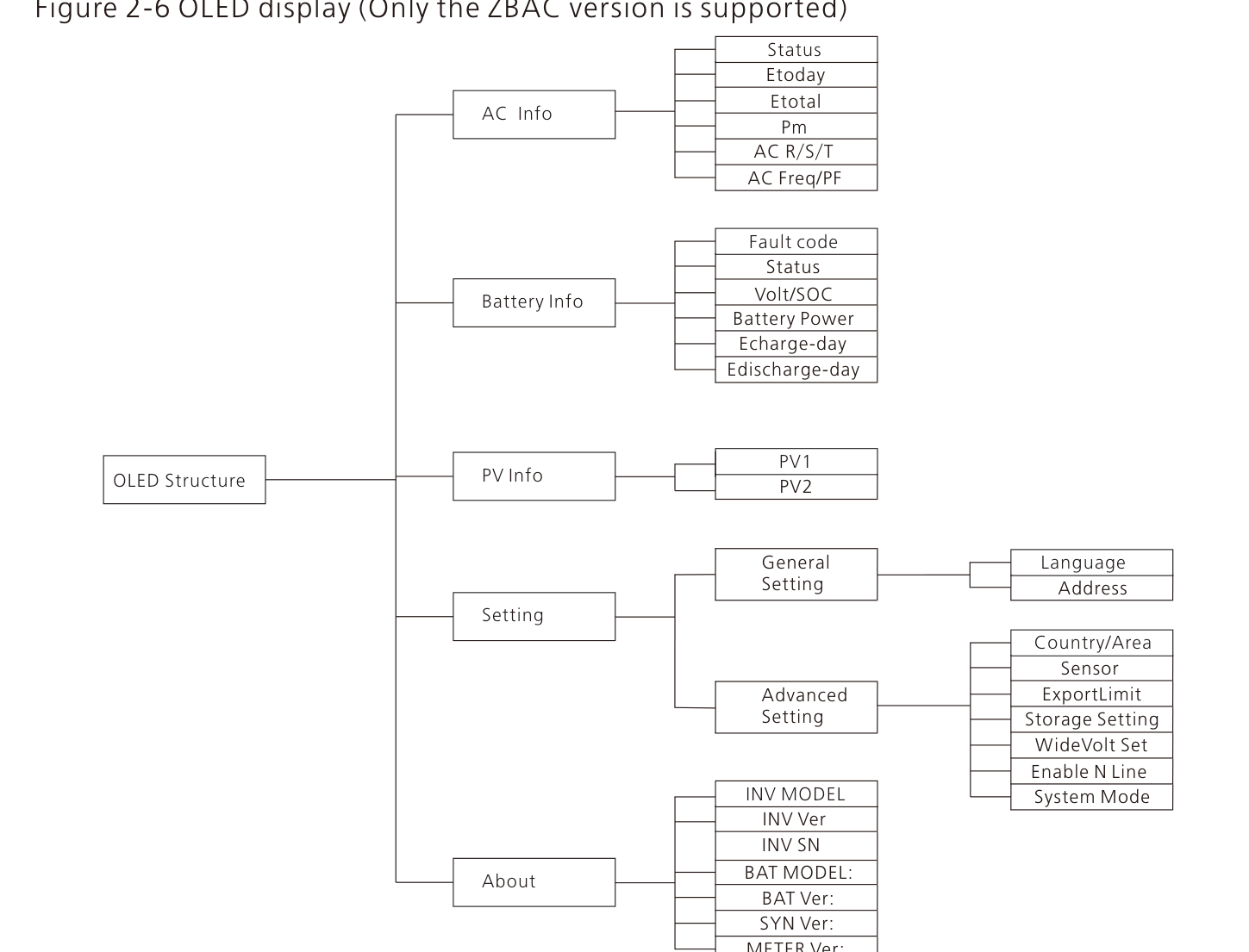
High voltage grid inverter Growatt signals in two stages. Warning 301 is a warning: the mains voltage is outside the permissible range - the instructions tell you to measure it, and if it is within the norm, contact the serviceError 300 is a system fault: "Grid voltage is beyond the permissible range" - the inverter disconnects from the grid and returns when conditions return to normal. The same logic and the same numbering apply to single-phase MIN and three-phase MID.
Key distinction: this is a SYSTEM fault, not an inverter fault. Polish manual MIN It states it bluntly—systemic faults "are primarily caused by the system, not the inverter," and it recommends checking the installation before anyone considers replacing the device. The inverter behaves exactly as the connection standard requires: it protects the grid and neighbors by disconnecting any source that would raise the voltage even higher.
| Code | Meaning | First steps according to the instructions |
|---|---|---|
| Warning 301 | mains voltage outside the permissible range | measure the voltage; if within the range - contact with Growatt |
| Error 300 | mains voltage out of range - disconnection | turn off the DC disconnector, check the AC wiring (especially N and PE), voltage compliance with the local standard |
| Error 303 (MIN) | voltage between N and PE above 30 V | check N-PE connection and AC wiring |
| Warning 302 / Error 304 | network frequency out of range | check frequency and wiring; restart |
| Error 302 / Warning 300 | no network or power failure | check if the mains power is down; wiring and AC circuit breaker |
A note of order for those searching through old forum threads: on older generations of inverters Growatt (before the current three-digit numbering) the same symptoms were described by different codes - that's why you'll see different numbers for the same problem in archived discussions. Always read the code table in your unit's manual carefully; a full index of current MIN, MOD and MID we maintain a knowledge base in a separate article.
It's also worth knowing what high grid voltage looks like from a symptom perspective without looking at the codes: production in the app increases normally until mid-morning, then during the best hours, the graph becomes a sawtooth—a series of starts and stops—or a flat drop to zero, only to return in the evening. If this pattern repeats on sunny days and disappears on cloudy ones, the diagnosis is almost complete before you even get on the ladder. High grid voltage leaves a signature so distinctive in the monitoring system that an experienced technician can recognize it from a single screenshot.
Where does high grid voltage come from - three layers of causes
Layer one: the grid – and this is where high grid voltage most often arises, as a phenomenon of the neighborhood, not of a single house. During sunny afternoons, all installations on the same LV circuit release energy simultaneously, and the voltage in the entire area increases – the further from the transformer, the greater the increase. The low-voltage grid voltage standard (PN-EN 50160) allows a deviation of ±10% from 230 V, i.e., an upper limit of approximately 253 V – this is a normative value, not a setting in the inverter's manual, and it is this value that is monitored by connection thresholds. If the voltage at the terminals without a working installation approaches this limit, no inverter has any more room to operate.
Layer two: your own installation. Every ampere flowing into the grid increases the voltage across the cable resistance—the longer and thinner the AC cable between the inverter and the distribution board and connection, the greater the voltage increase at the inverter terminals themselves. Therefore, the instructions for Error 300 recommend first checking the AC wiring, with particular attention to the neutral wire and grounding—a loose N terminal can generate the exact same code as an overloaded grid, while Error 303 (N-PE above 30V) directly indicates a problem with the neutral wire.
Layer three: regional settings. The inverter adopts voltage and frequency thresholds from the country/region selected at startup—in the MOD series, this is set directly from the OLED panel. A unit configured for the incorrect region will disconnect "for no reason" or—worse—operate outside of Polish connection requirements.
Step-by-step diagnostics before you call for service
The order follows the instructions and measurement practice. First, measure the voltage at the inverter's AC terminals with the installation OFF (DC switch open)—this is the grid's background voltage. Second, measure the installation while it is operating at peak production—the difference between the two measurements is the increase generated by its own cables and the export. Third, inspect and tighten the AC connections, with particular attention to N and PE. Fourth, verify the region in the settings.
| Two-point measurement result | Proposal | Direction of action |
|---|---|---|
| background at the edge of the range, small increase | network overload - a problem in the area | auto consumption/warehouse, export limitation, reporting to OSD with measurements |
| healthy background, large growth | resistance of own AC route or connections | terminals, cable cross-section and length, connection point |
| healthy background, small growth, and the codes are coming back | settings or electronics | region verification, then contact the service |
| voltage codes interspersed with frequency codes | unstable network | event registration and reporting to the DSO |
The interpretation is binary. If the background voltage is high, the problem lies with the network and the solutions are the responsibility of the operator and auto-consumption. If the background voltage is healthy and the increase during operation is large, the problem lies with the cross-sections and connections on your side and needs to be fixed there. In practice, document both measurements with the date and time; this is the exact set of data that service will request. Growatt (the manual lists the network voltage among the information to be reported), and the operator when making a complaint about network parameters.
What really helps with high network voltage?
The first group of measures: limiting peak exports. The energy storage facility absorbs the surplus from the south instead of pushing it into the overloaded grid – this is the most effective tool the owner has and the main technical reason why battery-ready MIN, MOD and MID designed for batteries. Alternatively, the inverter can limit export through software: the export limitation function with a smart meter allows you to throttle feed-in to the grid. Meter and limit configuration are described in detail in a separate article about export limit.
The second group: shifting consumption to peak production—DHW heating, car charging, midday washing machine. Every kilowatt consumed on-site is a kilowatt that doesn't raise the voltage on the cable. The third group, on the infrastructure side: shortening or thickening the AC route during modernization and—if the background voltage is high without the installation's involvement—a formal complaint about the grid parameters with the operator. The grid must comply with voltage standards; documented background measurements outside the range are the basis for a complaint, and lowering the transformer tap by the DSO solves the problem for the entire neighborhood, not just a single home.
Cables and Clamps - Half the Cases End Here
The relationship is purely ohmic and should be understood qualitatively: the voltage increase on the AC line increases directly with the export current and cable resistance, while resistance increases with the length of the line and inversely with the cross-section. Hence, a rule of thumb for diagnosis: if the difference between the background measurement and the measurement at full production is large, you are "making" the high grid voltage on your own wiring—and no amount of talking to the operator will change that. This is a common scenario when the inverter is installed far from the distribution board: a detached garage, a barn, or the opposite end of the building.
The second silent culprit is the connections. It's no coincidence that the manual instructs you to check the wiring for Error 300, "especially the neutral and ground wires"—a loose or burnt terminal has a resistance many times higher than a healthy one and generates a local voltage spike precisely at the inverter's measurement point. The dedicated code 303 for N-PE voltages above 30V exists precisely because neutral wire problems are frequent enough to deserve their own entry in the table. In practice, checking the tightness of the AC terminals between the inverter, the distribution board, and the connection takes fifteen minutes, which resolves a surprisingly large number of reports.
Reporting to the operator - how to do it effectively
When the background measurement shows that high grid voltage occurs without your installation being involved, the matter is transferred to the DSO – the grid must comply with the voltage standard parameters regardless of the time of day. In practice, when handling such reports, a request to check voltage parameters is submitted to your distribution operator (via the complaint form or Customer Service Office), describing the symptom specifically – "L2 phase voltage exceeds the permissible range between 11 a.m. and 15 p.m., measurements from..." – and attaching your own readings. The operator usually installs the recorder for several to a dozen or so days; if the recording confirms the exceedances, the transformer tap correction orace networks are on his side.
Two things increase effectiveness. First, a collective report—high grid voltage affects entire circuits, so three neighbors with the same symptom is a threefold stronger conclusion. Second, technical precision: inverter codes (Error 300 with occurrence dates), background and operational measurements, and an emphasis on the reported installation and its regional settings consistent with the connection. Note: procedures and deadlines vary between operators—confirm formal requirements on your DSO's website, as no inverter manual describes this.
What NOT to do when Error 300 occurs
- Do not raise voltage thresholds above the values resulting from Polish connection requirements - thresholds exist to protect the network and receivers; "tweaking" them in the service menu is working outside the connection conditions and carries a real risk of liability.
- Do not change the country/region to another, more "loose" one - the regional settings should correspond to the place of installation.
- Do not replace the inverter to start - the manual clearly classifies Error 300 as a system fault, not a hardware fault.
- Don't ignore the neutral wire - Error 303 (N-PE over 30V) and the Error 300 procedure indicate N and PE as the first check points.
- Don't diagnose without two measurements (background + work) - a single reading doesn't determine whose cause is.
- Don't confuse the codes: Error 301 is reversed AC terminals, not a voltage problem - a typo in the report is sending diagnostics in the wrong direction.
High voltage, parallel operation and ROCOF
In installations with multiple units, the symptoms can multiply: a series MID allows up to nine inverters to operate in parallel in a grid system, with each unit measuring the voltage at its own terminals—the one furthest from the distribution board will disconnect first and be considered "faulty" in the customer's eyes. Equalizing the length of the AC routes or relocating the connection point can be the entire solution.
In addition to the voltage thresholds, frequency protections operate: Error 304 and Warning 302 indicate a frequency out of range, while Error 309 triggers ROCOF protection, which responds to the rate of frequency change. If voltage and frequency codes appear alternately, you're likely looking at a weak, unstable grid—and this is cause for a call to the operator, not a call for inverter service.
Prevention: How to Design to Keep Error 300 from Coming Back
The cheapest way to combat this problem is with the design. First, the AC route: since voltage gain increases with length and decreases with cross-section, an inverter located close to the distribution board and a cable selected with a margin, rather than "on the butt," removes a whole layer of causes from the installation side. Second, the connection point: a circuit dedicated to the inverter instead of connecting it at the end of an existing, loaded line. Third, commissioning: the correct region in the settings and a background voltage measurement entered into the acceptance protocol—a reference point for years to come.
Fourth, anticipation: in circuits where high grid voltage is already approaching its limits, design with a warehouse or at least a battery-ready unit, so that the battery is a matter of purchasing, not rebuilding. The phase sequence for meters and export functions must be correct at the installation stage—correcting it a year later, when the customer adds a battery and meter, means additional work at the switchboard. High grid voltage will increase in Poland with installation density; a design that assumes this will age slower than one that pretends the problem doesn't exist.
From the installer's practice
Four habits from objects on which Error 300 returned - practical tips, not manufacturer requirements.
- In practice, record the background voltage measured when the installation was turned off in the acceptance report. When the shutdown begins after a year, a single historical measurement can determine in a minute whether the grid has deteriorated or something has happened in the installation.
- From practice: when reporting "it turns off at noon", ask the customer about neighbors with photovoltaics - if half the street has the same symptom at the same time, you will save traveling and immediately prepare arguments for the DSO.
- From practice: when proposing a warehouse as a remedy, show the client a production graph from the app with the peaks cut off - the cut off midday is exactly the energy that the battery would have absorbed; a picture sells better than a table.
- From practice: after each intervention on the AC terminals, perform a tightening check during the next seasonal visit - a loose N is a silent generator of voltage errors that returns after months.
- From practice: in offers for circuits with a history of outages, include background measurement as a separate service item - the customer sees that the diagnosis precedes the expenses, and you have the data before high network voltage becomes a warranty dispute.
FAQ - Frequently asked questions about high mains voltage
Does Error 300 damage the inverter or lower the warranty?
No—disconnection at exceeded limits is a safety measure specified in the manual, and the code itself is classified as a system fault. The cost is unproduced energy, not hardware wear and tear—which is precisely why the problem is worth resolving rather than waiting it out.
Is there also high grid voltage in winter?
Less frequently, the phenomenon is a function of collective generation on the perimeter, so it peaks during sunny months. Winter occurrences of Error 300 are more likely to indicate local causes: connections, neutral wire, settings—and therefore merit two-point diagnostics instead of waiting for summer.
How much energy do I lose by shutting down?
We won't calculate this honestly here—the loss depends on the number and duration of outages at your facility. Monitoring provides a realistic picture: days with a "cut" flat production peak in the app are days with outages; comparing them with days without outages shows the scale. In practice, this is the most common reason why a customer decides to use energy storage.
The operator claims the voltage is normal. What's next?
Return to the two-point measurement: if the background voltage is indeed within the norm, but the inverter still disconnects, the cause lies in the growth of your cables or connections—and this needs to be fixed on the installation side (cross-sections, terminals, connection point). If the background voltage is near the limit, collect measurements with dates and times—a series of documented exceedances is the basis for an effective complaint.
Does a thick AC cable really solve the problem?
It solves the part of the problem you create yourself: with a large increase in the time between the background measurement and the measurement during operation, increasing the cross-section or shortening the route reduces the increase proportionally to the resistance drop. It will do nothing about the high background—high grid voltage on the operator's side requires action from the section on reporting to the DSO. Therefore, a two-point measurement always precedes expenditure.
Will export limitation do the trick instead of a warehouse?
It limits exports, so it also limits voltage boosting—but energy you don't export and consume simply won't be created. The storage system converts that same peak into evening self-consumption. This feature requires a meter and configuration—for a full guide, see the export limit article in the knowledge base.
Error 300 / Warning 301 diagnostic checklist
- Read and noted the exact code from OLED (300 ≠ 301 ≠ 303).
- Background voltage measurement with the DC disconnector open.
- Voltage measurement during peak operation; difference calculated.
- AC terminals, neutral and PE wires checked and tightened.
- Region/country in settings consistent with the place of installation.
- With multiple units: compare which unit disconnects first and how the AC routes run.
- Decision: self-consumption/warehouse — export limitation — complaint to OSD (with measurements).
- A complete set for a possible report gathered in one place: serial number, model, exact code, AC and DC voltages from measurements, repeatability of the phenomenon and environmental conditions.
If the diagnosis indicates an overloaded network, the real remedy is storage - you can check the selection of the battery family for your inverter in configurator Growatt, and the starting point for battery-ready units is set APX 5 kWh for MIN-XH or larger configurations from the category Energy storageInstructions with complete code tables are published download center Growatt.