
Growatt SPF 5000 ES - inverter programs, settings and operating modes off-grid
Growatt SPF 5000 ES is an inverter off-grid 5 kVA / 5 kW on a 48 V DC bank. Settings are made from the LCD: entry by holding ENTER for 3 seconds, source priority in Program 01, charging current up to 100 A in Program 02, battery type in Program 05.
Island inverter Growatt SPF The 5000 ES is configured entirely from the LCD panel—dozens of programs numbered 01 to 50 determine source priority, charging currents, voltage thresholds, and parallel operation. This article covers the settings that the installer actually changes: programs 01, 02, 03, 05, 11, 12, 13, 21, 23, and time windows 49 and 50. We've described battery selection for this series in a separate article—here, we'll cover what to enter into the inverter once the battery is installed. All values are taken from the manufacturer's manual (Polish edition, version 4.0) and the series catalog datasheet.
What is Growatt SPF 5000 ES and what does the control panel show?
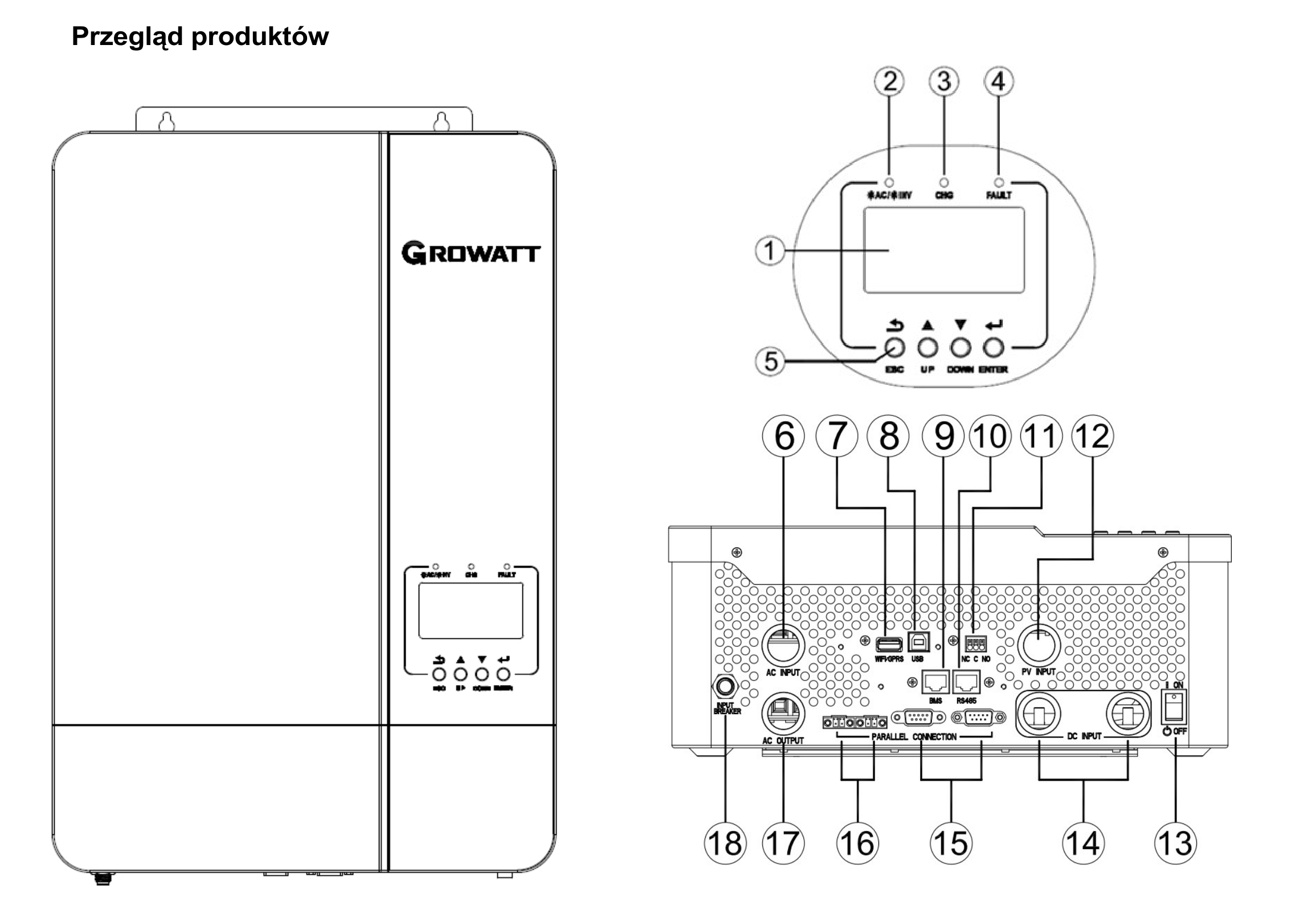
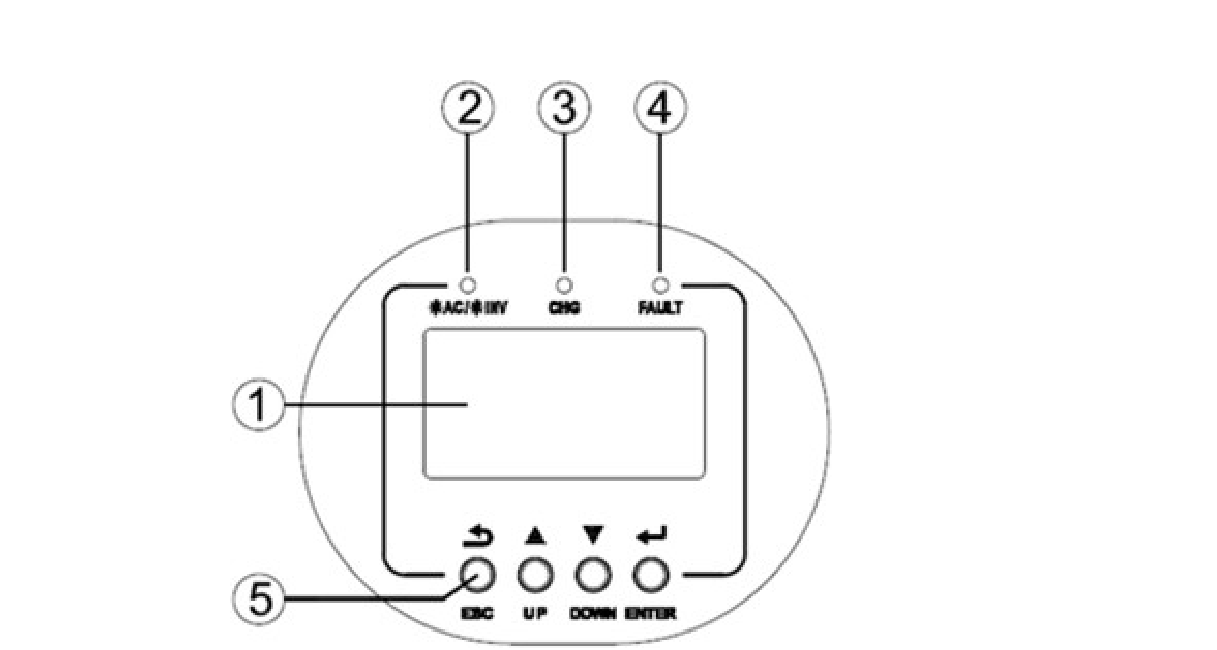
Growatt SPF 5000 ES is a single-phase inverter off-grid with a power of 5 kVA / 5 kW, operating on a 48 V DC battery bank. The front of the device has an LCD display, three indicators (status, charging and fault) and four function buttons: ESC, UP, DOWN and ENTER. The connection board includes, among others, AC input and output, PV input, battery input, port BMS (CAN/RS485), RS485 port, WiFi/GPRS port for datalogger, potential-free contact, parallel communication and power sharing ports and automatic switch.
Three power parameters define the framework for all settings: maximum PV charging current up to 100 A, maximum grid charging current up to 80 A, and a 10/20 ms transfer time when switching sources. The little brother — SPF 3500 ES - has 80A from PV and 60A from mains respectively and shares all program logic with the 5, so everything below applies to both, with separate current forks.
| Element | Value |
|---|---|
| Rated power | 5 kVA / 5 kW (SPF 5000 ES) |
| Battery bank | 48V DC; acid AGM/FLD or lithium with BMS |
| PV charging current / grid | up to 100 A / up to 80 A |
| Battery cable | 1×2 AWG, torque 2–3 Nm (SPF 5000 ES) |
| Recommended bank capacity | at least 200 Ah |
| Entering settings | holding ENTER for 3 seconds |
Before You Touch the Programs - Connecting the Battery Bank
The settings only make sense when the bank is correctly connected. For lead-acid batteries, the manual requires a 48V bank with a capacity of at least 200 Ah, a 1×2 AWG cable with ring terminals tightened to a torque of 2–3 Nm (for SPF 3500 ES - 1×4 AWG) and a separate DC overcurrent protection or disconnect switch between the battery and the inverter. The recommended charge current for an acid bank is 0,2C - and it is this, not the inverter maximum, that determines a reasonable setting for Program 02.
Three assembly prohibitions from the same page of the manual: nothing can be placed between the flat part of the inverter terminal and the ring terminal (risk of overheating), the terminals should not be lubricated with anti-oxidant agents before tightening, and the positive-to-positive and negative-to-negative polarity should be checked before closing the DC disconnect switch. The lithium battery has an RJ45 cable connected to the port BMS — without him Growatt SPF 5000 ES will not communicate with the bank and LI mode will not start.
How to enter the programs and who is responsible for what?
W Growatt SPF 5000 ES, enter the settings mode by holding ENTER for 3 seconds; use the UP/DOWN buttons to scroll through programs, ENTER to confirm your selection, and ESC to go up a level. Two programs have status locks: the output voltage (Program 08: 230 V by default, selectable 220/240/208 V) and frequency (Program 09: 50 Hz by default) can only be changed in standby mode, with the output turned off—just like the AC output mode in Program 23.
The matrix lists the programs on which the system's behavior depends in 90% of the installation. Growatt SPF The 5000 ES has more of them (auto-restarts 06/07, alarms 15-18, equalization 43-48, clock 37-42), but the ones below are decisive for economy and work safety.
| Programme | Feature | Default | Range (SPF 5000 ES) | When to change |
|---|---|---|---|---|
| 01 | priority of the power supply source for loads | Utility first | SOL / UtI / SBU / SUB | SBU for maximum self-consumption with battery |
| 02 | max. charging current in total (PV + grid) | 60 A | 10-100A | adjustment to the bank charging current; non-editable for LI |
| 03 | AC input voltage range | APL 90-280 VAC | APL / UPS 170–280 VAC / GEN | UPS for sensitive loads; GEN for diesel generator |
| 05 | battery type | AGM | AGM / FLD / LI / User / User 2 | LI for lithium battery with BMS — mandatory |
| 11 | max. charging current from the mains | 30 A | 0-80A | limitation of consumption from the network; when P02 < P11, P02 applies |
| 12 / 13 | return to grid/battery thresholds for SBU and Solar first | 46,0 V / V 54,0 | 44,0-51,2 V / 48,0-58,0 V | Battery operation depth tuning; at LI in % SOC |
| 21 | low DC cut-off voltage | 42,0 V | 40,0-48,0 V | bank protection; with LI in % SOC (default 20%) |
| 23 | AC output mode | single | PAL / 3P1 / 3P2 / 3P3 | parallel operation and three-phase systems; standby only |
| 49 / 50 | time window for charging from the mains/AC output | 0000 = whole day | 4 digits: start 00–23, end 00–23 | charging from the network only during cheap tariff hours |
Source priority in Program 01 – SOL, UtI, SBU or SUB?
Program 01 decides who supplies power to the load. In the Utility First setting (default), the grid does this, with the PV and battery only coming on board when there's a power shortage—the inverter then acts as a UPS with a solar charger. Solar First gives priority to the sun, adding battery power when there's a shortage, and the grid only switches on when there's a PV shortage or the bank voltage drops to the threshold set in Program 12.
The two remaining variants differ in the role of the grid during solar operation. In the SBU, the load is powered by the sun, supported by a battery, and the grid only comes on board when the bank drops to the warning threshold or the Program 12 setting—this is the maximum self-consumption setting. In the SUB, the grid first supplements the solar deficiency, and the battery only comes on board when there is insufficient PV or grid—the bank operates at a lower frequency, at the expense of greater grid consumption. Growatt SPF The 5000 ES in Polish homes most often runs on an SBU; the SUB is chosen where the battery is to be an emergency reserve, not daily storage.
Settings for lithium battery - "LI" in Program 05 and protocol 36
Lithium battery requires communication BMS: after setting the type "LI" in Program 05, the display goes to Program 36, where the protocol is selected - L01–L50 for RS485, L51–L99 for CAN; the appropriate protocol for the given battery is indicated by Growatt. RJ45 cable connects the port BMS battery with port BMS inverter. When switching to LI, three programs change the units from volts to percentage of SOC: Return to Grid (P12) default 50% in a range of 6–95%, Return to Battery (P13) default 95% in a range of 10–100%, Cut-off (P21) default 20% in a range of 5–50%.
There are two consequences of LI mode that you need to know by heart. First, the maximum charging current is no longer editable—it is controlled by BMS battery, not the user. Secondly, the loss of communication with BMS ends up cutting off the inverter output - therefore the cable BMS is carefully managed and, in a parallel system, connected to the main inverter. For lithium batteries without communication, there is the "User-Defined 2" type, in which the charging and cut-off voltages are set manually in programs 19, 20 and 21, with the recommendation of the same value in P19 and P20 - treat it as an emergency solution, not a final one.
What the display shows - operating modes Growatt SPF 5000 ES
The inverter switches between four modes. In standby (or power saving) mode, it does not output voltage but can charge the battery; in linear mode, it supplies the load from the grid while also charging; in battery mode, the load is supplied by the battery and the PV; the error mode indicates an internal fault or an external cause, such as overtemperature or an output short circuit. Icons on the LCD indicate the charging source: grid, PV, or both.
The most commonly misunderstood threshold in Growatt SPF 5000 ES is the DC cutoff from Program 21. Once it is reached, three different things happen, depending on the available sources: when only the battery is present, the inverter turns off; when there is PV and a battery, the inverter charges the bank without applying voltage to the output; when PV, battery, and grid are available, it switches to linear mode, powers the load, and charges. Therefore, "The installation went out at night" with an empty bank and no grid is design behavior, not a failure.
Parallel Operation - Program 23 and Wiring
Growatt SPF The 5000 ES operates in parallel in single-phase and three-phase systems. This is configured in Program 23, only in standby mode and only with the battery connected: for single-phase parallel operation, each unit receives "PAL", and in a three-phase system, a minimum of three inverters, one per phase - 3P1, 3P2 and 3P3 respectively according to the connection phase. The current sharing cable connects only between units of the same phase - never between phases - and the saving mode then automatically switches off.
From the electrical side the manual gives cross-sections and moments (for SPF 5000 ES battery cable 1×2 AWG at 2–3 Nm) and a table of recommended AC input breakers for two- and three-unit sets. The manual also provides power and communication wiring diagrams for configurations of two to six inverters, as well as three-phase variants with varying unit phases. Wiring should be performed according to the diagram for the exact number of units you are installing, as parallel communication port pairs are not arbitrary. For generator power, Program 03 with the GEN setting applies. Only diesel generators with a capacity of at least 10 kVA are permitted, and for a three-phase parallel system, at least 20 kVA with a maximum of two units per phase.
Equalizing Lead-Acid Batteries - Programs 43-48
For Flooded and User-Defined banks, the inverter offers an equalization function, disabled by default and activated in Program 43. Process parameters set the following programs: equalization voltage default 58,4 V in the 48,0–58,4 V range (P44), equalization time default 60 minutes in the 5–900 range (P45), timeout default 120 minutes (P46), and repeat interval default every 30 days in the 1–90 range (P47). Program 48 allows equalization to be run immediately, outside of a schedule.
Growatt SPF The 5000 ES also maintains program dependencies: equalization is configured only when Program 05 specifies a Flooded or User-Defined bank—for AGM and lithium batteries, the function remains hidden, and that's how it's meant to be. Enabling equalization on a bank that doesn't need it is the quickest way to shorten its lifespan.
What NOT to do when setting SPF
- Do not change the voltage (P08), frequency (P09), or output mode (P23) while the output is running - these programs are only available in standby mode.
- Do not set the battery type "by eye" - LI requires working communication BMS, and its breakage cuts off the inverter output.
- Do not modify voltages in programs 19-21 for AGM/FLD/LI types - manual thresholds apply only to User-Defined modes.
- Do not run a current sharing cable between units of different phases in a three-phase system.
- Do not connect a petrol generator or unit under 10 kVA - GEN mode only allows diesel generators of a specific capacity.
- Don't bypass the DC overcurrent protection between the battery and the inverter - the manual requires it regardless of the bank type.
Growatt SPF 5000 ES in the Series - What Does the Successor Inherit?
In the ES family, the program logic is common: Growatt SPF 5000 ES and SPF 3500 ES differ in current range (100/80 A vs 80/60 A from PV and grid), and the successor — SPF 6000 ES Plus — increases power to 6 kVA / 6 kW and adds a second tracker MPPT, staying with the same class of LV 48 V batteries and the same matrix of compatible families AXE, ARK i HOPEThe ability to tune the programs described above is therefore transferred directly to newer units.
Our compatibility table lists a 2-year warranty for the series with a 5-year variant - please confirm the conditions for a specific delivery before bidding, as warranty variants in this family were updated between batches.
From the installer's practice
Four observations from the series runs SPF — practical tips, not manufacturer requirements.
- From practice: make settings in the following order: 05 → 36 → 01 → 02/11 → 12/13/21 → 49/50. Battery type first, because LI switches the units of the three subsequent programs from volts to percentages and changes what you will be setting in general.
- From practice: after setting windows 49/50, check the inverter clock (programs 37–42) - the tariff window calculated according to the wrong time loads the bank at expensive hours and no one sees it until the first bill.
- In practice, record the values of all changed programs in the acceptance protocol. After a reset or board replacement, restoring the settings from memory takes an hour, and something is always missing.
- From practice: show the SBU customer on the display the transition to linear mode at the threshold from Program 12 - one demonstration saves a series of calls "why is it drawing from the network when I have a battery?"
- From practice: when upgrading from an acid bank to a lithium one, start the settings from scratch, not "only Program 05" - after changing to LI, the thresholds 12/13/21 change units and the old volt values lose their meaning, although they look familiar on the display.
FAQ - Frequently asked questions about Growatt SPF 5000 ES
What is the difference between SBU and SUB in Program 01?
The order of support during solar deficiency: in an SBU, the battery adds the missing power, and the grid only steps in at the Program 12 threshold; in a SUB, the grid first adds the missing power, and the battery operates only when both other sources are missing. SBU = cheaper operation, SUB = less frequent bank operation.
Why Growatt SPF 5000 ES turned off during the night?
Most likely, the bank reached the low DC cut-off voltage (Program 21) and the grid and PV were unavailable - in this scenario, the inverter shuts down by design. If the grid was available, check the Program 03 range: in the UPS setting, the inverter accepts a narrower window of 170-280 VAC.
How to charge from the network only during cheap tariff hours?
Program 49: four digits, the top two being the start time and the bottom two being the end time of the charging window; for example, 2320 allows charging from 11:00 PM to 8:59 PM the following day, while 0000 means 24 hours a day. The charging current is limited by Program 11.
Czy Growatt SPF Will the 5000 ES start without a battery?
The operating mode table provides a "no battery connected" state in linear mode, so powering loads from the grid without a bank is provided on the display. A hard exception is parallel operation—Program 23 only works with a connected battery. Operating range off-grid without a bank, the manual omits this arrangement - confirm this arrangement with the technical department before offering it.
How many units SPF I will connect in parallel?
The manual covers single-phase parallel operation (PAL) and three-phase systems with a minimum of three inverters, with protection tables for two and three units; our compatibility table notes for series (except SPF 3000 ES) up to 6 units. For configurations exceeding three units, please confirm with the technical department before submitting an offer.
Checklist of settings before acceptance
- Program 05 compatible with the bank (LI for lithium with BMS; protocol in P36 as indicated Growatt).
- Program 01 set consciously (SBU/SUB/UtI/SOL) and discussed with the client.
- Charging currents: P02 ≤ bank capacity, P11 ≤ connection power allocation.
- Thresholds 12/13/21 checked after changing battery type (volts vs % SOC).
- P08/P09/P23 set in standby mode, before output starts.
- Clock (P37–42) consistent with local time if using windows 49/50.
- Bank DC overcurrent protection installed.
- The complete set of settings is written down in the acceptance protocol.
- Time windows 49/50 tested at the turn of the day if the interval passes through midnight (four-digit format counts up to 20:59 the following day).
- The customer knows how to read the operating mode from the display icons and what the error mode means.
Door Line SPF ES already has a successor in the current offer: GROWATT SPF 6000 ES Plus (6 kVA, two trackers MPPT) shares the 48V battery class with the unit described here, and the ready set SPF 6000 ES Plus with battery AXE-L 5 kWh reduces the selection to one item. You can verify the inverter-battery pair in configurator Growatt, and the current series instructions are published download center Growatt.
Sources
- Growatt AXE 5.0L Modular Battery - Datasheet (EN) — card SPF (archive /downloads/)
- Growatt HOPE 5.0L-B1 -2509 - Datasheet — — manual SPF 3500-5000 ES (PL, v4.0) quoted from the local corpus; print pages = PDF-2