
Growatt ARK — A1 vs A2 versions, tower limits and module mixing rules
Growatt ARK is a modular LiFePO4 battery: 2,56 module kWh / 51,2 V in LV variant (tower 1-10 modules) and HV with controller HVC 60050-C2 with a range of 90–585 V. You can recognize the version by the suffix on the plate: "-A2" charges to −10°C, "-A1" only from 0°C.
Battery Growatt ARK It comes in two voltage classes and two generations—and this combination is responsible for most warehouse and installation errors in this series. This article addresses the issue from the installer's perspective: how to distinguish the A1 from the A2 version before the tower is placed against the wall, how many modules can actually be connected, what the manufacturer's declaration says about mixing old and new packages, and where sources contradict each other. All numbers come from catalog cards, manuals, and version declarations. Growatt.
What is Growatt ARK and what are the differences between versions A1 and A2?
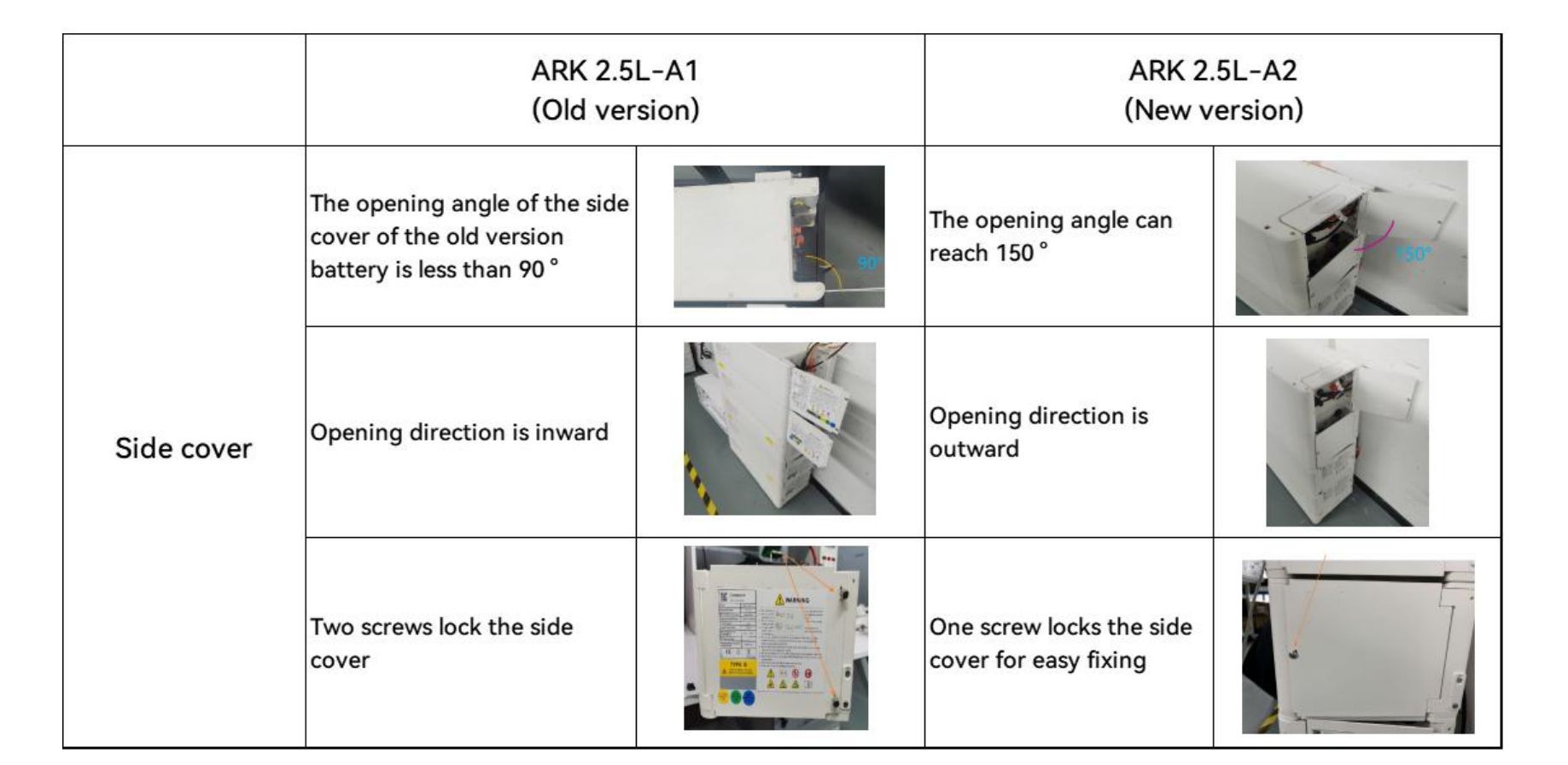
Growatt ARK is a modular LiFePO4 battery with a capacity of 2,56 kWh and a voltage of 51,2 V per module, produced in a low-voltage variant ARK 2.5L (51,2V tower) and high voltage ARK 2.5H (serial tower with controller HVC 60050-C2 with a range of 90–585 V). Version A2 is a design iteration of version A1: the manufacturer has optimized the side cover, cable outlets, signaling panel and cells.
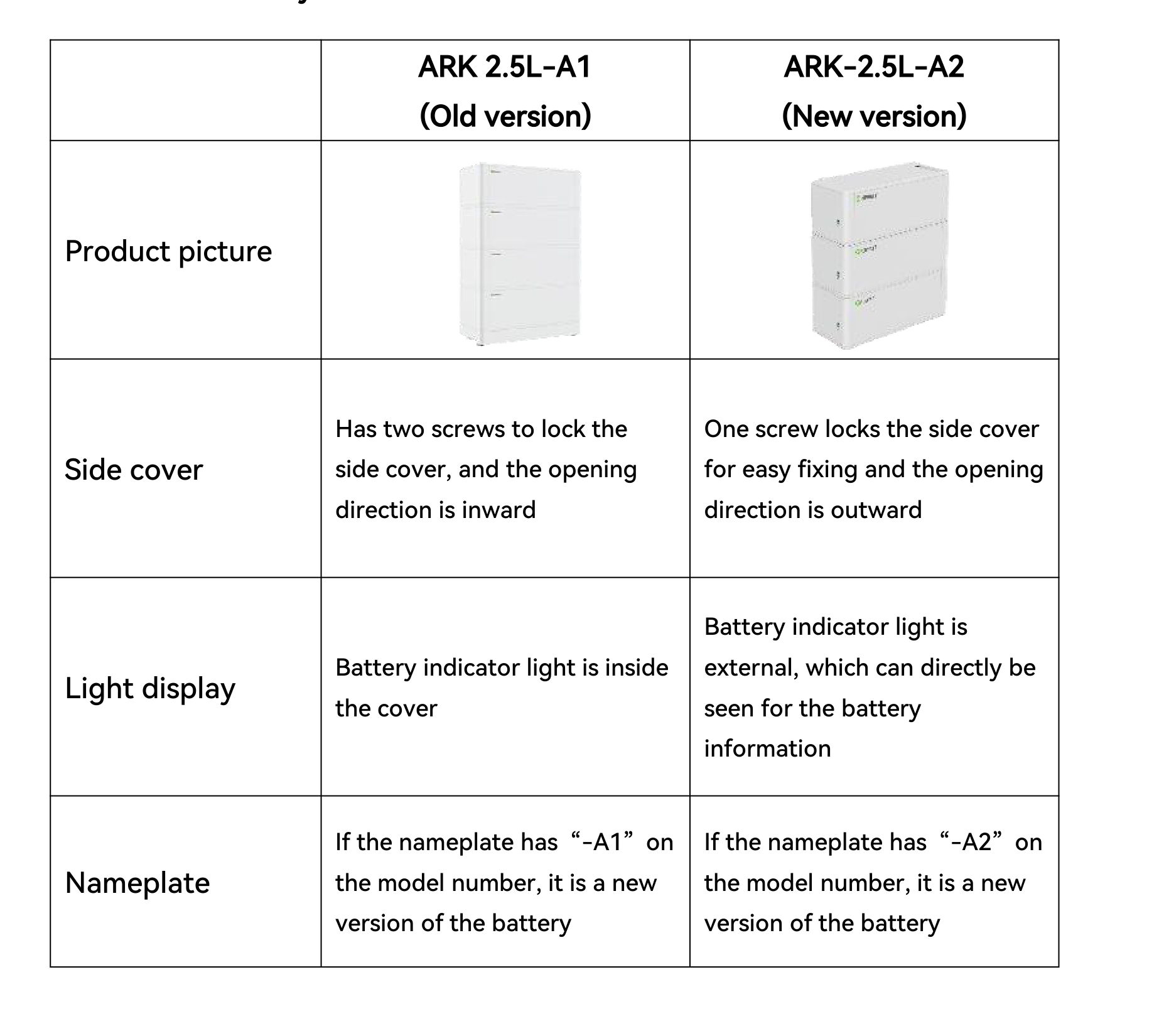
Four changes have practical implications. First, the A2's side cover opens outward to 150° and is held in place by a single screw—in the A1, it opened inward at an angle below 90° with two screws. Second, the LED indicator in the ARK-LV A2 has been moved to the outside of the case, so you can see the battery status without removing the cover; in the ARK-HV, the light panel sits on the front of the controller. BMSThird, the A2's inverter cables can be run from the top and rear. Fourth—most importantly in winter—the A2's cells charge at temperatures down to -10°C, while the A1's only charge from 0°C and above.
| Element | Value |
|---|---|
| Module | 2,56 kWh, 51,2V, LiFePO4 |
| Module weight | 28 kg (2.5L-A2) / 27 kg (2.5H-A2) |
| Class LV | 51,2V tower, 1-10 modules |
| Class HV | serial tower + controller HVC 60050-C2 (90–585 V) |
| Charging at low temperature | A2: up to −10°C; A1: from 0°C |
| Warranty | 10 years (both classes A2) |
The division into voltage classes is not a cosmetic naming convention, but rather two distinct architectures. In an LV tower, modules operate in parallel on a common 51,2 V bus, so the DC current increases with the number of modules: from 25 A for one to 100 A nominal for four or more. In an HV tower, the arrays are connected in series under a controller, so the voltage increases while the current remains constant: 25 A nominal, 48 A maximum, regardless of the tower height. The practical consequence: in LV, the number of modules determines the charging power and the cross-section of the DC cabling; in HV, the power is determined by the number of modules combined with the voltage, and the cabling is designed once. Growatt ARK both classes use the same LiFePO4 cells and the same module capacity - this similarity makes it easier to confuse the classes.
How to recognize the battery version Growatt ARK before assembly?
The nameplate is the deciding factor: a model with the suffix "-A2" is the new version, a model with "-A1" is the old version. Editor's note: in the manufacturer's declaration identification table, both columns of the "Nameplate" row end with the phrase "it is a new version"—this is a printing error; the column headings (Old version / New version) clearly indicate that "-A1" denotes the old version.
Before you even get to the nameplate, the version is revealed by its appearance. The new generation ARK-LV has a light and button on the outside of the case—if you need to check the battery status, you're looking at A1. A side cover with a single screw that opens outward is A2; two screws and opens inward is A1. The third clue is logistical: the new version's cartons bear an "A2" label, while the old packages have none—which allows you to spot a warehouse error even before unpacking, on the loading dock.
Growatt ARK in the HV version, identification is analogous, with one difference: the A2 light panel is located on the front of the control module, not on the packages. In case of mixed deliveries (selected extension of an existing tower), check each carton separately - order "ARK 2.5H” without a version suffix can arrive in any combination.
How many modules in a tower? Configurations ARK 2.5L-A2 and ARK 2.5H-A2
The matrix combines both voltage classes and both generations. LV configurations scale in increments of 2,56 kWh from a single module, HV configurations start according to the card from three modules (7,68 kWh) — we write about the discrepancy with the instructions below the matrix.
| Variant | The class | configurations | Winter charging | Identification | Status in the offer |
|---|---|---|---|---|---|
| ARK 2.5L-A2 | LV 51,2 V | 1–10 modules = 2,56–25,6 kWh | up to −10°C | "-A2" plate, outdoor lamp | current generation LV to SPF i SPH 1-phase |
| ARK 2.5H-A2 | HV, 90–585 V controller | 3–10 modules = 7,68–25,6 kWh according to the card | up to −10°C | "-A2" plate, panel on the controller | current generation HV to SPH TL3 BH-UP and MIN TL-XH |
| ARK 2.5L-A1 | LV 51,2 V | like L-A2 (same family) | only from 0°C | "-A1" plate, light under the cover, two screws | discontinued version; found in expansions |
| ARK 2.5H-A1 | HV | like H-A2 (same family) | only from 0°C | label "-A1", cardboard without label | discontinued version; watch out for controller cables |
The full configuration of the HV tower with a datasheet in hand looks like this:
| Modules | Energy | Nominal power | Power | System height | Mass |
|---|---|---|---|---|---|
| 3 | 7,68 kWh | 3,84 kW | 7,37 kW | 740 mm | 91 kg |
| 5 | 12,8 kWh | 6,4 kW | 12,29 kW | 1110 mm | 145 kg |
| 7 | 17,92 kWh | 8,96 kW | 17,2 kW | 1480 mm | 199 kg |
| 10 | 25,6 kWh | 12,8 kW | 24,58 kW | 2035 mm | 280 kg |
The DC current of the HV tower is constant regardless of the number of modules: nominally 25 A (0,5C), maximum 48 A – power increases with tower voltage, not current. In the LV class, the opposite is true: nominal current increases from 25 A with one module to 100 A with four or more, so small LV configurations limit the inverter's charging power.
2-10 or 3-10 Modules? A Source Contradiction You Need to Know
Data sheet ARK 2.5H-A2 (revision 202506) tabulates configurations from 3 to 10 modules. The user manual (revision 202511) states explicitly: "from two to ten packages ARK 2.5H-A2 can be connected in series." The discrepancy is for the minimum configuration - 5,12 kWh vs 7,68 kWh to start with - and is important for the smallest offers.
We don't take this discrepancy for granted. We accept the variant from the catalog card (from 3 modules) for our quotes, as the card tabulates ready-made configurations with power and weight specifications. Treat a two-module configuration as unconfirmed until the technical department confirms it for a specific inverter. Growatt ARK it has a second, harder lower limit: the minimum operating voltage of the inverter - the controller window of 90-585 V does not guarantee that each inverter will accept the lowest tower, and the compatibility of the set is confirmed only by the manufacturer's matrix.
Where does this discrepancy even come from? Data sheets and manuals live in separate revision cycles—data sheet 202506 and manual 202511 for the same product were created five months apart—and describe different layers: the data sheet for ready-made commercial configurations, the manual for physical connection options. In your project documentation, record both values with source addresses, just as we do here; a quote based on a single number without a trace of its origin is untenable in a dispute. The same principle applies to every value in this article—that's why we provide the file and page number with the numbers.
Can you mix old and new modules? Growatt ARK?
It's possible, but the manufacturer doesn't recommend it—the declaration explicitly states that the versions can work together, but for optimal performance, mixing them should be avoided. If the system connects A1 to A2, three rules apply: the entire system operates according to the old MAP, charging and discharging below 0°C is prohibited, and the system's usable capacity is determined by the weakest—i.e., the old—battery.
The wiring has its own pitfall. The cables between the modules are interchangeable: new ones fit old batteries and vice versa. However, the cables leading from the control module to the inverter are NOT interchangeable between the old and new controller versions—replacing the HV controller requires replacing its entire cable set. In the A2 version, the power connectors are designed so that the positive and negative cables cannot be interchanged, eliminating the classic reverse polarity error.
For HV towers, the declaration describes controller × package combinations: all variants are allowed, but any combination containing an old-generation element inherits the mix limitations (old map, no operation below 0°C); an exception applies to the old controller + A2 packages pair, where the controller can be updated to support operation below 0°C. The update is performed by service - do not assume its availability without confirmation.
What NOT to combine in the ARK series
- Do not use controller→inverter cables interchangeably between controller versions - unlike inter-module cables, they are not compatible.
- Do not allow charging or discharging below 0°C in a mixed A1+A2 system - the manufacturer explicitly prohibits this.
- Do not calculate the capacity of the mixed system based on new modules - the capacity of the weakest, old battery applies.
- Do not connect the tower ARK 2.5L (LV 51,2 V) for inverters requiring HV batteries - voltage classes are separated by a compatibility matrix: 2.5L works with SPF i SPH single-phase, 2.5H with SPH TL3 BH-UP and MIN TL-XH.
- Do not identify the version by its front appearance upon delivery - the suffix on the nameplate is decisive; the description in the declaration contains a printing error in the Nameplate line.
- Do not offer a two-module HV tower without confirmation - the card starts the configuration with 3 modules, and the discrepancy with the instructions is described above.
Tower assembly ARK — Spacing, Controller and Ports
When floor-mounting the HV tower, the instructions require a clearance of 500–600 mm from the wall and at least 300 mm of free space on the sides, maintaining right angles. Controller HVC The 60050-C2 includes a control unit, DC disconnect switch, power supply, and communication terminals. The panel includes a PCS+/PCS− output for the inverter, a USB port, a system breaker, and a power button for battery recovery. The controller itself measures 650/260/185 mm and weighs 8,5 kg.
Each package communicates with its neighbors via Link0/Link1 ports and connects to adjacent modules via Module+/Module− paths; the enclosure has a pressure relief valve that must not be covered. The system's operating principle is simple: at night, the battery powers the load via the inverter, while during the day, PV energy has priority, and any excess energy charges the tower. Growatt ARK consists of 50 Ah cells in 1P16S configuration giving 51,2 V.
Daily operation: signaling and maneuvering elements
The new generation battery status can be read without tools: the ARK-LV A2 has an indicator and button on the outside of the housing, while in the HV towers, the information is presented by a light panel on the front of the controller. This is a change that customers notice every day—and the main reason why users of older LV towers call asking "where's that light?": in the A1, the indicator is located under the side cover.
The controller controls the HV system's maneuvering elements: the breaker turns the entire battery on and off, and the power button wakes it up. Therefore, when servicing the DC side, you always start with the controller, not with individual battery packs—the modules communicate with each other via a Link0/Link1 chain, and the track is shut down at a single point. Growatt ARK On the user side, it does not require daily maintenance; the operating rhythm results from the system principle - at night, the load is powered by the battery, during the day, PV production has priority.
Transport and logistics of ARK modules
Modularity Growatt ARK is a logistical advantage: individual 27-28 kg packages are carried to the installation site, rather than a finished battery weighing as much as a refrigerator. However, the complete tower weighs a considerable amount—from 91 kg for three HV modules to 280 kg for ten—so the ceiling, platform, or mezzanine must be able to support it point-by-point. Floor installation of the LV tower requires an additional base measuring 650/260/80 mm, which must be included in the order.
For the transport of lithium cells, carriers require a UN 38.3 certificate - both cards ARK declare it, alongside IEC 62619, IEC 62040, CE and RoHS; the HV variant is added by IEC 62477. When receiving the delivery, the "A2" label on the box allows you to verify the generation without unpacking - the lack of a label when ordering a new version is a signal to stop unloading and call the supplier before the pallets leave the truck.
From the installer's practice
Four observations from installations and expansions – practical tips, not manufacturer requirements.
- From practice: when expanding an existing tower, order modules with the version clearly noted in the order and check the "A2" label on the boxes upon receipt - expansion is the most common moment when the A1/A2 mix enters the system unnoticed.
- From practice: tell a customer with a mix of versions directly about the prohibition of operation below 0°C and the old map - before he discovers in winter that the battery has stopped charging in an unheated garage.
- From practice: when planning the space, calculate the height of the tower with the card in hand and add a margin for spacing - ten HV modules with a controller is over two meters, and the required 500-600 mm from the wall can be surprising in a narrow boiler room.
- In practice: photograph the nameplates of all modules before assembling the tower. Once clamped together, the version suffix of the lower modules can be invisible, and photographic documentation shortens any service call.
- From practice: in the offer and in the acceptance protocol, enter the full designation with the version suffix ("ARK 2.5H-A2″, not "ARK 2,5"). This clear provision protects both parties when, years later, an extension is selected or a complaint is considered.
FAQ - Frequently asked questions about batteries Growatt ARK
What inverters does it work with? Growatt ARK?
Variant LV (ARK 2.5L-A2) works with inverters SPF and single-phase SPH; HV variant (ARK 2.5H-A2) with three-phase SPH TL3 BH-UP via controller HVC 60050-C2 and single-phase MIN TL-XH and TL-XH2 via module BDC 95045-A1. Confirm pairs outside the compatibility matrix with the technical department.
How many years of warranty do ARK batteries have?
The catalog cards for both A2 variants state 10 years. Warranty terms for previously purchased A1 versions are based on the documents from the time of purchase—do not transfer current card records to older deliveries.
Czy ARK Does the A2 really charge at -10°C?
This is what the manufacturer declares: the new version's cells support low-temperature charging down to -10°C, unlike the A1 with a 0°C limit. The operating range of the entire system is -10~50°C; with a mix of versions, the 0°C limit returns.
Are the 2.5L-A2 and 2.5H-A2 modules interchangeable between classes?
No. Despite the identical capacity of 2,56 kWh and common module voltage of 51,2 V are separate products: they differ in weight (28 vs 27 kg), connection architecture and the fact that the HV tower requires a controller HVC 60050-C2, which LV doesn't use at all. Growatt ARK always ordered with the full variant designation - "L" or "H" in the model name is not a typo, but the voltage class.
Can I add modules? ARK to the tower next year?
Design-wise, yes—LV accepts 1-10 modules, HV, according to the datasheet, 3-10. The practical risk is the version of the purchased modules: if the tower is A2-based, purchasing A1 on sale triggers all mix limitations. Confirm instructions for connecting cell batches and SOC equalization before upgrading in the service documentation—the version declaration doesn't describe them.
ARK Tower Pre-Assembly Checklist
- Version confirmed on each module's label: suffix "-A2" (or a conscious decision to mix with its limitations).
- Voltage class compatible with the inverter: 2.5L → SPF/SPH 1f, 2.5H → SPH TL3 BH-UP / MIN TL-XH.
- Number of modules in card slot: LV 1–10, HV 3–10.
- Controller cables from the same generation as the controller.
- Mounting distances: 500–600 mm from the wall, ≥300 mm on the sides.
- In case of a mix of versions: the customer is informed about the prohibition of operation below 0°C and the capacity according to the oldest module.
- Decompression valve of each module exposed.
- Photos of the plates in the installation documentation.
The last piece of advice concerns documents: for series Growatt ARK The version differences declaration, both datasheets, and the user manual change at separate intervals, so keep all current revisions with the project, not "somewhere on your hard drive." All four source documents for this article can be found in our documentation archive, linked in the sources section below.
You can check the inverter-battery pair in configurator Growatt inverter + batteryFrom the offer: single module Growatt ARK 2.5H-A2 (2,5 kWh HV) for the expansion of towers and ready set ARK 15 kWh for SPH inverters; other configurations in the category Energy storageCurrent card revisions and version declarations are published download center Growatt.
Sources
- Growatt ARK A1&A2 Versions Differences - Document ARK A1&A2 Versions Differences (202503), pp. 1-8
- Growatt ARK 2.5L-A2 Battery - Datasheet — card ARK 2.5L-A2 (202412), p. 2
- Growatt ARK 2.5H-A2 Battery - Datasheet — card ARK 2.5H-A2 (202506), p. 2
- Growatt ARK 2.5H-A2 - User Manual (EN) — instructions ARK 2.5H-A2 (202511), print pages = PDF-3