
Balcony photovoltaics - how it works and what to buy to make it worthwhile
A balcony photovoltaic system is the smallest solar installation that makes sense: two panels on a railing, one microinverter, and a cable to the outlet. This article explains how such a system works, how its components are selected, and what you need to buy to make the whole thing work. We describe the current regulations separately in the article about the draft Technical Conditions WT 2026. We dissect the complete storage technology in the article about balcony energy storage. NOAH 2000. Here we cover selection, installation, costs and what the balcony kit won't do.
Balcony photovoltaics are the smallest solar installation that makes sense: two panels on a railing, one microinverter, and a cable to the outlet. This article explains how such a system works, how its components are selected, and what you need to buy to make the whole thing work. We describe the current regulations separately, in the article about draft Technical Conditions WT 2026We disassemble the complete warehouse technology in article about balcony energy storage NOAH 2000Here we cover selection, installation, costs, and what a balcony kit can't do.
Contents
- What is balcony photovoltaics and how does such a set work?
- Photovoltaic panels for the balcony - how to choose a module for a microinverter
- Microinverter for balcony set - family NEO
- Energy storage in the apartment — Growatt NOAH 2000
- IP66 and IP67 - what do these numbers mean in the rain?
- Photovoltaics on a balcony in a block of flats - manager, construction, electrics
- Formalities in Poland - framework and where to find details
- What makes up the set and in what order should you buy it?
- How much does balcony photovoltaics cost?
- Is balcony photovoltaics profitable? - an answer without promises
- Balcony photovoltaics - frequently asked questions
What is balcony photovoltaics and how does such a set work?
Balcony photovoltaics differ from rooftop systems in scale and connection method, not in their operating principle. The panels do exactly the same thing as on the roof. The only differences are where they are located, how many of them there are, and where in the home they deliver power. Instead of an inverter in the boiler room and cables running to the distribution board, we have a single device the size of a thick book, bolted just behind the panels, and a standard cable terminated with a plug.
A balcony photovoltaic system has three mandatory components and one optional component. The mandatory components are the panels, the mounting structure, and the microinverter. The optional component, though the one that will impact your home's bill the most, is the energy storage unit. Each of these components has parameters that must be compatible—and this is precisely what choosing a balcony system is all about, not just the price.
The energy path from the panel to the socket
The panels produce direct current. The microinverter converts it to alternating current (AC) with household parameters and outputs it to the circuit to which it is connected. From that point on, the energy behaves like any other energy in the home: it powers whatever is currently running: the refrigerator, the router, the circulation pump, chargers, and appliances in standby mode.
The order matters because it determines the entire calculation. The apartment's current consumption is met first. Only what's not currently used flows out of the circuit. This is what balcony photovoltaics look like from the energy flow perspective: a single connection point and a circuit that automatically distributes the current among the working loads. How the surplus is billed depends on the contract with the energy supplier and the connection rules – check with your grid operator (DSO) and the seller; we don't make the decisions for you.
Why does noon and evening not coincide?
This is the main limitation facing balcony photovoltaics. Panels produce their greatest energy during the middle of the day. A typical household uses the most energy in the morning and evening, and between 8:00 AM and 4:00 PM, the apartment is often unoccupied. Production and consumption differ by several hours.
Without a warehouse, this gap is impossible to make up. The system then only operates efficiently on the portion of production that goes into current consumption: the refrigerator, standby equipment, and anything that runs continuously. The rest flows out. The warehouse doesn't increase production by a single watt-hour—it shifts it over time, which is why it makes a bigger difference in an apartment than in a single-family home, where people are more likely to be present during the day.

Photovoltaic panels for the balcony - how to choose a module for a microinverter
Balcony photovoltaics are less forgiving when it comes to selection than a rooftop system. There are a few modules, not a dozen, so a mistake with just one of them weighs significantly more heavily in the balance. The panels are selected to suit the microinverter, not the other way around. This stems from a simple fact: the microinverter specifies what can be connected to it in its datasheet, while the panel has no such restriction. Two values matter. The first is the number of inputs. MPPT, i.e., how many modules the device supports independently. The second is the power range of a single module—a column that seems trivial in the table below, but is a prerequisite for selection.
In the family NEO This range starts at 320W for the smallest model and reaches 700W for the largest. This isn't a manufacturer suggestion or a "recommended" range. It's the range within which the device is described. Going beyond this range in any direction means the datasheet no longer provides any insight into how the set will perform.
Module Below Range - What You're Missing
A panel weaker than the lower limit of the range won't damage the microinverter. The problem is economic, not technical. You're buying a device with a specific power rating and feeding it power that it can never convert into the current it can handle. You're paying for throughput you won't use—this is editorial arithmetic, not a specification.
There's another side effect, more important for balcony systems than for rooftops. Balcony photovoltaics are ruthless in this regard, because a balcony has limited space. If it can accommodate two modules, and only two, every watt of module power is a watt you can't recover elsewhere. With such a tight budget, going below the card's budget is usually the worst possible savings.
Module Above Range - Where the Catalog Card Ends
The flip side is more interesting. A microinverter delivers no more than its rated power to the system—an 800W model will deliver 800W and not a watt more, regardless of how much current the panels deliver. The surplus simply isn't converted. This phenomenon is familiar to anyone who has designed installations, and it's not in itself a mistake: some oversizing of the DC side can be a conscious decision, as panels rarely operate at their rated output.
However, the limit is set by the card, not intuition. A module more powerful than the upper limit of the range is a configuration that the manufacturer has not described, and therefore one for which no one can honestly say how it will perform during the twelve-year warranty period. Before you decide on such a set, check the current version of the documentation in download section Growatt — cards are sometimes updated, and the version from the internet forum from two years ago is not the source.
Balustrade or wall
Balcony photovoltaics allow for two mounting options, and they differ in more than just appearance. Mounting on a railing is the default option, and often the only option. The modules then stand vertically, parallel to the span. Verticality comes with a price: in summer, when the sun is high, a vertical panel receives less light than a tilted one. It also has a lesser-mentioned advantage: in spring, autumn, and winter, when the sun is low, a vertical surface performs relatively better and snow doesn't cling to it.
Wall or bracket mounting allows you to tilt the module and increase yield in the summer months. However, it involves modifying the façade and creating a sail out of the panel, which transfers the load to the anchors in windy conditions. Neither the permissible load for the balustrade nor the wall's load-bearing capacity can be read from the panel's data sheet and won't be found in any article—these are determined by the building manager, or, in the case of older balconies, by someone with the appropriate building permits. Therefore, photovoltaic panels for balconies are selected twice: once for the microinverter, and again for the load the structure can support.
Microinverter for balcony set - family NEO
Balcony photovoltaics rely on a single device that dictates the rest of the setup. The table below summarizes microinverters. NEOAll models in this family are single-phase, have an IP67 protection rating and a 12-year warranty.
| Door Design | Entrances MPPT / panels | Power | Module power range | Communication |
|---|---|---|---|---|
| NEO 800M-X | 2 (2 panels) | 800 W | 320–540 W+ | WiFi |
| NEO 1600 | 4 (4 panels) | 1600 W | 320–530 W+ | WiFi or LoRa |
| NEO 1800 | 4 (4 panels) | 1800 W | 360–600 W+ | WiFi or LoRa |
| NEO 2000 | 4 (4 panels) | 2000 W | 400–670 W+ | WiFi or LoRa |
| NEO 2250 | 4 (4 panels) | 2250 W | 450–700 W+ | WiFi or LoRa |
| NEO 2500 | 4 (4 panels) | 2500 W | 500–700 W+ | WiFi or LoRa |
Data source: GROWATT-KEY-PARAMETERS.md. Parameters that are not in the catalog card are not added to the table.
Two panels or four - which microinverter for the balcony?
Division in the family NEO is sharp and runs exactly where a typical balcony ends. The 800M-X supports two panels at two entrances. MPPTAll other models support four panels with four inputs. There is no model for three, and there is no way to convert a two-panel device into a four-panel device.
A typical apartment's balcony photovoltaic system can fit into two modules, as that's how much it can fit over the balustrade of a standard apartment balcony. This is the natural territory of the 800M-X model. Four entrances make sense where there's more space: a long corner balcony, a terrace, a loggia, or a gable wall where the property manager has allowed the structure to extend. In this case, the 1600W and higher versions allow for the entire system to be powered by a single device, instead of having to install two microinverters and run two circuits.
There is also a difference that becomes apparent when it comes to shading, as balconies can be obscured by trees, neighboring buildings, or their own balcony slab on the floor above. Each entrance MPPT works independently, so the panel is dimmed by the comin doesn't drag down the others. Four independent inputs provide more flexibility than two in uneven lighting.
Today in our store there is available from this family NEO 800M-X — checked August 31, 2026. We're listing larger models because questions about them keep coming back for every larger balcony. You can check current availability at microinverter category.
WiFi or LoRa
The card only partially resolves this for us. The 800M-X model comes in a WiFi variant. Four-port models have "WiFi or LoRa" listed in the table, indicating two separate hardware versions of the same device, not a menu switch. Therefore, the decision is made when ordering and cannot be changed later.
The datasheet doesn't specify what the differences are between these two transmission paths in a specific installation—what range they have, how they're configured, what happens with thick walls. Installation and configuration instructions are available in the manufacturer's documentation, and should be consulted there.
Energy storage in the apartment — Growatt NOAH 2000
A balcony photovoltaic system with a storage system differs from a system without one, but it's fundamental. The storage system solves the problem we described at the beginning: it transfers energy from production hours to consumption hours. During the day, the surplus energy from the panels charges the battery instead of flowing out of the apartment. In the evening, the storage system transfers it to a microinverter, which powers the circuit. This is the entire mechanism and the only reason why a storage system in a balcony system makes sense.
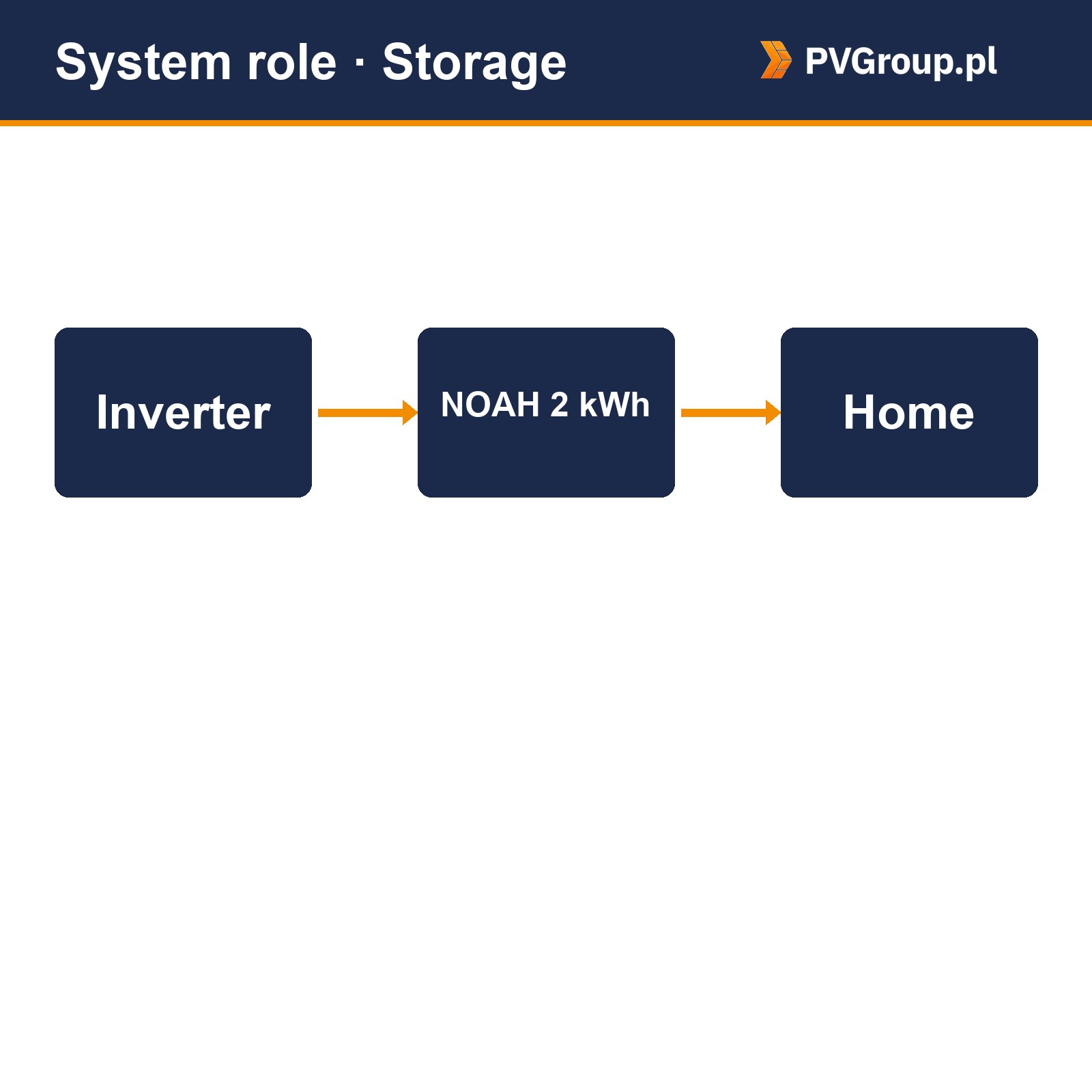
The place where NOAH 2000 It stands in the chain, explains the rest, because it's not a device attached to the side. The card provides two inputs for it. MPPT and 800 W of DC power fed into the microinverter. The panels enter the storage unit, and the storage unit decides whether the energy goes to the microinverter or the cells. This is also the natural choice for the 800M-X model: 800 W on both sides.
parameters NOAH 2000:
| Parameter | Value |
|---|---|
| Capacity of one module | 2048 Wh |
| Development | up to 4 pieces, i.e. up to 8192 Wh |
| Cells | LiFePO4, 51,2 V |
| DC power output to the microinverter | 800 W |
| Entrances MPPT | 2 |
| Level of security | IP66K |
| Warranty | 10 years |
| Partnerships | microinverters NEO |
Source: GROWATT-KEY-PARAMETERS.md.
Development NOAH 2000 to four modules and its limits
The card allows for the connection of up to four units, which gives 8192 Wh instead of 2048 Wh. Expansion makes sense when one module ends before the end of thewitem, meaning when the apartment's nighttime consumption regularly depletes the supply before morning production. This symptom is easy to spot in the app and doesn't require counting anything on a piece of paper.
However, the limit is clear and must be stated clearly. Expansion increases capacity, meaning how much energy can be stored. It does not increase production, because that is determined by the panels. The data sheet provides a value of 800 W of DC power for NOAH 2000 and does not specify how a set of four modules behaves in this respect - we will not add this number, check the manufacturer's documentation. The principles of connecting modules into a stack are discussed in compared NOAH 2000 with NEXA 2000, and the full list of compatible microinverters and installation conditions - in technical article about NOAH 2000For other capacities and formats, please see energy storage categories.
IP66 and IP67 - what do these numbers mean in the rain?
The equipment that powers balcony photovoltaics hangs outside year-round, so the protection level isn't just a decorative detail from a leaflet. NEO have IP67, warehouse NOAH 2000 - IP66. Both values are from the data sheets.
The IEC 60529 standard, which defines this notation, reads these numbers sequentially. The first refers to solid objects: a six in this position indicates complete dust-tightness, the highest level on this scale. The second refers to water. A six indicates resistance to strong water jets from any direction, while a seven indicates resistance to brief immersion. The practical conclusion for a balcony is that both devices are designed for operation in rain and driving winds.
What these numbers don't mean should be made equally clear. The degree of protection describes the result of testing under specific laboratory conditions, not a promise of any type of treatment for the equipment. The device must be installed according to the manufacturer's instructions and is not intended for permanent submersion or submersion in water.
In addition, the manufacturer's declarations regarding durability are included. The data sheet provides a 12-year warranty for the microinverters. NEO and 10 years for NOAH 2000. The scope and terms of these warranties are described in the manufacturer's documentation, not the seller's, so please consult the current documentation before purchasing. On our side, the equipment is shipped to the customer with a European service warranty.
Photovoltaics on a balcony in a block of flats - manager, construction, electrics
Balcony photovoltaics in an apartment building come down to three things, and none of them is model selection. The first is the building manager.
In market practice, it's not the network operator that's the real barrier, but the community or cooperative. Some property managers have regulations regarding the appearance of facades, some treat balustrades as part of the common property, and others have no opinion on the matter until someone asks. The conversation with the property manager takes place before the purchase, not after the pallet is delivered. We describe this as a market observation, not a legal status quo.
The second factor is the construction. The panel has a measurable mass, a large surface area, and works like a sail with every strong gust. The balustrade's load, the mounting method, and whether the anchors even need anything to hold on to should be determined by the building manager, or, in the case of older balconies, by a qualified person. We won't provide any figures on this matter, as there are no universal ones—they depend on the building, the age of the structure, and the installation method.
The third is the apartment's electrical system. An electrician should assess the outlet and circuit into which you plug the microinverter: what else is running on that circuit, what protection it has, and what condition it's in. Photovoltaics on a balcony in an apartment building is a small installation, but still an installation, and it should be treated as such.
Formalities in Poland - framework and where to find details
Balcony photovoltaics with a capacity of up to 800 W do not currently require notification to the grid operator. The limits described in the draft Technical Conditions, known as WT 2026, are drafts, not binding law, and are subject to change. Therefore, every offer and purchase is verified against the current regulations, not against announcements. Details, dates, and work status are described in a separate article: Balcony Photovoltaics and Storage in Apartment Buildings and the WT 2026 Project . If you have any questions about your situation—connection, meter, or contract terms—check with your grid operator (DSO). This article should not be considered legal advice.
Territorial scope. The above paragraph describes the situation in Poland only. This text is also available in machine translation into other languages, and regulations regarding micro-installations, connections, and notifications vary in each country. Readers outside Poland should check their own national regulations and the policies of their network operator—Polish rules cannot be transferred to another jurisdiction.
What makes up the set and in what order should you buy it?
The balcony photovoltaic system comes complete with five components: photovoltaic panels, a mounting structure suitable for a railing or wall, a microinverter, DC wiring, and a power cord. The sixth component, the energy storage unit, is technically optional and economically most important if the apartment is unoccupied during the day.
We don't have photovoltaic modules in our catalog today PVGroup.pl — verified August 31, 2026 — so we do not provide panel prices in this article, and we will not estimate them. Panels and the structure are priced separately by the module supplier. We describe the part of the kit we offer: the microinverter and energy storage.
Order of purchases when the budget is phased
Balcony photovoltaics are well suited to a phased purchase, as long as the stages are completed in the correct order. This order is determined by what is required. First, consultations with the property manager and an assessment of the structure, as a negative response at this stage costs a single phone call, not a pallet of equipment. Then, the panels, along with the structure and microinverter, are purchased as a single decision. Warehouse comes last.
Postponing the storage until the second stage has a rationale beyond financial ones. After a few weeks of operation, the system's app displays how much energy is actually flowing from the apartment during the day, and only then can you determine whether the storage unit has enough to store it. Expanding to four modules means that the initial purchase doesn't lock you in—capacity is added later, module by module.
How much does balcony photovoltaics cost?
Gross list prices as of August 31, 2026:
| Product | SKU | Gross list price | Availability |
|---|---|---|---|
| Growatt NOAH 2000 - balcony energy storage 2048 Wh | 99415 | 2 280,63 zł | Delivery within 5 business days |
| Growatt NEO 800M-X - 800W Microinverter | 99307 | 512,91 PLN | Delivery within 5 business days |
Balcony photovoltaics start with two items from our catalog, and the rest is assembled separately. Additionally, there are panels, mounting structures, and cabling, which are not included in our catalog and are not priced. Installers see discounted prices net of VAT after logging in.
The total cost of a balcony photovoltaic system depends on the unpriced part of the system and whether the storage system comes in immediately or in a second step. The microinverter itself is the smallest item in this calculation, yet it determines everything that can be connected to it—so saving on it rarely pays off.
Is balcony photovoltaics profitable? - an answer without promises
We won't provide savings figures, as they would be fictitious without knowing the specific case. The result depends on the apartment's consumption profile, the orientation and shading of the balcony, the power of the panels, the presence of a storage facility, and the terms of the contract with the energy supplier. Anyone who provides a single figure for all apartments in Poland is guessing.
Balcony photovoltaics are more cost-effective the more of their production goes towards current consumption—and this mechanism can be described without a single penny. Without storage, you only use the energy you consume at the time of production, meaning in the middle of the day. With storage, you shift some of your production to the evening, when more appliances are in use. The fewer people home between 8 a.m. and 4 p.m., the greater the difference between these two options.
Your own consumption profile is the only honest guide here. If your highest consumption occurs after returning from work, a storage system makes sense. If someone works from home and consumes energy at midday, you'll get much more out of a microinverter system alone, and the storage system can wait. Balcony photovoltaics won't replace a rooftop system, and that's not why they were created—they cover part of the consumption of an apartment where a rooftop system isn't feasible.
Balcony photovoltaics - frequently asked questions
Should balcony photovoltaics be connected to a standard outlet? Yes. A microinverter converts the direct current from the panels to alternating current and outputs it to the apartment's circuit through the outlet. An electrician should assess the condition of the outlet and the circuit you're connecting the kit to.
Do photovoltaics on a balcony in an apartment building require a permit? We discuss regulatory issues in our article about the WT 2026 project , and if you have any questions about your own connection, check with your grid operator (DSO). Regardless of the regulations, the building manager, i.e., the community or cooperative, remains a matter of concern—and in practice, this can be more difficult.
How many panels will fit on the balustrade? On the electrical side, the number is determined by the microinverter: NEO The 800M-X accepts 2 panels, the other models in the table accept 4 each. How many modules will physically fit and whether the balustrade will support them depends on the dimensions and construction of the balcony - this should be agreed with the building manager and a person with appropriate permissions.
Which panel fits NEO 800M-X? The datasheet states a range of 320–540 W+ for a single module and two inputs MPPT. A module outside this range is a configuration not described in the documentation, not "slightly worse" - you can find the current cards in download section Growatt.
Is an energy storage system necessary for a balcony system? Technically, it's not. It makes sense when the apartment is unoccupied during the day, as most of the production would otherwise flow outside the system. With peak consumption during midday hours, a microinverter system alone will be sufficient to get you started.
What does the expansion give you? NOAH 2000 to four modules? Four modules provide 8192 Wh of capacity instead of 2048 Wh from one. This increases inventory, not production. Combination rules and limits are described in compared NOAH 2000 with NEXA 2000.
Will the set withstand outdoor use year-round? Microinverters NEO have IP67 protection class, warehouse NOAH 2000 - IP66. Warranty is 12 years for microinverters NEO and 10 years for NOAH 2000. The conditions of installation and operation of the warehouse are described in technical article about NOAH 2000.
How does a balcony photovoltaic system differ from a rooftop system? The scale and connection method. A balcony photovoltaic system delivers energy to a single residential circuit via a power outlet, rather than to the building's distribution board. It has a single microinverter instead of an inverter and is housed in several modules. A rooftop system serves the entire property and requires a different connection.