
Energy Storage Funding – What Equipment Qualifies for the PME 2 Program?
As of: October 2, 2026.
The PME 2 call for proposals has begun October 20, 2026 at 9:00 AM and will last until October 1, 2027 (20:00 p.m.) or until the budget is exhausted.
The October 2026 programme adds a condition for equipment: the devices must be new, "manufactured within 24 months of installation" (point 7.3, point 15).
We quote the terms and conditions from the following page: przydomowemagazyny.gov.pl i PME 2 priority program (reading from October 2, 2026).
Funding for energy storage from the second part of the program home energy storage does not depend on the brand of the device, but on five conditions met jointly by the storage unit and the devices working with it. One of them is pure arithmetic: the storage unit's capacity must be at least twice the power of the photovoltaic installation, so an 8–10 kWp installation requires 16–20 kWh, and the software threshold is 10 kWh does not cover it.
This article covers hardware requirements only: how many kilowatt-hours are needed for a given photovoltaic output, how to check the price limit, and what the program requires from the inverter and EMS system. The subsidy amount is calculated in the guide. subsidy for energy storage, and recruitment dates and models Growatt from 10 kWh with the current price we collect on our page about the program PME 2We also write directly what we don't know. The program is managed by the National Fund for Environmental Protection and Water Management.
Energy storage subsidy - five conditions that the equipment must meet
Five conditions determine whether you are eligible for a subsidy, and everyone can cross out the application on their own.
1. Capacity from 10 kWh. The program says briefly: "Capacity from 10 kWh"—this is about nominal capacity, not usable capacity. This is the entry threshold; the target value is determined by condition 2.
2. Capacity at least twice the photovoltaic power. Quote: "The nominal capacity of the energy storage device, expressed in Wh (watt-hours), must be equal to or greater than twice the peak power of the PV installation, expressed in Wp (watt-hours)." We devote a separate section to this condition.
3. The price of the warehouse does not exceed PLN 3,000 per 1 kWh. The purchase and installation price of the warehouse (without supporting devices, e.g. inverter, EMS system) cannot exceed PLN 3,000 per 1 kWh nominal capacity".
4. Islanding capability. The program requires "demonstration of the capability of so-called islanding (understood as emergency power supply) by the inverter or a set of devices cooperating with the energy storage"—this is a requirement for the inverter, not the battery.
5. Energy Management System (EMS). The energy storage system must be equipped with an energy management function (EMS), either built into the inverter or implemented by an external system.
Formal requirements: purchase, installation, and notification to the operator from November 1, 2025, permanent installation at the address of the micro-installation connected to the grid. The beneficiary is an individual – the installation company selects the equipment, and the customer submits the application.
Rule of 2× - Why 10 kWh only enough for 5 kWp of photovoltaics
First, two units, because the rule compares them. kWp, kilowatt-peak, is the peak power of a photovoltaic installation - how much the panels produce under test conditions. kWh, kilowatt-hour, is the storage capacity - how much energy the battery can hold.
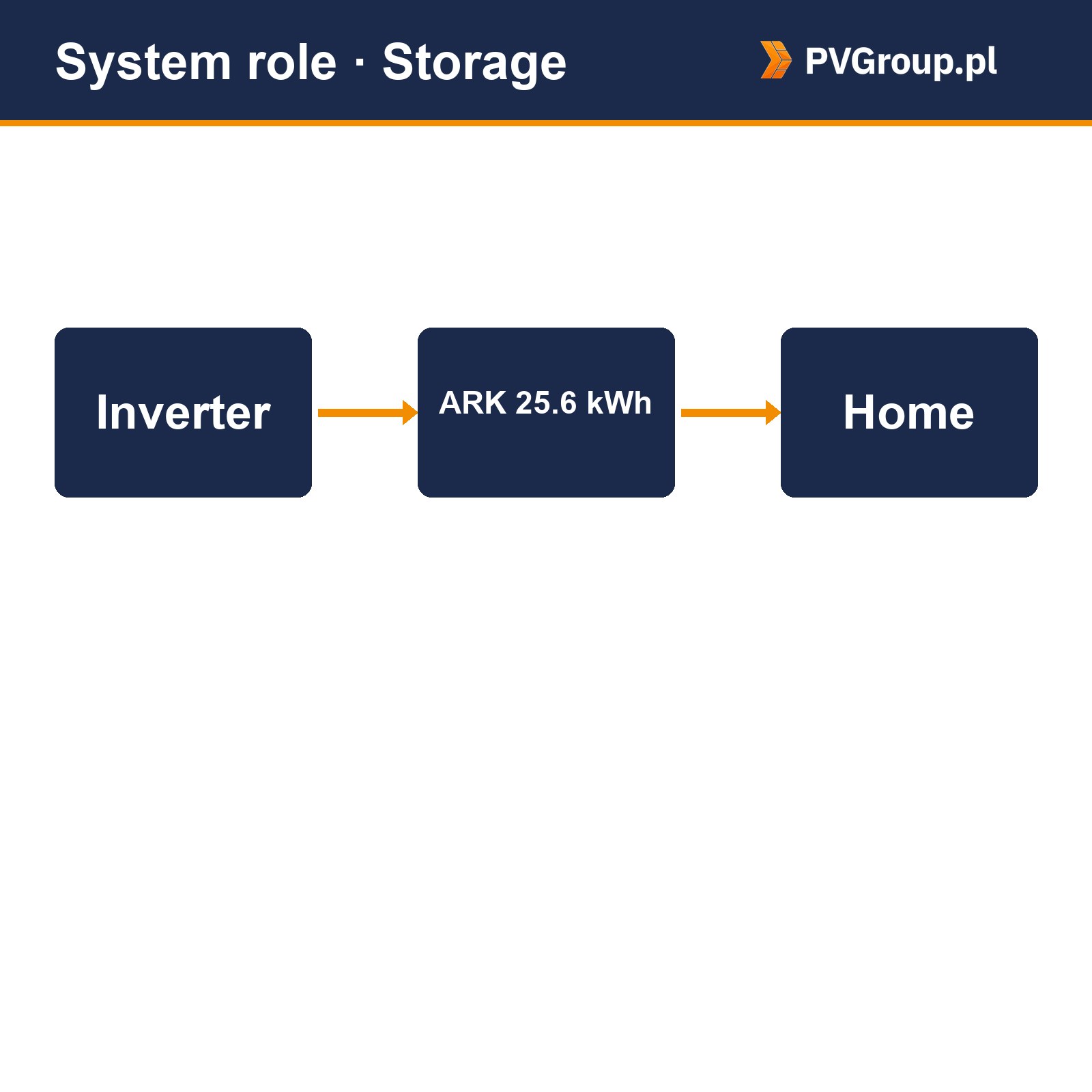
The rule is simple arithmetically and ruthless in practice: the capacity in watt-hours must be at least twice the photovoltaic power in watt-hours. A 5 kWp installation is 5,000 Wp, so the storage must be 10 kWh. A 10 kWp installation is 10,000 Wp, so you need 20 kWh.
The proposal is inconvenient for the industry: threshold 10 kWh provides subsidy only for installations up to 5 kWpAt 9 kWp, storage 10 kWh meets the minimum threshold but not the second condition, so does not qualify at all.
| PV installation power | Minimum warehouse capacity |
|---|---|
| 3 kWp | 10 kWh |
| 5 kWp | 10 kWh |
| 6 kWp | 12 kWh |
| 8 kWp | 16 kWh |
| 10 kWp | 20 kWh |
| 12 kWp | 24 kWh |
| 15 kWp | 30 kWh |
| 20 kWp | 40 kWh |
The table shows the minimum capacity at which the subsidy comes into play, not the optimal capacity for the consumption profile - this selection is described in the guide kWh energy storageThe program treats modules connected to a single PPE as a single warehouse. Expansion to the required capacity is only possible with additional modules of the same model, if the manufacturer allows it. All parts must be purchased, installed, and reported to the OSD by November 1, 2025, and warehouses from two different manufacturers are not eligible (FAQ, questions 4, 13, and 14).
Subsidy for energy storage with a limit of PLN 3,000 per 1 kWh
The limit applies to the purchase and installation of the storage unit itself. Installation is included in the limit, but not the inverter or EMS system. You can check it with a single calculation: the price of the storage unit, including installation, divided by the nominal capacity in kWh, cannot exceed PLN 3,000. In other words, the warehouse 10 kWh it can cost up to 30,000 PLN including assembly and 20 PLN for storage kWh — at most PLN 60,000 (PLN 3,000 × capacity).
We calculate gross, meaning we should be more cautious: the program does not specify whether the limit applies to the price with or without tax, and value added tax is an eligible cost. The program requires that gross costs be entered in the application (point 9.2, item 7), but with a limit of PLN 3,000 per 1 kWh he doesn't write it directly.
With the same action you can check every warehouse Growatt z our list of models — we show the price there live, not from the day the article was written.
Islanding - what the program requires when selecting an inverter
The program requires "demonstration of the possibility of so-called island operation (understood as emergency power supply) by an inverter or a set of devices cooperating with an energy storage, enabling the maintenance of access to electricity in the household in the event of a temporary/local power grid failure."
Without demonstrating islanding, the subsidy is not applicable, but this obligation does not apply to the battery, only to the inverter. A battery alone on a standard grid inverter will disconnect along with the grid; a hybrid inverter with an emergency output or a set of devices that provides such an output is decisive. Therefore, the set is crucial for the subsidy: a battery matched to a specific inverter series. You can check the series compatibility at inverter and battery configurator GrowattIf the customer already has an inverter, first check if it has a backup power output. Inverters are in the category inverters, and the relationship between the battery and power backup is described on the page energy storage Growatt.
EMS - the condition that cuts out the most offers
The program requires an energy management system (EMS), either built into the inverter or externally. The program defines it as intelligent control of energy flow between current consumption, energy storage, and thermal storage, based on priorities: current demand, energy storage, thermal storage, and surplus feeding into the grid.
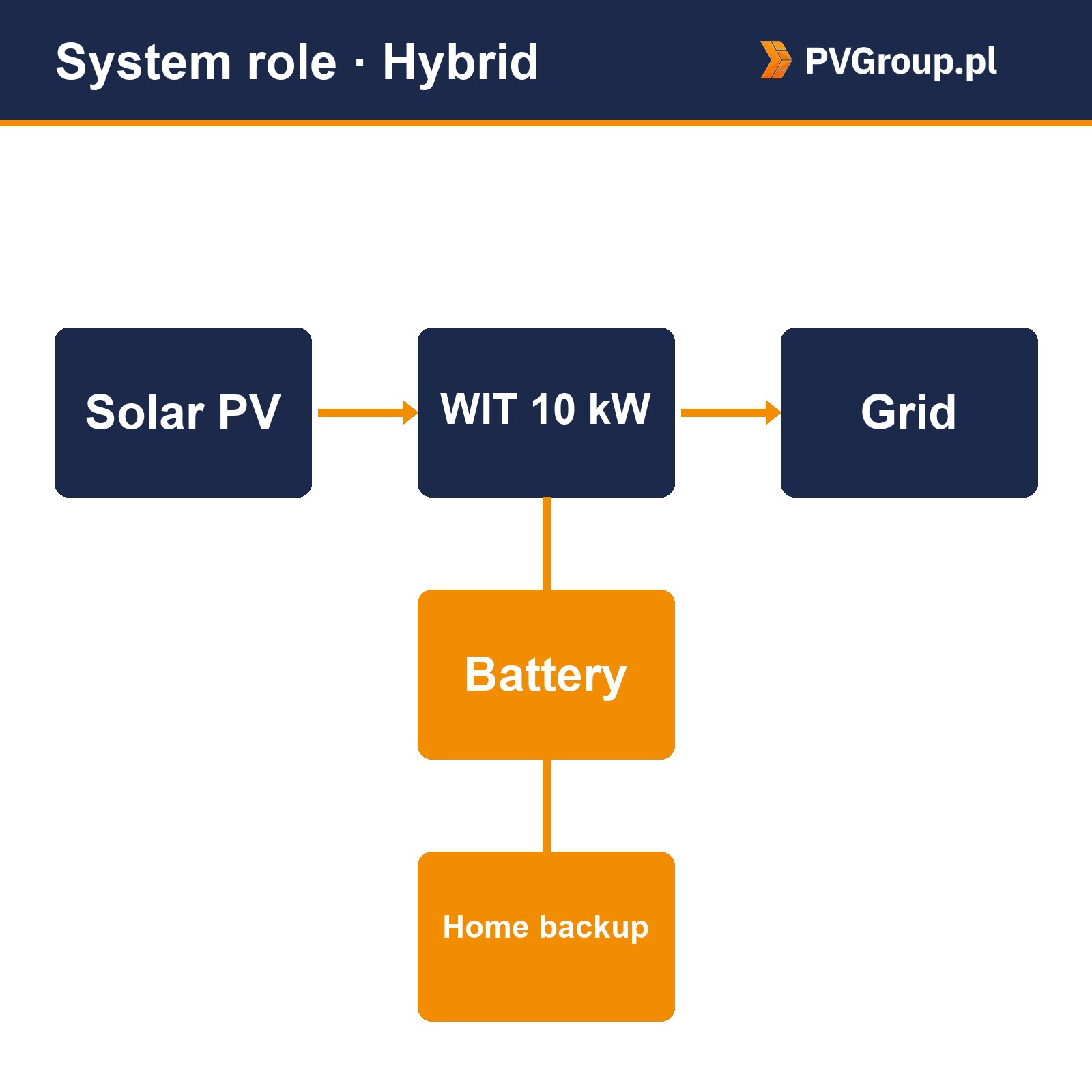
The key is the exclusionary sentence: "Simple controllers or visualization applications that do not have decision-making functions and do not analyze weather or economic data are NOT considered EMS."
The minimum functionality is three-pronged: charge control, discharge control, and time-based operation. The application must specify the system name, type, and functionality, and this information must be included in the acceptance protocol—without this, the grant will not be awarded. Cybersecurity requirements also apply: the EMS "must meet the requirements arising from European regulations"—the NIS2 directive, the CRA (Cyber Resilience Act), RED DA requirements, and the ETSI EN 303 645 standard.
We have a manufacturer's declaration for these requirements. Manufacturer's declaration Growatt (PDF) exhibited by Shenzhen Growatt New Energy Co., Ltd., signed the Regulation Compliance Manager. It states that inverters Growatt and the EMS system cooperating with them meet the cybersecurity requirements of European Union regulations, "including CRA and RED DA", and are compliant with ETSI EN 303 645. Compliance with CRA is ensured by certification of data loggers according to ETSI EN 303 645 and CE marking, while compliance with RED DA (Article 3, paragraph 3, letter d) is included in the EU Declaration of Conformity by the EN 18031-1:2024 standard.
The declaration refers to three of the four documents listed by the program. NIS2 is not included , and we make no claims about compliance with this directive—that question remains open to the manufacturer.
The strongest section concerns decision-making functions: the declaration lists "energy price arbitrage (AI Smart Scheduling Mode)," which analyzes economic data, and "predictive household energy management based on weather forecasts," which analyzes weather data—precisely the criteria the program considers as grounds for exclusion. It also lists "scheduled battery charging and discharging," which covers the three minimum functions.
However, this doesn't work out of the box. Weather and price analysis is carried out through AI Smart Scheduling Mode, a service on the monitoring platform Growatt OSS, available "subject to meeting the applicable device, firmware, communications, and platform requirements." The installation company must configure the platform and verify the firmware before entering decision-making functions into the acceptance protocol, and the protocol is a required appendix to the application.
The declaration covers six series of hybrid inverters: MIN-XH, MOD-XH, MOD-HU, MID-XH, WIT-HU and SPH BH-UP. Does not include the series SPF, i.e. inverters working outside the grid - the same one whose sets off-grid The program's FAQ excludes it from the grant (question 2). The document lists specific model designations, so for variants written differently, such as MOD-XH BP or SPH-HU, it's worth confirming the coverage with the manufacturer.
Which warehouses meet the requirements - model list

List of warehouses Growatt from 10 kWh with today's price, availability and basket - together with inverters from the EMS declaration and a box for self-checking the price limit - we run on one page: home energy storage modelsWe won't repeat it here because prices change more frequently than program terms. Meeting the hardware requirements is not a decision regarding funding: the program operator decides whether to grant funding.
The prosumer's billing system also influences the amount. Net billing is value-based billing: surplus energy fed into the grid is converted into money. Net metering is volume-based billing: surplus energy is later collected in kilowatt-hours.
The limit is set by the date of submitting a micro-installation for connection - the program website requires a separate document confirming net-billing from applicants "who changed the billing system from net-metering to net-billing" when "the installation was submitted for connection by March 31.03.2022, 16." The subsidy limit for energy storage depends on the system: PLN 8 or PLN 16. Which system applies to the prosumer is decided by the comprehensive agreement or the energy sales agreement; the program decides the most important case: whoever changed net-metering to net-billing has a limit of PLN 000 (point 7.2 item 1 letter a). Changing the system is not a condition for the subsidy, it only affects its amount (FAQ, question 5). We do not advise changing the billing system: it is a decision with broader effects than the subsidy. The formula for the subsidy amount, with limits of 30 percent and PLN 800 per 1 kWh, we write in the guide subsidy for energy storageFull offer: energy storageEveryone can see gross prices, while installation companies, after logging in, can see prices excluding VAT with a wholesale discount.
Energy storage subsidy - what is not included
At the equipment Growatt the subsidy will not cover an additional PLN 2,000 for production in the European Union. The program provides a one-time payment of up to PLN 2, not more than 50 percent of the eligible cost, for a hybrid inverter or energy storage device manufactured in the European Union. Growatt is a Chinese manufacturer. Therefore, we do not claim that the devices we offer provide this part of the subsidy.
Heat storage, self-assembled batteries, mobile storage. Heat storage receives up to 30 percent of the cost, up to a maximum of PLN 1, and only those manufactured in the European Union—we don't offer this type of product. The program "does not allow the use of batteries, especially self-assembled batteries/sets or other non-certified solutions," and outright excludes mobile storage, i.e., vehicles and traction storage.
Inverter kits off-grid. The offer includes battery sets with inverters of the following series: SPF, working outside the network. The program's FAQ excludes installation off-grid: if the network operator confirms the system off-grid, the subsidy will not be granted (question 2). When planning a subsidy, choose a set with a hybrid inverter connected to the grid. Inverters SPF There is also no manufacturer's EMS declaration, so we recommend a hybrid kit with an inverter from this declaration.
Frequently asked questions about energy storage funding
Which energy storage device qualifies for funding for an 8 kWp installation?
Warehouse at least 16 kWh, because the program requires twice the power. The offer Growatt this capacity has, for example, HOPE 16.0LM-A1 (16 kWh), which, according to the manufacturer, works with inverters of the series WIT-HU; the inverter must provide island operation. Current prices and other models from 16 kWh shows model list.
Is warehouse 10 kWh enough for every photovoltaic installation?
No. Capacity 10 kWh meets the rule of two only up to 5 kWp. At 6 kWp you need 12 kWh, at 8 kWp 16 kWh, at 10 kWp 20 kWh.
Will I get PLN 16,000 in funding for an energy storage facility?
Only with an eligible cost of at least PLN 53,333 (PLN 16,000 ÷ 0,30), capacity from 20 kWh (800 PLN × 20 kWh) and net-billing. For lower costs, the subsidy is 30 percent of the cost.
Is the manufacturer's application for viewing energy production sufficient as an EMS system?
No. The program does not recognize simple controllers or visualization applications without decision-making functions or analyzing weather or economic data as EMS systems. Manufacturer's Declaration for Hybrid Inverters Growatt mentions energy price arbitrage and weather forecast prediction, both functions via AI Smart Scheduling Mode on the platform Growatt OSS, and includes CRA, RED DA and ETSI EN 303 645. NIS2 does not appear in the declaration.
Is the warehouse Growatt gives an additional PLN 2,000 for production in the European Union?
No. This part of the subsidy is available for a hybrid inverter or energy storage device manufactured in the European Union. Growatt is a Chinese manufacturer, so we do not promise this addition.
Is the kit with an inverter off-grid from series SPF qualifies for the program?
The program's FAQ excludes installations off-grid: if the network operator confirms the system off-grid, the subsidy will not be granted (question 2). If you plan to receive a subsidy, choose a set with a hybrid inverter connected to the grid. Series SPF nor does it include the manufacturer's EMS declaration.
About this article
The article was prepared by the editorial team PVGroup.pl — photovoltaic wholesalers and energy storage companies Bytomia, which sells to installation companies in Poland and the European Union. Program terms are quoted from the program page with the date of publication, and prices and availability are shown on product cards. Warehouses Growatt APX HV Battery 2.0, ARK i HOPE 16.0LM-A1 are available PVGroup.pl 10-year European warranty. Warranty claims are handled by the manufacturer's service center. Growatt in Mysłowice. More: about us i contact.
We are not the program operator and do not process applications. Binding interpretations are issued by the National Fund for Environmental Protection and Water Management, hotline 22-45-90-800 , open from 7:30 a.m. to 3:30 p.m.; between 3:00 p.m. and 3:30 p.m., only calls already in the queue are handled. Confirm the amounts and document templates at przydomowemagazyny.gov.pl , and the prices are listed on the product card.
Update Log
| Date | Change |
|---|---|
| 31.08.2026 | Publication of the first version. Program conditions from the government website screenshot from August 31, 2026: recruitment without a day date, threshold 10 kWh, the rule of doubling the power of photovoltaics, limit of PLN 3,000 for 1 kWh, island work, mandatory EMS system. Gross list prices and subsidy calculations from the product matrix as of August 31, 2026, 7:15 PM. |
| 31.08.2026 | Correction after editorial review: clarification of what actually limits the subsidy. Added definitions of units and settlement systems. |
| 31.08.2026 | Supplement after verification of sources: opening hours of the NFOŚiGW hotline, cut-off date 31/03/2022 separating net-metering and net-billing. |
| 31.08.2026 | Section on EMS system rewritten after receiving manufacturer's declaration (Shenzhen Growatt New Energy): CRA, RED DA and ETSI EN 303 645 coverage, decision-making functions via AI Smart Scheduling Mode, six inverter series covered. NIS2 remains outside the declaration. |
| 31.08.2026 | Manufacturer's declaration published as PDF and linked in the EMS section - everyone can check its scope on their own. |
| 25.09.2026 | The program status was re-checked on the program website on September 25, 2026: recruitment planned for Q4 2026, with no date set; equipment conditions unchanged. We have removed the table of kit prices from August 31, 2026, and the subsidy calculations based on those prices—the warehouse list. Growatt The current price is listed on the home energy storage website, and the formula for the amount is in the subsidy guide. The doubling rule table only provides the minimum capacity. The limit is PLN 3,000 for 1 kWh we describe it as an activity to be checked by yourself. |
| 02.10.2026 | Tuemin recruitment according to the program website and recruitment regulations: start 20/10/2026 9:00 AM, end 01/10/2027 8:00 PM or until the budget is exhausted. A condition from the priority program has been added: new devices, manufactured within 24 months before installation. Sets SPF, warehouse expansion and net-billing described according to the program and FAQ PME 2. |
The next update will follow a change in the program terms or a notification that the budget has been exhausted.