
LV battery Growatt - comparison AXE 5.0L, HOPE 5.0L, HOPE 14.3L and ARK 2.5L
LV battery Growatt are four families with a common voltage of 51,2 V and completely different designs: modular AXE 5.0L-C1 (5-50 kWh in the tower), parallel HOPE 5.0L-B1 (up to 48 pieces), wall-mounted HOPE 14.3L-A1 (14,3 kWh in one block) and tower ARK 2.5L-A2 with IP65. The choice depends on the inverter from the matrix and the mounting conditions.
LV battery Growatt It's not a single product, but four families designed for different scenarios: one for a heated boiler room, another for an uninsulated garage, and yet another for hanging on a wall when the floor is occupied. The common denominator is a nominal voltage of 51,2 V and LiFePO4 chemistry—then the differences begin, which determine the choice. This article summarizes all four families in a single table: an inverter compatibility matrix, electrical parameters, environmental conditions, and expansion logic, and finally provides a simple selection algorithm.
Which LV battery Growatt to which inverter?
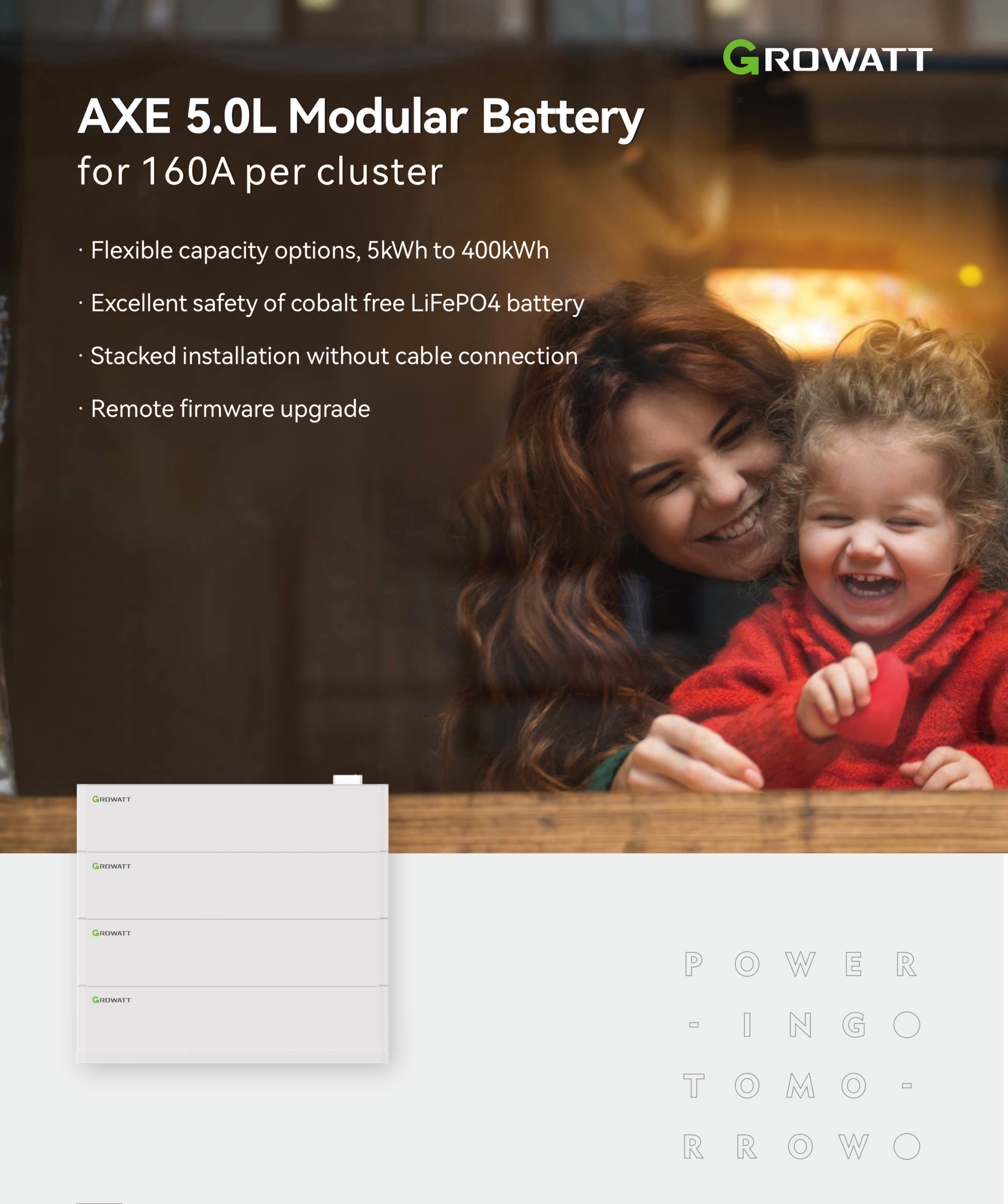
The starting point is always the Compatibility Matrix - LV Battery Growatt It must be listed for a specific inverter series, as voltage class is a necessary but not sufficient condition. The matrix below comes directly from the distributor's verified table.
| Battery | Module | Compatible inverters (matrix) | graduation |
|---|---|---|---|
| AXE 5.0L-C1 | 5,0 kWh / 51,2V | SPF / SPH single-phase / WIT 8-15K-HU | tower 1-10 modules, up to 8 clusters and 400 kWh |
| HOPE 5.0L-B1 | 5,12 kWh / 51,2V | SPF / SPH single-phase | up to 48 pieces in parallel |
| HOPE 14.3L-A1 | 14,3 kWh / 51,2V | WIT 4-15K-HU (next to AXE) | up to 48 pieces, 14,3-686,4 kWh |
| ARK 2.5L-A2 | 2,56 kWh / 51,2V | SPF / SPH single-phase | tower 1-10 modules, 2,56-25,6 kWh |
Two observations from the matrix. First, to the series WIT 4-15K-HU are included only AXE 5.0L i HOPE 14.3L - smaller HOPE i ARK they stay with SPF and single-phase SPH. Secondly, the matrix also includes ALP 5.0L-E2, but without a confirmed list of inverters - until the manufacturer's data is completed, we do not include it in the offers.
Electrical parameters - currents, DoD, durability
In this table, the LV battery Growatt shows the greatest variations between families – from currents to declared durability.
| Parameter | AXE 5.0L | HOPE 5.0L-B1 | HOPE 14.3L-A1 | ARK 2.5L-A2 |
|---|---|---|---|---|
| Nominal current | 2,5/3,1 kW (1 module); from 4 modules 160 A | 100 A | 140 A | 25 A/module, max 100 A tower |
| Peak | — (the card does not provide a peak value) | 250 A / 150 ms | 225/245 A for 3 sec | — (the card does not provide a peak value) |
| Discharge depth | 92 % | 98 % | 93 % | 90 % |
| Durability | — (the card does not provide the number of cycles) | over 6000 cycles | at least 6000 cycles | — (the card does not provide the number of cycles) |
| Communication | CAN/RS485 | CAN/RS485 | CAN/RS485 | CAN/RS485 optional |
| Warranty | 5/10 lat. | 5 years | 10 years | 10 years |
The highest depth of discharge is HOPE 5.0L-B1 — 98%, meaning almost the entire rated capacity is operating capacity. The lowest starting current is for a single ARK module: 25 A — the tower current increases with the number of modules up to 100 A. Conclusion: with inverters with high charging current, single small modules are the bottleneck — the LV battery Growatt in minimal configuration it limits the system, it does not drive it.
Work environment - this is where decisions are made
If any LV battery Growatt is to work outside the heated interior, this table decides the selection faster than the price list.
| Parameter | AXE 5.0L | HOPE 5.0L-B1 | HOPE 14.3L-A1 | ARK 2.5L-A2 |
|---|---|---|---|---|
| Level of security | IP20K | IP20K | IP20K | IP65K |
| Working temperature | 0-50 °C | charging 0-55°C, discharging from -20°C | charging 0-55°C, discharging -20-60°C | -10-50 ° C |
| Assembly | floor, base as an addition | rack/column, 440/480/130,5 mm | wall, 440/812/265 mm | wall or floor, base 650/260/80 mm |
| Module weight | 40 kg | 43 kg | up to 120 kg | 28 kg |
This is the most important table in this comparison. Three of the four families are IP20 and charge from 0°C – for dry, heated rooms. Only ARK The 2.5L-A2 combines IP65 with charging from -10°C, making it our choice wherever "technical room" effectively means a garage without heating. Each LV battery Growatt of these four declares current derating as a function of temperature and charge state - catalog parameters read as values at 25°C.
Monitoring BMS — what each LV battery reports Growatt
The common feature of all four is communication with the inverter via CAN/RS485, but the reporting scope is only described directly on the card. AXE: BMS monitors SOC, system voltage, current, cell voltages and temperatures, and PCBA temperature. For the installer, this means diagnostics at the individual cell level—when making a claim, you don't have to guess which module is out of order; you can just read it from the app. ARK 2.5L-A2 communication port is an optional item - when ordering this family for lithium inverter, make sure the communication variant is in the order because the LV battery Growatt without BMS-a visible to the inverter operates in voltage mode and loses the greatest advantage of LFP chemistry.
All family cooling is passive — HOPE The 14.3L uses natural convection directly—so there's no noise generation and no fans to service. The flip side of the coin: passive cooling requires air circulation around the case; a tight cavity without airflow raises operating temperatures and triggers derating.
Granularity of Expansion - How Every Family Grows
LV battery Growatt grows differently in each family - the expansion jump can be more important than the price per kilowatt-hour. ARK grows smallest: every 2,56 kWh, from 2,56 to 25,6 kWh in the tower - it's easy to hit the customer's budget. AXE jumps every 5 kWh to 50 kWh in the tower, and then in clusters up to 400 kWh — the only one of the four that makes sense for large banks. HOPE 5.0L adds 5,12 kWh parallel to 48 pieces. HOPE 14.3L jumps the thickest — after 14,3 kWh — but one block on the wall replaces the entire tower and scales to 686,4 kWh.Tower heights for comparison: full tower ARK is 1814 mm, full turret AXE — 1425 mm.
Certificates and transport - the formal side of delivery
All four families have transport documentation for lithium cells, but the scope of certification differs and can be an argument in tenders. AXE The 5.0L is fully CE, RoHS, UL1973 with FCC and UN 38.3 with PI965 certified – the presence of UL1973 makes it stand out in projects where the investor requires American cell safety standards. HOPE 5.0L-B1 has CE(EMC), UN 38.3, MSDS and RoHS, HOPE 14.3L-A1 adds IEC 62619 to the mix—an industrial cell safety standard increasingly requested by building insurers. The UN 38.3 certification, common to all, formally authorizes batteries for shipment—pallet carriers request it upon shipment, so keep it on your shipping documents.
Shipment volumes are growing rapidly: the tower AXE 30 kWh is 274,8 kg, full tower ARK 25,6 kWh — 280 kg. LV battery Growatt in larger configurations, it always travels on a pallet with a lift; plan unloading without a ramp with two people and a trolley.
Three typical objects - what does selection look like in practice
The following scenarios are installation practice based on source parameters - numbers have addresses, assignments are ours.
Year-round house with a boiler room, SPH single phase. A dry, heated room opens the full list. If the client wants to start small and add to it each season— ARK with a step of 2,56 kWh is the most flexible. If simplicity is key: HOPE The 5.0L and its 98% depth of discharge give you the most working capacity from each rated kilowatt-hour.
Summer house with SPF, unheated garage. In winter, temperatures drop below freezing - charging from -10°C and an IP65 enclosure leaves only the ARK in the game. Tower 3-4 modules (7,68-10,24 kWh) covers evening consumption, and in summer the system works at full capacity.
Workshop with WIT 12K-HU, large daily energy flows. The matrix narrows down the selection to AXE i HOPE 14.3L. With a charging current of 250A, this inverter's current capacity is what counts: two units HOPE 14.3L give 280 A and full coverage - conclusion from summing the currents; AXE will stop at 160 A. The wall instead of the floor is an additional argument for HOPE in a cramped workshop.
What not to combine when choosing LV?
- LV batteries with HV inverters. 51,2V is a different class than high voltage storage — SPH TL3 BH-UP, MIN TL-XH or WIT-XHU have families in the matrix ARK 2.5H, APX i AXE 5.0H.
- Models outside the matrix of a given series. HOPE 5.0L-B1 and ARK 2.5L not included WIT 4-15K-HU, although the voltage class is correct - the matrix is a closed list.
- Different families in one bank. Each card describes an expansion only within its own model; mixing AXE z HOPE ARK is not provided for in any document.
- IP20 outside dry interior. AXE and both HOPE require a room - only the outside remains ARK with IP65.
- ALP 5.0L-E2 on offer without confirmation. The matrix does not provide compatible inverters for it - we are waiting for manufacturer's data.
Four-step selection algorithm
- The inverter tops the list. WIT 4-15K-HU → AXE or HOPE 14.3L; SPF/SPH single-phase → AXE, HOPE 5.0L or ARK.
- The room cuts the list further. Unheated or damp → stays ARK (IP65, from -10°C). Dry and heated → all options open.
- The inverter current sets the minimum. The set must cover the charging current: 160 A from 4 modules AXE, 140 A per unit HOPE 14.3L, 100A HOPE 5.0L, 25A per ARK module.
- Granulation and location complete the selection. Little floor → wall HOPE 14.3L; minor expansion → ARK; large bank → AXE.
From the installer's practice
- Don't sell just capacity. Every LV battery Growatt tempting price for kWh, but From experience: the customer compares kWh and price, and the lifespan of the bank is determined by the room temperature and current relative to the limit - show him the environmental table before choosing the cheapest option.
- ARK to the garage, not "because it's cheaper". IP65 and -10°C are the only valid justification for this family in a cold room - based on real installations, IP20 batteries in garages end up with complaints.
- Weight per person: 28 kg ARK versus 120 kg HOPE 14.3L. Modules ARK contributed by one person, unit HOPE 14.3L - crew with sling; include this in the assembly cost.
- Count the bases and handles at once. Basis AXE and the basis ARK are separate items - a common mistake is to price the modules alone.
FAQ - LV Battery Growatt
Why is the usable capacity different from the rated capacity?
Because it is limited by the depth of discharge: 92% for AXE, 98% for HOPE 5.0L, 93% for HOPE 14.3L (13,3 of 14,3 kWh) and 90% for ARK. Always calculate the backup time from the useful value - the difference between families reaches eight percentage points and in larger banks translates into full kilowatt-hours.
Is the LV battery Growatt Will it work with another brand of inverter?
The compatibility matrix covers inverters only Growattand communication BMS via CAN/RS485 requires compatible protocols. We do not assemble these batteries outside the manufacturer's ecosystem.
Which LV battery Growatt has the best energy to mass ratio?
HOPE 14.3L-A1: 14,3 kWh with a weight of up to 120 kg. For comparison, the tower ARK with a similar capacity (12,8 kWh, 5 modules) weighs 140 kg - a conclusion from a direct comparison of the cards.
Can families be replaced during the life of the installation?
Yes, while maintaining the matrix: inverters SPF/SPH single-phase accept three families, so replacing e.g. ARK na HOPE with modernization it is possible - but the bank is built from scratch, without connecting old and new families.
Why the discrepancy between 5/10 year warranties?
AXE has a 5/10 year record in the card (extension option), HOPE 5.0L - 5 years for variant 5 or 10 in the matrix. Confirm coverage when ordering; the manufacturer's European service warranty applies. Source cards can be found in download center Growatt.
Selection checklist
- Identify the inverter series and read the allowed families from the matrix.
- Assess the room: winter temperature and humidity cut the list to IP65/IP20.
- Calculate the inverter charging current and select the minimum configuration of the set.
- Select the expansion granularity to suit your budget and installation development plan.
- For floor towers, add the base and check the target height relative to the room: full tower ARK reaches 1814 mm plus a base of 80 mm - under a low basement ceiling there may be insufficient installation space to connect the cables from above.
- Schedule your bank's annual inspection: reading SOC and cell voltages from the app, tightening connections, checking for moisture traces at IP20—a half-hour check that catches problems before the heating season.
- Verify the set in the tool inverter + battery configurator Growatt.
Every LV battery Growatt from this comparison you will find in our offer: AXE 5.0L, HOPE 5.0L-B1 and HOPE 16.0LM-A1 — Net prices for installers visible after logging in. For combined orders of inverters and warehouse, we select a complete set of cabling and mounting accessories for a specific family, ensuring a single, complete delivery to the construction site—from the tower base to the communication terminals. BMSThis shortens assembly by one trip and eliminates downtime for missing parts, which in energy storage systems can cost more than the parts themselves.
Sources
- Growatt AXE 5.0L Modular Battery New - Datasheet (EN) — card AXE 5.0L (202506), p. 2
- Growatt Hope 14.3L-A1 - Catalogue Card (EN) — card HOPE 14.3L-A1 (202409), p. 2
- Growatt HOPE 5.0L-B1 -2509 - Datasheet — card HOPE 5.0L-B1 (2509), p. 2 — transcription
- Growatt ARK 2.5L-A2 Battery - Datasheet — card ARK 2.5L-A2 (202412), p. 2