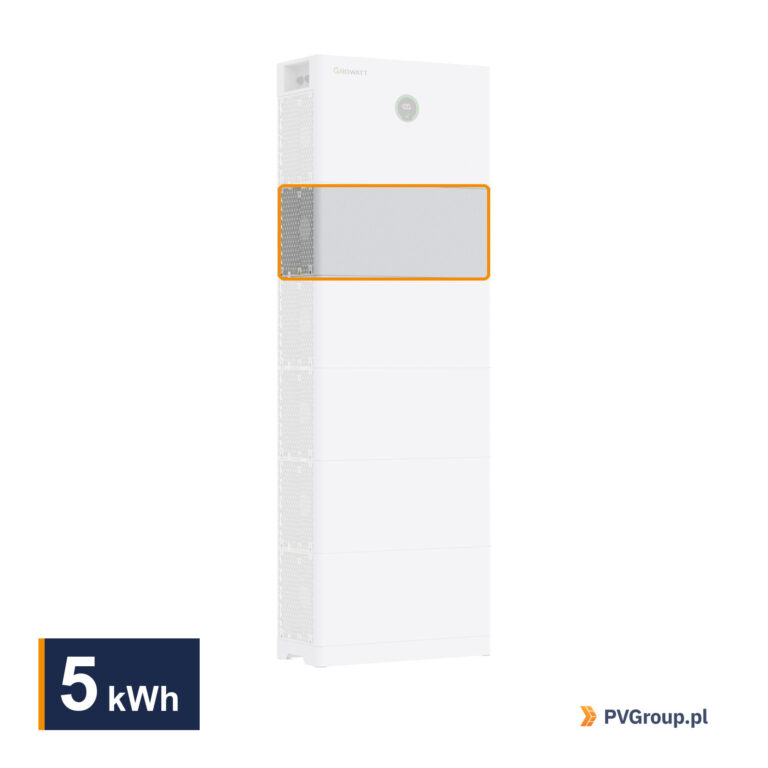
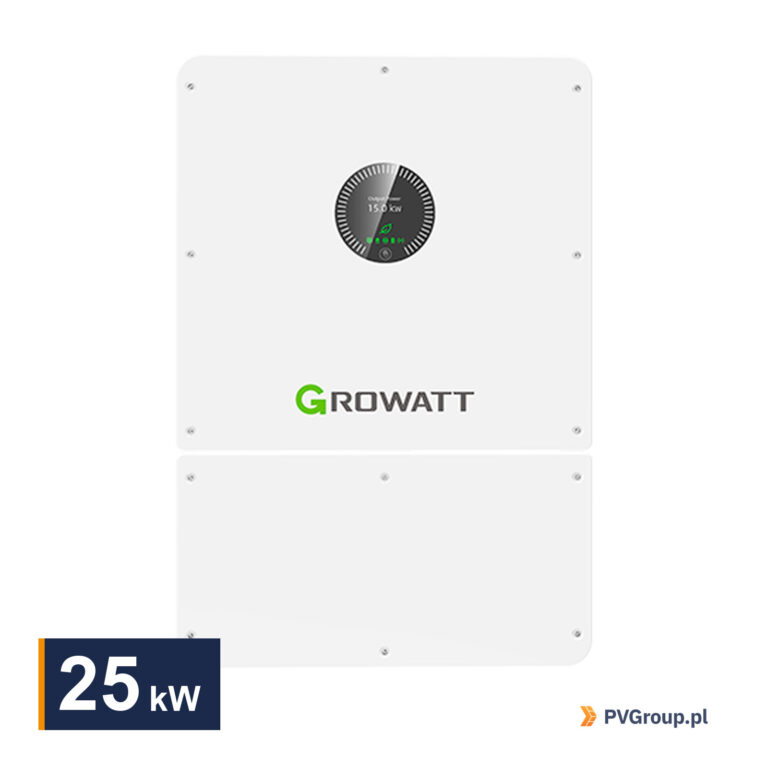
"How many kWh Do I need an energy storage facility?” — this question opens most conversations about expanding the installation, and the answers from advertisements (“10 kWh "enough for everyone") are worth as much as a horoscope. A reliable selection involves three independent calculations: the energy balance for the evening and night, the peak power of the loads that the storage system is to support, and—if emergency power is involved—the backup time of critical circuits. This guide goes through all three with specific formulas and shows how to translate the results into modular battery families. Growatt, in which capacity and power increase together.
Ile kWh energy storage for self-consumption? First bill: energy
The starting point is your monitoring app, not the retailer's calculator: read the home's consumption from sunset to dawn (typically from ~18:00 PM to ~7:00 AM) over several weekdays and a weekend. This is the energy that the storage system will realistically cover—because the photovoltaics power the home continuously during the day. Adjust the result for the usable capacity: batteries operate at a specific depth of discharge (DoD), so take the usable value from the data sheet, not the nominal value—in families. Growatt DoD is from 90% (ARK, APX) up to 92–98% depending on the family, and the difference between 5,12 kWh nominally a 5,0 kWh usefully, with larger banks it accumulates.
Working formula (editorial methodology, not the card entry): usable capacity ≈ evening-night consumption × 1,1 (buffer for conversion losses and winter capacity loss). Example: a house using 8 at night kWh I need about 8,8 kWh useful capacity, i.e. in practice a bank of 10 kWh nominally — two modules of 5 kWh (APX, AXE, ALP, HOPE) or four of 2,56 each kWh (ARK). Anything above this value works less frequently and extends the payback; a shortfall means the grid continues to top up every evening.
Second Calculus: Power – The Silent Killer of “Cheap” Configs
Capacity tells you HOW LONG the storage will release energy; power tells you HOW MUCH AT ONCE. In modular families Growatt the system power increases with the number of modules: tower ARK HV outputs according to the card from 3,84 kW with three modules to 12,8 kW with ten, and the system APX in a three-phase line with a module 98034-P2 — from 2,5 kW with one module to 15 kW with six. The practical consequence: a bank selected "for a snug fit" in terms of capacity is often too weak in terms of power — an induction cooktop plus a kettle means a temporary dozen or so kW that a minimal tower simply won't deliver, and the grid will add the difference, disrupting the balance of self-consumption.
Therefore, asking how much kWh To buy an energy storage device, simultaneously check the house's evening peak consumption (using an OSD meter with power recording or peak clamp measurement) and compare it with the power of the selected configuration from the card. A rule of thumb from selection practice: a configuration is healthy when the bank's power covers a typical evening peak without grid support, and its capacity covers the full evening and nighttime capacity. In modular homes, both conditions are often linked by the same decision: "add one module."
Bill three: backup - how much kWh energy storage for emergency power supply?
Here's where the philosophy changes: during a grid outage, you don't power the "house," only selected circuits. Start with a critical list—refrigerator and freezer, lighting, router, furnace/central heating pump, gateway—and add up their average continuous draw; in a typical home, this is surprisingly low, on the order of several hundred watts. The formula is: backup capacity ≈ sum of continuous power × assumed backup time × 1,3 (buffer for inrush peaks and SOC reserve). Example: 400 W critical circuits × 12 hours × 1,3 ≈ 6,2 kWh — it's worth leaving this much "untouchable" reserve in the bank if the blackout is to be slept through, and not waited out by candlelight.
Remember the hardware layer: the bank alone cannot support the house without a backup line - in families Growatt these are boxes SYN for battery-ready units or hybrids with UPS/EPS functionality; we described the architectural differences in the hybrid inverter comparison. The SOC backup reserve is set in the inverter—the thresholds are described in the articles on settings—and it is this reserve that makes the "self-consumption" and "backup" storage partially two different pools of the same battery.
Heat pump - the most common selection mistake
A heat pump can change your bill more dramatically than you might think. A 2-3 kW compressor running for several hours a day in winter costs 20-40 kWh daily consumption - no reasonable home storage facility will carry a house with a pump for 24 hours without sun. There are two fair goals: shorter backup (maintaining the pump for a few hours of failure, e.g. 3 kW × 3 h × 1,3 ≈ 11,7 kWh) or tariff optimization (bank loaded in a cheap zone and returned in a expensive one, dimensioned for the daily pump operation window in expensive hours).
Therefore, in houses with a heat pump, the selection begins with the decision of the GOAL, not the capacity: "surviving a failure" leads to a bank of 10-15 kWh with a hard SOC reserve, "earn on the tariff" - for configurations calculated on the pump consumption profile, often 15-25 kWh and upwards, where modular towers (ARK to 25,6 kWh, APX to 30 kWh, clusters AXE much further) allow you to reach your goal in stages. The promise "a warehouse will make you independent from electricity with a heat pump" without these reservations is marketing, not engineering.
Three mistakes that make the bill wrong anyway
Mistake number one: counting from nominal capacity. The question is "how much kWh "energy storage" always refers to useful kilowatt-hours - the nominal value from the box less DoD and conversion losses is the only number that powers the house. Mistake two: selecting the annual average. In winter, nights are longer, production is lower, and the heat pump is hungry - a bill based on June data will disappoint in December; count on a profile from a cold month or add a buffer. Mistake three: ignoring charging power. The bank must have time to charge during the production window - how much kWh there would be no energy storage in the boiler room, if the configuration's charging power cannot keep up with the surplus from the roof, part of the midday sun will be lost anyway.
All three errors share a common denominator: treating capacity as the sole axis of decision-making. In modular systems Growatt capacity, discharge power and charging power are coupled with the number of modules - therefore the correct answer to the question "how many kWh "energy storage" is always in the form of a configuration (number of modules × family), not just a number.
From the result to a specific bank - conversion table
Below are three typical house profiles translated into modular family configurations. Growatt (configuration values from catalog cards; profiles and buffers - editorial methodology):
| House profile | Bill | Score | Sample configurations Growatt |
|---|---|---|---|
| House without pump, nightly consumption 6 kWh, 8-hour "fridge" backup | 6×1,1 + 0,3×8×1,3 | ≈ 9,7 kWh | 4 × ARK 2.5H (10,24 kWh) / 2× module 5 kWh (APX, ALP, HOPE) |
| House with EV car charged at night from the bank, consumption 12 kWh | 12 × 1,1 | ≈ 13,2 kWh | 6 × ARK 2.5H (15,36 kWh) / 3× module 5 kWh (15 kWh) |
| House with heat pump, purpose: backup 3 hours + night 8 hours kWh | 8×1,1 + 3×3×1,3 | ≈ 20,5 kWh | 9–10× ARK 2.5H (23–25,6 kWh) / 5× module 5 kWh (25 kWh) |
Notice the pattern repeating across all the rows: the calculation result almost never matches the configuration perfectly—and then round UP to the nearest module, because system power grows with capacity, and there's never been too much room for future needs (EVs, pumps, rising prices). Which system fits YOUR inverter—that's the question of the compatibility matrix, which our guide to storage families addresses. Growatt and configurator.
From the installer's practice
- In practice: don't rely on customer declarations ("we use little")—rely on data. A screenshot from the app or a week's meter readings provide an irrefutable bill and eliminate disappointment after the first winter bill.
- From practice: when performing a backup, go around the house with the client and write down the critical receivers on the boards - a list of "what MUST work" made on a piece of paper in front of the client is always shorter than his imagination and cheaper to cover.
- From practice: show two variants in the offer (the result of the calculation and the result + one module) with a price difference - the customer almost always chooses the larger one when he sees that it is a module and not a new system.
- From practice: leave physical space for the expansion of the tower during the first assembly - adding a module takes fifteen minutes, moving the system to a new location takes a day of work.
Frequently asked questions (FAQ)
Is it 10? kWh enough storage for a typical home?
For a house without a heat pump and without an EV, with a nightly consumption of 6–8 kWh — usually yes, that's why ~10 configurations kWh are the most frequently sold. But a "typical home" is a statistic, and the calculation is made based on YOUR readings: an hour with a monitoring app gives a better response than any market average.
Ile kWh Do I need an energy storage unit for my heat pump?
First, choose your goal. Multi-hour backup: Pump power × hours × 1,3 – typically 10–15 kWh. Tariff operation: daily pump consumption in expensive zone × 1,1 - often 15-25 kWh. Full autonomy in winter: unrealistic on a home bank scale, and an honest seller will tell you that straight.
Ile kWh energy storage under the dynamic tariff only, without PV?
The calculation is analogous to a pump tariff: daily consumption during expensive hours × 1,1, plus the power requirement—the bank must return what the house takes in during the peak of the expensive zone. The price difference between zones and the efficiency of the cycle determine its feasibility; with small price differences, the payback increases faster than the bank increases.
Is it better to have one large module or a tower of small ones?
Modular families win with flexibility: power increases with the number of modules, expansion is cheap, and entry into the system is low. Large units (like HOPE 14,3/16 kWh) make sense when the billing result is immediately high and the minimum number of connections is important. In both cases, the choice of family is determined by the inverter compatibility matrix, not capacity alone.
You already know how much kWh your home needs energy storage - you can translate the bill result into a specific system in inverter and battery configurator Growatt — and the starting point in modular families are Growatt ALP 5.0L (Module 5 kWh) and larger units like HOPE 16.0LM-A1 (16 kWh); for a full overview, please see the category Energy storageCatalog cards with usable capacities and configuration powers are published download center Growatt.