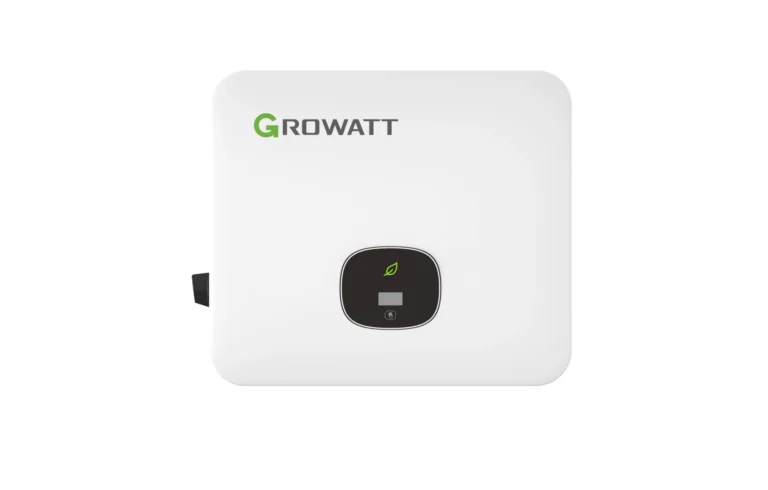
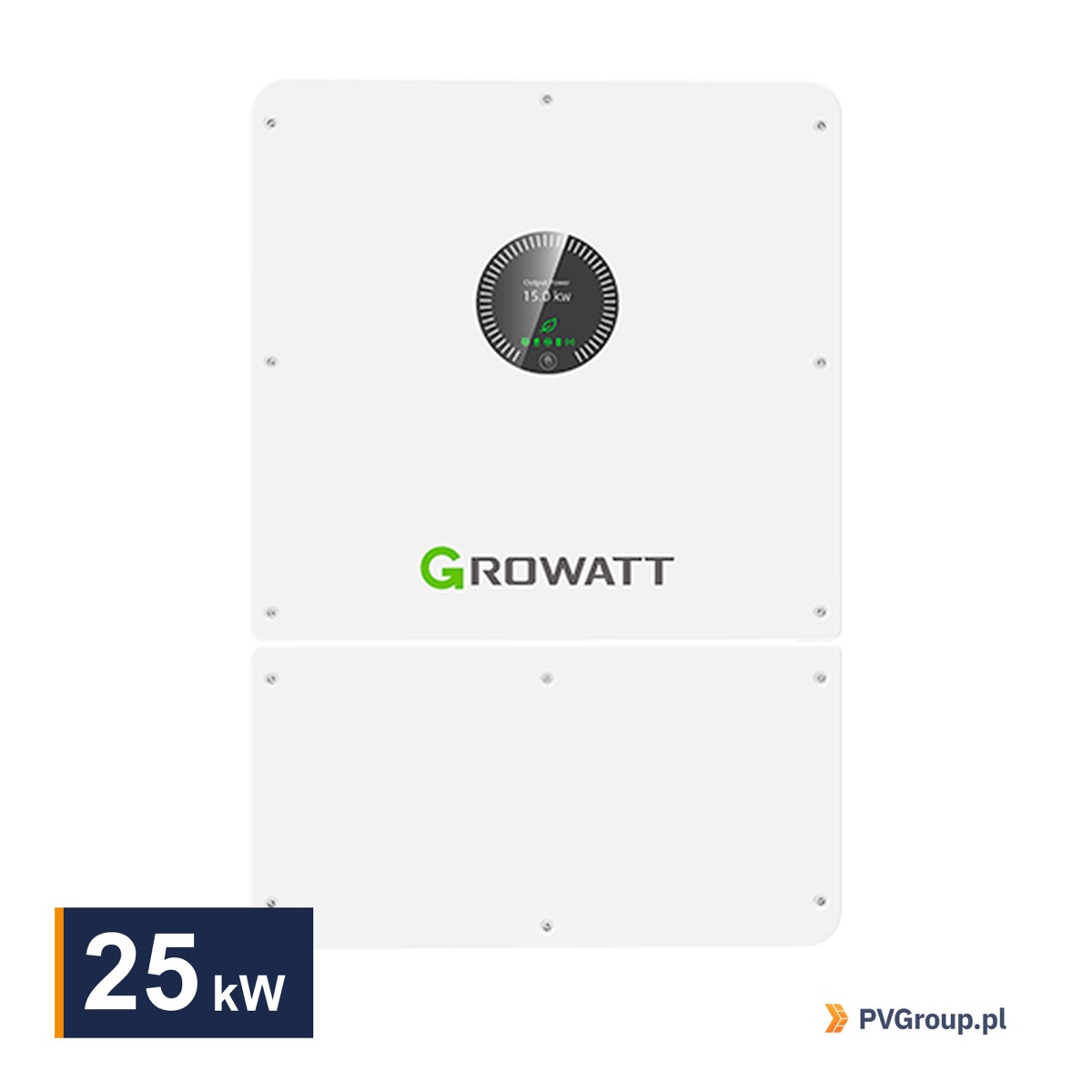
Growatt WIT 17-25K-HU are three-phase hybrid inverters for large homes and small commercial facilities where 15 kW is no longer enough. Growatt WIT The 17-25K-HU accepts a PV system with up to twice its output power—the 25 kW model can handle up to 50 kWp—and charges the storage system with up to 420 A, more than twice as much as the 4-15 kW series. It also features a UPS function and the ability to run the system off-grid. In practice, it's a home system with a heat pump, car charger, and workshop all on a single connection.
When 15 kW is not enough
The limit is found where several large consumers operate simultaneously. A heat pump with a heating capacity of 12 kW consumes 4-5 kW of electricity in winter, a car charger consumes 11 kW, and then there's the current consumption of the house. The total exceeds the capacity of a 15 kW unit during the hours when everything is running simultaneously. There's a fourth scenario: reserve for future expansion. Switching from 15 kW to 20 kW after two years means replacing the unit and a new procedure with the operator, so a reserve capacity purchased at the start can be the cheapest option.
The second indicator is the roof size. A 25-30 kWp installation on a building with a large roof or a carport won't fit a 15 kW inverter, even with permissible oversizing. Growatt WIT The 17-25K-HU solves this with a margin, as the maximum recommended power of the modules ranges from 34 kW for the 17 kW version to 50 kW for the 25 kW version.
The third case is a mixed-use development: a house with a commercial section, an agritourism farm, a workshop attached to the house, and a farm with a cold storage facility. In this case, the consumption profile is more even throughout the day, and the storage facility operates more intensively than in a typical single-family home.
Growatt WIT 17-25K-HU — parameters of the entire series
Some parameters are common to the entire series:
- two trackers MPPT two strings, maximum 40 A per tracker,
- MPP range 150-850 V, nominal voltage 625 V, maximum DC voltage 1000 V,
- maximum battery charging and discharging current 420 A,
- battery voltage 40-60 V, recommended 51,2 V, one battery input,
- Emergency exit overload twice for 10 seconds.
We have summarized the differences between the models in the table:
| Parameter | 17K-HU | 18K-HU | 20K-HU | 22K-HU | 25K-HU |
|---|---|---|---|---|---|
| AC output power | 17 kW | 18 kW | 20 kW | 22 kW | 25 kW |
| Max PV power (STC) | 34 kW | 36 kW | 40 kW | 44 kW | 50 kW |
| AC Input Power | 34 kW | 36 kW | 40 kW | 44 kW | 50 kW |
| Max apparent power output | 18,7 kVA | 19,8 kVA | 22 kVA | 24,2 kVA | 27,5 kVA |
| Emergency exit power | 17 kW | 18 kW | 20 kW | 22 kW | 25 kW |
| Max. emergency output current | 51,52 A | 54,55 A | 60,61 A | 66,67 A | 75,76 A |
| Warranty | 10 years | 10 years | 10 years | not specified in the card | 5 years |
Catalog cards and service manuals can be found in the manufacturer's download center.
Battery Current 420 A - What Does It Change?
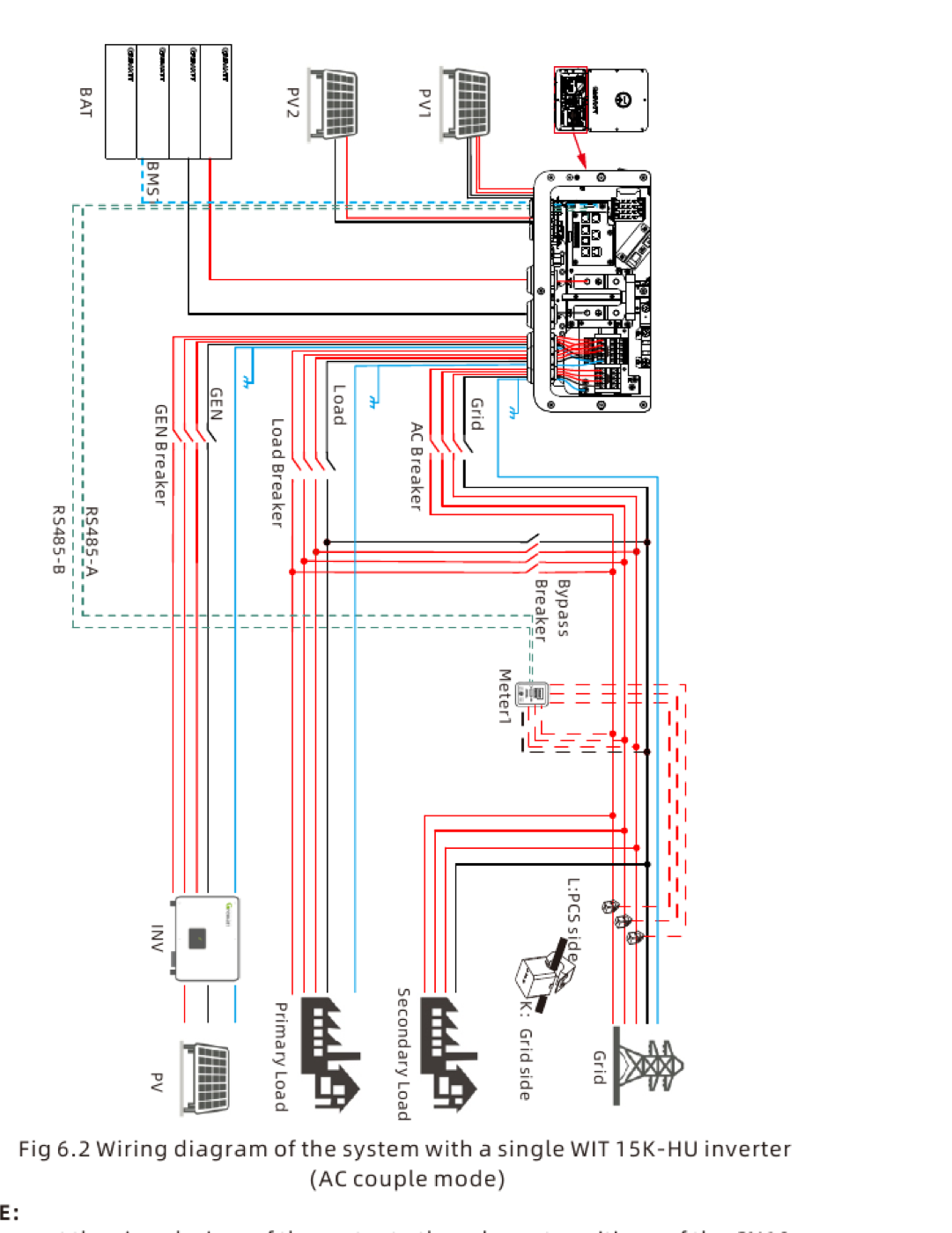
The permissible charging and discharging current of 420 A at an operating voltage of approximately 51,2 V corresponds to a power exceeding 21 kW. Growatt WIT The 17-25K-HU can therefore output practically its full rated power from storage, provided that the battery on the other side is capable of supplying such current.
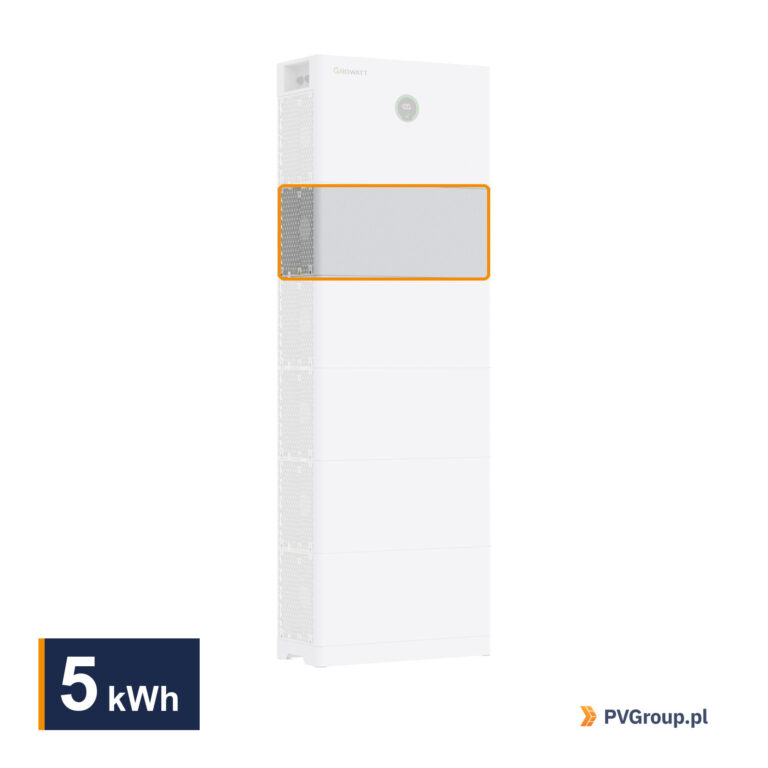
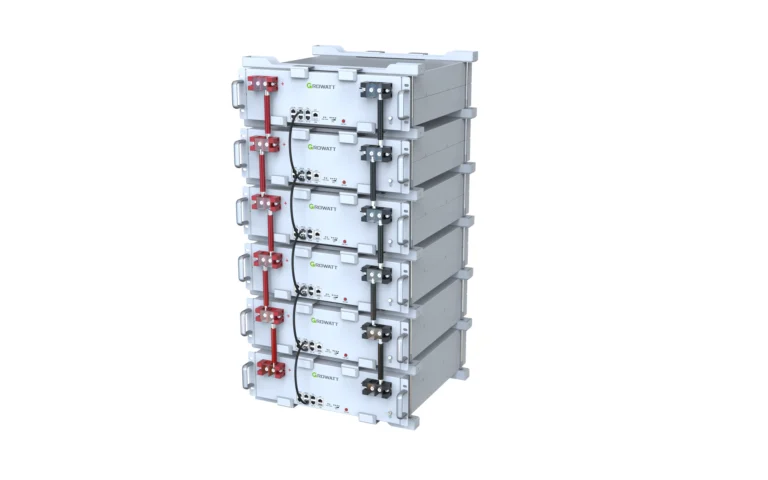
Single module HOPE The 14.3L-A1 operates at 140 A, while the 14.3L-R1 variant operates at 220 A. Therefore, utilizing the inverter's full capabilities requires three A1 modules or two R1 modules. This is important information when pricing: the inverter alone does not provide island power if the storage is minimally sized.
The reverse also works. A high charging current allows the storage to be filled during a short window of cheaper energy under dynamic tariffs. An AC input with twice the output power—up to 50 kW in the 25 kW model—provides a real advantage here, provided the connection has the appropriate contractual power.
Double power AC input works with dynamic tariffs. Growatt WIT The 17-25K-HU can draw up to 50 kW from the grid, so the storage is filled during the short window of the cheapest hours, and during peak prices the house runs on battery power. We show how to configure such a schedule in the article about mode Growatt Smart Scheduling, and the consumption limit is set so as not to exceed the contractual capacity of the connection.
UPS and system startup without network
The whole series WITThe HU is available as a hybrid inverter with a UPS function, and the 17-25 kW units also support off-grid startup. This second feature is important during longer outages: if the storage system discharges completely overnight, the PV system can restart on its own in the morning and restore battery power without waiting for the grid to return.
The emergency output in this series delivers full rated power, from 17 kW to 25 kW, with a two-times overload for 10 seconds. With the 25 kW model, this translates to a peak output of 50 kW, covering the start-up of virtually any household appliance, including larger farm engines.
Output voltage distortion is below 3% with full power linear load and rated voltage is 220/230/240V phase to neutral and 380/400/415V phase to phase.
Network side and connection restrictions
The inverter operates in 3P3W+PE and 3P4W+PE configurations, with a voltage range of -15% to +10% of the rated value and an operating frequency of 45-55 Hz and 55-65 Hz. The power factor at rated power exceeds 0,99, and power factor control covers the full range from -1 to +1. Current harmonic content remains below 3%.
The practical limitation is often not the inverter itself, but the connection itself. The conventional power of a typical single-family home rarely exceeds 14-20 kW, and pre-meter protection is sized accordingly. Growatt WIT The 17-25K-HU with an AC input of up to 50 kW can theoretically draw much more than the connection allows, so the charging power limit from the grid must be set consciously at the configuration stage.
An installation exceeding the micro-installation threshold requires a different formal procedure with the operator than a typical residential installation. This issue should be resolved before ordering the equipment, as connection conditions may impose limits on the power fed into the grid.
Growatt WIT 17-25K-HU and PV installation design
Two trackers MPPT Two strings each, with a limit of 40 A per tracker and a short circuit current of up to 50 A, define the design framework. With modern modules with an operating current of 13-14 A, two strings per tracker are within the limit without a margin for a third. Therefore, an installation spread over three or four slopes requires parallel connection of strings with similar parameters or switching to two smaller inverters.
The MPP voltage range from 150V to 850V is wide, but the full power range starts higher and moves with the model: from 425-750V in the 17kW version to 625-750V in the 25kW version. Growatt WIT The 17-25K-HU in its largest version therefore requires longer strings to maintain voltage within the full power window for most of the day. Short strings designed for a smaller inverter no longer fit after the model change.
The starting voltage is 180 V, and the maximum DC voltage is 1000 V. When designing the string length, the upper limit is set by the open-circuit voltage at the lowest expected temperature—in Polish conditions, calculated for approximately -20°C. Neglecting this correction can result in exceeding 1000 V on a frosty, sunny morning.
Growatt WIT 17-25K-HU and working and assembly conditions
Units in this series operate in a temperature range of -30°C to 60°C, with the manufacturer providing power reduction above 45°C. This is important when installing on a sunny, south-facing façade: on a hot day, the wall surface temperature can be significantly higher than the air temperature, and the unit then begins to reduce power precisely during peak production hours.
Cooling is forced, controlled depending on load. This means the use of fans, a component with a limited lifespan and audible in quiet environments. When mounting on a bedroom wall or near a terrace, it's worth considering this at the design stage, rather than after the first hot day.
Growatt WIT The 17-25K-HU has an IP66 rating, making it suitable for outdoor installation. The required maintenance clearances and the principle of avoiding direct sunlight remain the same as in the smaller series – the free space around the housing is responsible for heat dissipation.
With units of this size, the mechanical aspect also becomes increasingly important. A 25 kW device is heavier than a 10 kW home inverter, and hanging it on a bracket requires two people and a wall with adequate load-bearing capacity. The exact weight and dimensions are provided in the data sheet we keep at home. The procedure for hanging, connecting, and first start-up is common for the entire family—we described it in inverter installation guide WIT.
From the installer's practice
Check the contracted power before selecting an inverter. A customer with a 14 kW connection and a 25 kW inverter will receive equipment they won't use, and changing the contracted power is a separate procedure with the operator, with its own deadline and cost.
Choose a storage unit based on power, not just capacity. Growatt WIT The 17-25K-HU accepts 420A, but a single battery module will deliver a fraction of that. If the customer expects full island power, at least two or three modules are needed.
In practice, we often encounter questions about the difference in warranty within a series. For the 17 kW and 20 kW models, the manufacturer declares a 10-year warranty, while for the 25 kW version, the period is 5 years. The equipment is covered by a European service warranty, but this difference is significant when considering long-term pricing.
Design your distribution board for 75 A current. The emergency outlet on the 25 kW model provides more than 75 A per phase. The emergency section must be protected and sized for this rating, not for typical 25 A domestic circuits.
Documentation and certificates for the 17-25 kW series
We keep a complete set of documents for this series - it is useful when reporting the installation to the operator:
- Data sheet WIT 17-25K — parameters of all five powers.
- User manual — diagrams, configuration, service procedures.
- Certificate of Conformity for Poland — a document that the operator asks for when connecting.
It is worth downloading the certificate before submitting the application, not after the rejection – a complete application shortens the procedure by several weeks.
FAQ
How many PV modules will I connect to the 20 kW model?
The maximum recommended module power is 40 kWp, distributed across two trackers of two strings each, with a 40 A input current limit per tracker. For 450 W modules, this translates to nearly 88 units.
What batteries work with this series?
These are low voltage 51,2 V storages - HOPE 14.3L-A1 and modules from the same family. High-voltage batteries from the series APX i AXE 5.0H-E1 are intended for other inverters.
Is this inverter suitable for a single-family home?
Yes, if the house has a large PV system, a heat pump, and a car charger, and the connection allows for the use of the device's power. For a standard house with an installation up to 15 kWp, a unit from the 4-15 kW series is a better choice.
What is the difference between the HU series and the XHU series?
The 17-25K-HU models operate on 51,2 V low voltage batteries. The XHU series with a power of 30 kW and above uses high voltage storage AXE The 5.0H-E1 is a cabinet-mounted, industrial-grade device. A full comparison of both architectures can be found in the text. high voltage or low voltage inverter.
When to choose this series
- The PV installation exceeds 20 kWp or an expansion in this direction is planned.
- The house has a heat pump and a car charger that run at the same hours.
- The expected power on the emergency power supply exceeds 15 kW.
- The connection has a contractual power that allows the potential of the device to be used.
- The energy storage consists of at least two modules capable of delivering the required current.
We offer versions 20 kW and 25 kWWe can select the warehouse and check the connection limits together with our team. PVGroup.pl at the offer stage.