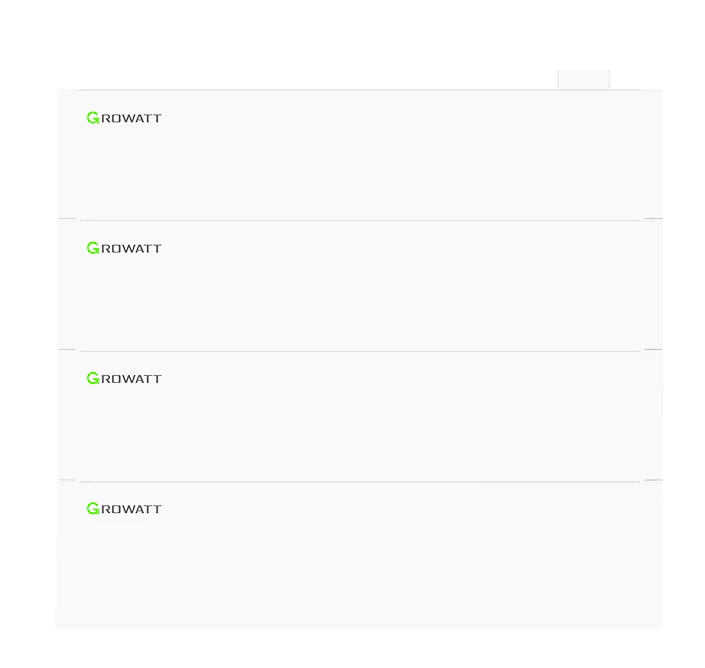
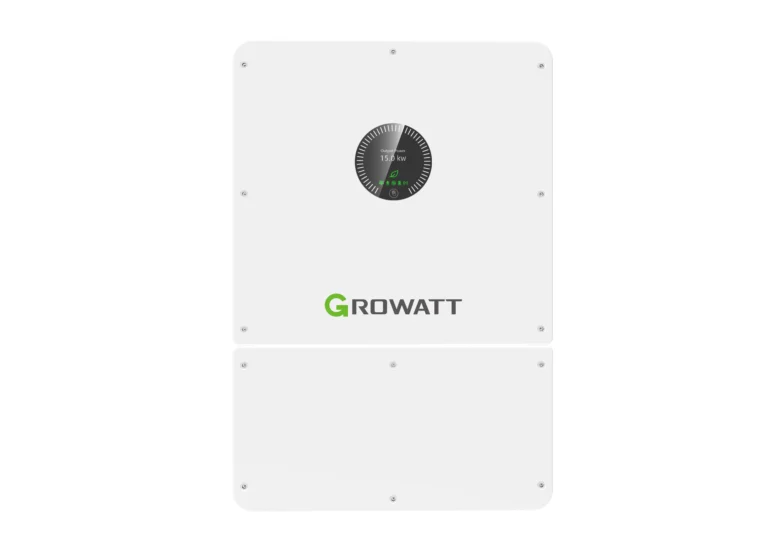
System Growatt NOAH 2000 You can expand by stacking modules up to three slave units, achieving a total capacity of up to 8192 Wh in a system with a NEXA 2000 master unit. In practice, this means that the customer starts with one module and then adds more without replacing the entire set. In this article, I show the difference Growatt NOAH 2000 from the NEXA 2000, how many modules you can realistically connect, what capacity and PV power you'll achieve in each configuration, and what proper commissioning looks like in a master-slave configuration. I'm basing this information on the manufacturer's whitepaper on stacking both devices, so you can advise the end customer with specifics, not guesswork.
Growatt NOAH 2000 vs NEXA 2000 - What's the Difference?
Both devices are balcony energy storage devices from the family Growattthat operate independently or integrate into a larger system. The key difference is the role in stacking and PV power. The NEXA 2000 supports higher PV input power on the master module and allows for connecting up to 4 panels, while Growatt NOAH 2000 works well as both a master and slave unit, with a PV limit of 1800 W.
In a combined system, one device acts as the master and the other as the slave. The master role can be performed by either the NEXA 2000 or NOAH 2000, and a subordinate role — NOAH 2000 or the EBM (Expansion Battery Module for NEXA 2000). This gives the installer several ready-made selection scenarios depending on what the customer needs: more charging power, features off-grid or simply larger capacity.
| Parameter | NEXA 2000 (master) | NOAH 2000 (master/slave) |
|---|---|---|
| Max. PV module power | 2600 W | 1800 W |
| Number of PV panels | to 4 | to 4 |
| Feature off-grid | so | |
| Cell chemistry | LiFePO4 | LiFePO4 |
How module stacking works Growatt NOAH 2000
Stacking in the balcony family Growatt involves connecting a master unit to slave units, which act as capacity expansion. The maximum number of connected units is three, and the master unit always controls the operating mode. The slave unit only handles charging and discharging according to the master's commands—it has no control logic of its own.
The manufacturer provides four basic combinations for a two-device system with a capacity of 4096 Wh. The table below shows the differences in PV power and maximum charging power, which directly affects how quickly the system recharges.
| Master Degrees | Slave | Capacity | PV master | PV slave | Max charge (AC+PV) |
|---|---|---|---|---|---|
| NEXA 2000 | EBM | 4096 Wh | 2600 W | 0 | 3300 W |
| NOAH 2000 | EBM | 4096 Wh | 1800 W | 0 | 1800 W |
| NOAH 2000 | NOAH 2000 | 4096 Wh | 1800 W | 1800 W | 3600 W |
| NEXA 2000 | NOAH 2000 | 4096 Wh | 2600 W | 1800 W | 4000 W |
The table shows a simple relationship: if the customer cares about maximum charging power, the best option is the NEXA 2000 set with the module NOAH 2000 as a slave, where you connect the panels to both units. A set of two modules Growatt NOAH 2000 gives lower charging power than the NEXA variant, but still allows you to use PV on both devices.
Maximum configuration: 1× NEXA 2000 + 3× NOAH 2000
The largest system provided by the manufacturer is one NEXA 2000 paired with three modules Growatt NOAH 2000This setup achieves a maximum system capacity of 8192 Wh. The NEXA 2000 accepts up to 2600 W of PV power and up to 4 panels, each NOAH 2000 another 1800 W and also up to 4 panels.
In practice, this means that the entire system supports a maximum of 16 solar panels with a total PV power of up to 8000 W. This is no longer a typical balcony installation for a single panel – this arrangement allows for covering a much larger portion of the auto consumption in a single-family home without interfering with the distribution board.
Master-slave configuration step by step
Properly executing stacking relies on a few simple rules. Before you begin installation, it's good to remember them: the slave always follows the master, and the installer controls the entire system through the master unit.
- Starting and shutting down: The slave starts and stops with the master. You only turn on the master unit, and the slave starts automatically. To shut down the system, turn off the master unit—the slave unit will shut down on its own.
- control: You set the operating mode on the master unit. The slave unit only performs charging and discharging.
- Firmware update: The slave updates together with the master and adopts the same software version automatically.
- Feature off-grid: even when NOAH 2000 works as an expansion module, NEXA 2000 retains full functionality off-gridMaximum port power off-grid remains unchanged and only grows completelywitand capacity.
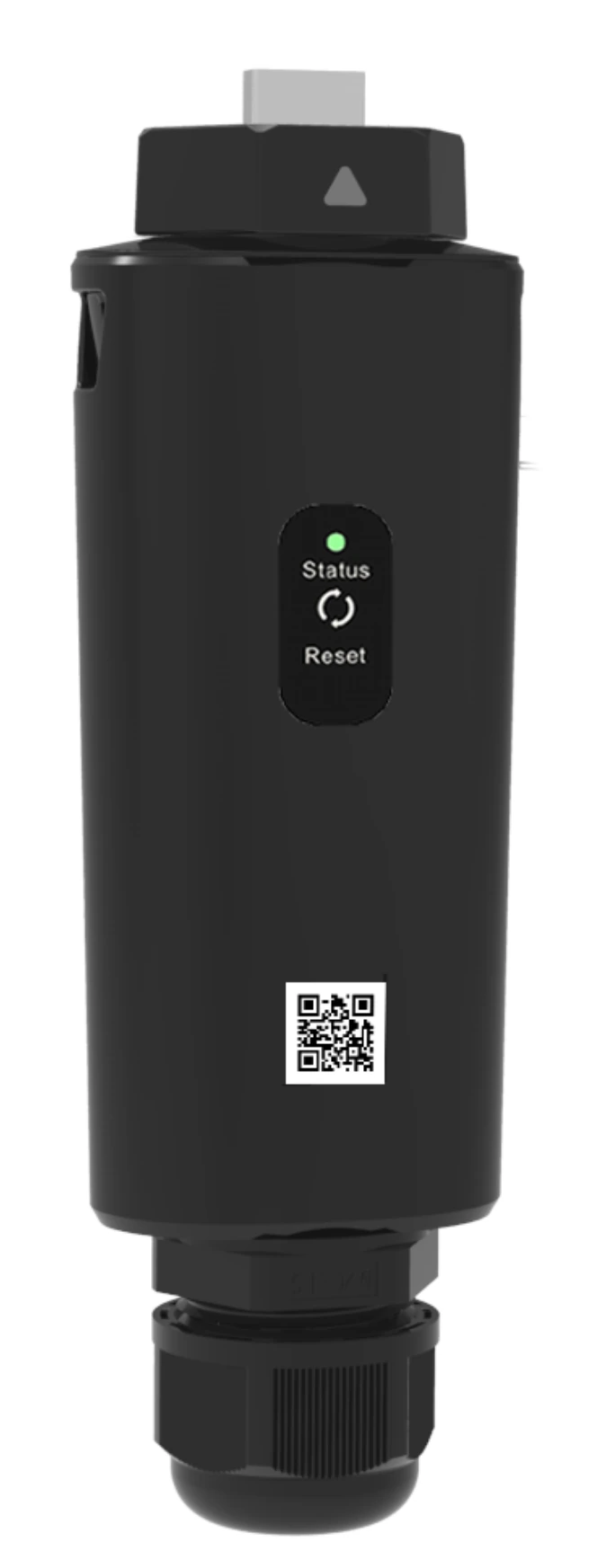
- Preview in the app: w Shinephone Click the master icon to view the serial numbers of connected devices, as well as the individual SOC and temperature of each module. Fault notifications appear next to the bell icon.
Growatt NOAH 2000 as a slave - what to remember
Several manufacturer limitations are so significant that ignoring them will result in a malfunctioning system. Growatt NOAH 2000 has deliberately limited functionality because it acts as an expansion battery and not as a standalone device.
- Slave NOAH 2000 cannot be connected to the network (networking). If it was previously connected, reset it by holding the IOT button for 6 seconds.
- Slave Outputs NOAH must not be connected to a microinverter for discharge. The slave serves only as an expansion of stacking capacity.
- Connect PV panels to the master first NOAH 2000, and you connect the slave as needed. If the panels are only supplied to the slave, the master may not fully charge – its SOC will reach at least 97%, but the last 3% may remain unfilled.
When NOAH, and when NEXA — customer-specific selection
Choosing between a configuration based on NOAH and the one from NEXA 2000 depends mainly on whether the client needs the work off-grid and high charging power. Experience has shown that when advising on balcony installations, a simple division works:
- Simple balcony installation, one or two panels, self-consumption: single Growatt NOAH 2000 or a system of two modules NOAHPlug & Play, no electrician required, installation in 1-2 hours.
- The customer wants emergency power (off-grid): here the base must be NEXA 2000, and NOAH 2000 you add as capacity expansion - port off-grid retains its power.
- Priority for fast charging from PV and the grid: NEXA 2000 + set NOAH 2000 achieves up to 4000W of AC+PV charging power, the most of all combinations.
- Maximum capacity for a larger home: 1× NEXA 2000 + 3× NOAH 2000, i.e. 8192 Wh and up to 16 panels.
Module Growatt NOAH 2000 you will find in our offer - check the product card Battery NOAH 2000 or an entire category energy storage. For balcony micro-installations, it combines well with a micro-inverter. Growatt NEO 800W.
From the installer's practice
A few things that will save you customer calls after launch:
- Don't forget to reset the slave before stacking. If the module NOAH The 2000 was previously used independently and connected to the network. In a slave system, it will begin to "fight" for a role. Holding the IOT button for 6 seconds immediately resolves the issue.
- Panels always on master first. A common mistake is to connect the PV system exclusively to the slave system because it's more convenient to wire it. The result is a master system that stalls at 97% SOC. The customer sees "incomplete charging" and files a complaint, even though the system is operating according to specifications.
- Explain the shutdown logic to the customer. In many cases, the user tries to disable the slave separately and is surprised that nothing happens. You operate the entire system through the master—this is one of the first things to show upon commissioning.
- Check the monitoring in Shinephone immediately. Once paired, it's worth clicking the master icon and confirming that all serial numbers, SOC values, and temperatures of the connected modules are visible. This proves that stacking has started correctly.
FAQ
How many modules Growatt NOAH Can 2000 be combined into one system?
The maximum number of connected units is 3. In the largest configuration, one NEXA 2000 works with three modules Growatt NOAH 2000, giving a total capacity of 8192 Wh and support for up to 16 panels with a PV power of up to 8000 W.
Are there two modules? NOAH Can 2000 be connected without NEXA 2000?
Yes. The manufacturer provides a combination NOAH 2000 (master) + NOAH 2000 (slave) with a capacity of 4096 Wh, with a PV power of 1800 W on each module and a maximum charging power of 3600 W. Off-grid is not available in this system, because this function is only provided by NEXA 2000.
Is it a slave? NOAH 2000 can be connected to a microinverter?
No. The slave unit's output cannot power a microinverter. The slave unit is intended solely as a stacking capacity extension and must not be connected to the grid.
A practical checklist before starting stacking
- Establish master and slave roles — off-grid requires NEXA 2000 as master.
- Reset slave NOAH 2000 (IOT 6 s) if it was previously connected to the network.
- Connect the PV panels first to the master, then optionally to the slave.
- Turn on only the master and check the automatic start of the slave.
- Verify in Shinephone serial numbers, SOC and module temperatures.
- Show the customer that the entire system is shut down by the master.
You can download full technical documentation, catalog cards and instructions from download center GrowattIf you are selecting a set for a specific client, the module Growatt NOAH 2000 you order from us as an authorized distributor Growatt, with a VAT invoice and a European manufacturer's service warranty.