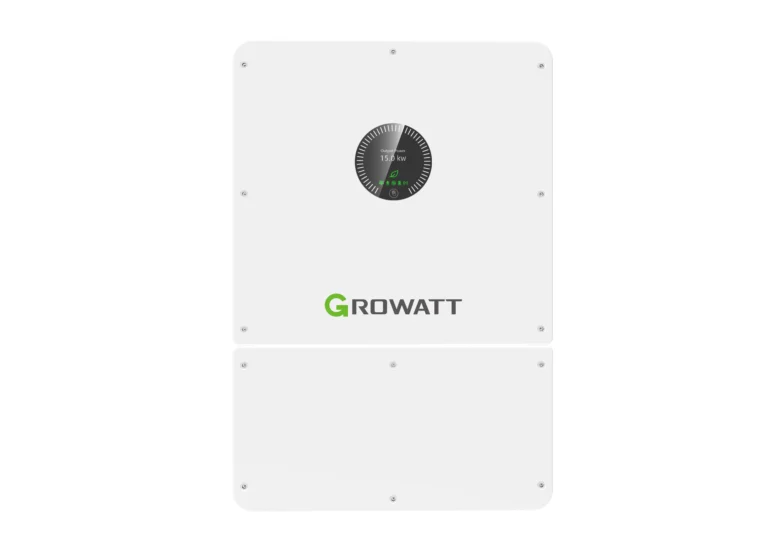
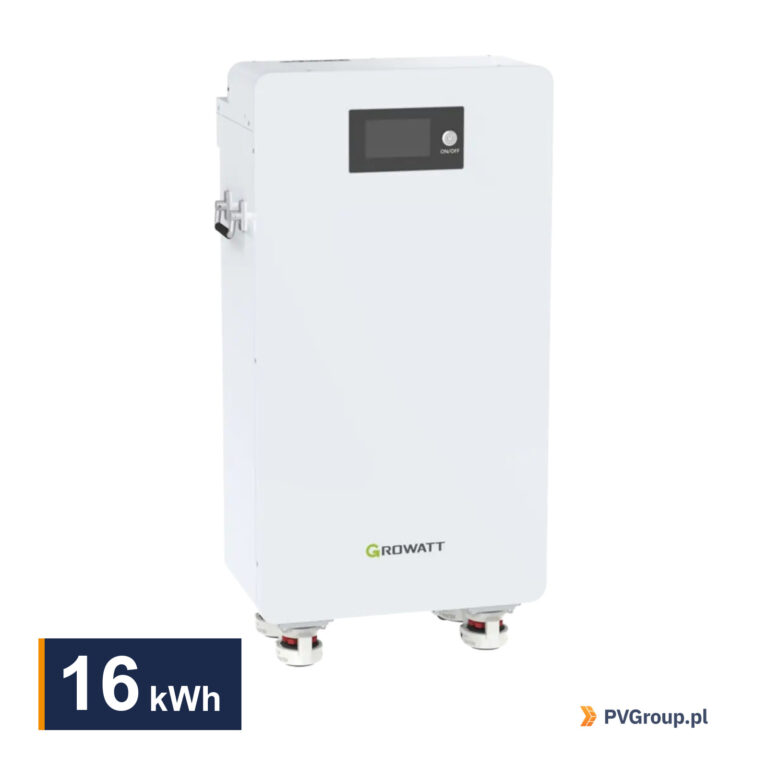
Growatt HOPE 14.3L-A1 is a wall-mounted LiFePO4 energy storage device with a nominal capacity of 14,3 kWh and useful 13,3 kWh, designed for low voltage 51,2 V inverters, including the entire three-phase series WIT-HU. Growatt HOPE 14.3L-A1 operates with a charge and discharge current of 140 A, withstands over 6000 cycles and can be connected in parallel up to 48 pieces, which allows you to build a system with a capacity of 686,4 kWhIn practice, this is a module for a home that requires one large storage unit instead of several smaller units. Below, we explain what each parameter means for the facility.
Growatt HOPE 14.3L-A1 Full Specifications
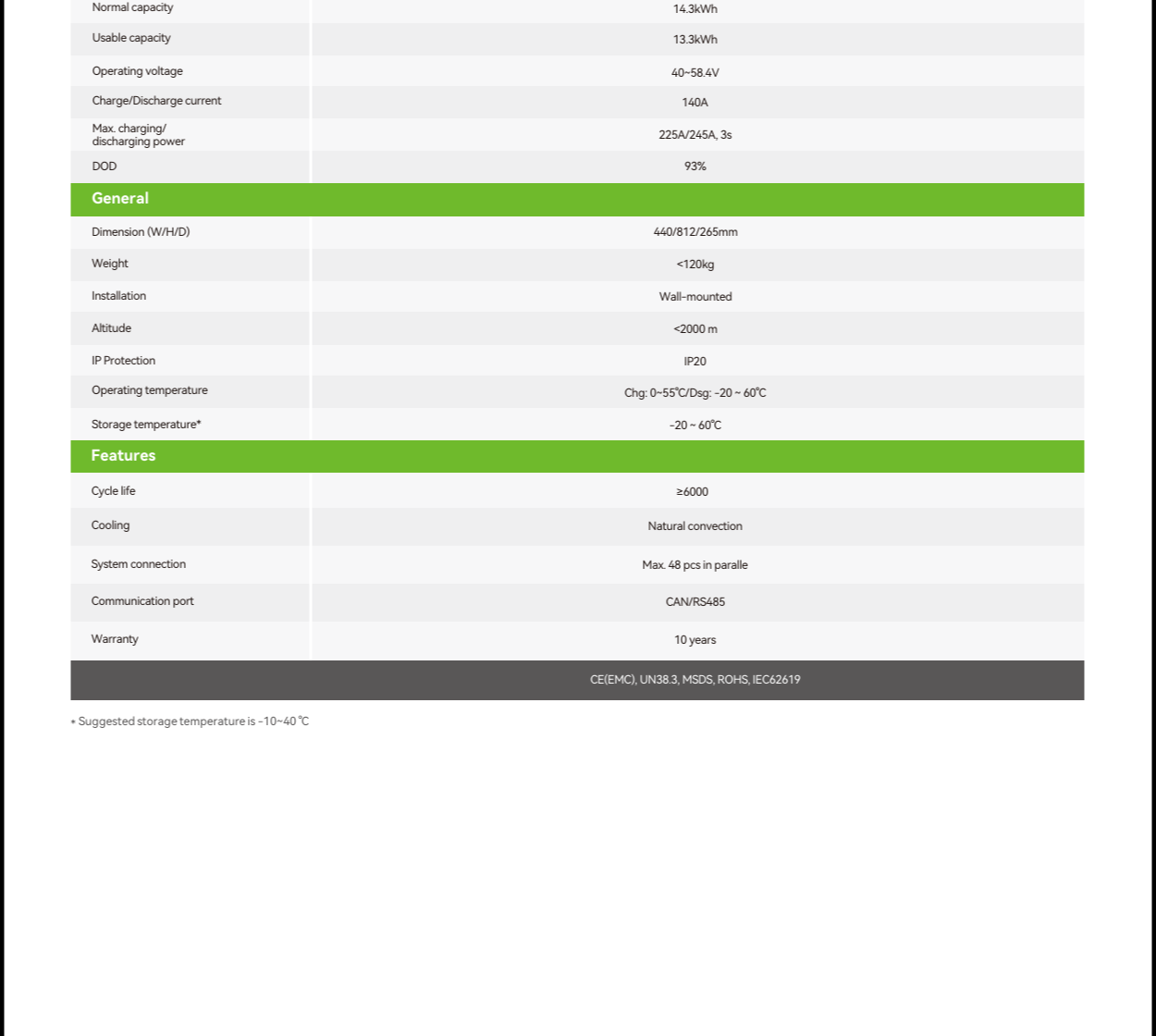
The module is built around lithium iron phosphate cells with a nominal voltage of 51,2 V and an operating range of 40 V to 58,4 V. Cooling is achieved by natural convection, without fans, eliminating noise and typical wear and tear. Communication with the inverter is via CAN or RS485.
| Parameter | Value |
|---|---|
| Cell type | LiFePO4 |
| Rated voltage | 51,2 V |
| Operating voltage range | 40 58,4-V |
| Nominal capacity | 14,3 kWh |
| Usable capacity | 13,3 kWh |
| Depth of Discharge (DOD) | 93 % |
| Charging and discharging current | 140 A |
| Peak power (3 s) | 225 A / 245 A |
| Cyclic life | over 6000 cycles |
| Dimensions (width/height/depth) | 440 / 812 / mm 265 |
| Mass | less than 120 kg |
| Mounting method | wall |
| Level of security | IP20K |
| Cooling | natural convection |
| Charging temperature | 0-55 °C |
| Discharge temperature | -20-60 ° C |
| The amount of work | up to 2000 m above sea level |
| Parallel connection | up to 48 pieces (686,4 kWh) |
| Communication | CAN / RS485 |
| Warranty | 10 years |
| Certifications | CE (EMC), UN38.3, MSDS, RoHS, IEC 62619 |
You can download the manufacturer's version of the catalog card from download center Growatt.
What do these numbers mean on the object?
The difference between 14,3 kWh to 13,3 kWh results from a depth of discharge of 93%. Always provide the customer with the usable value, because it translates into energy available in the evening. A house consuming 12 kWh between sunset and sunrise will cover this need with one module, with a small margin for capacity decline in the following years.
A current of 140 A at an operating voltage of approximately 51,2 V corresponds to a power of about 7,2 kW. This is the upper limit of continuous consumption from a single module. Growatt HOPE 14.3L-A1. If a house has peaks of 10 kW, one module won't cover them, and the inverter will draw the remaining power from the grid. The solution is a second module in parallel, or a conscious decision to keep the peaks on the grid.
The allowable current of 225 A and 245 A for 3 seconds is a reserve for starting. Induction motors—heat pump compressors, submersible pumps, and compressors—draw a multiple of their rated current for a fraction of a second upon startup. This parameter determines whether the device will start on emergency power or whether the protection will trip.
The claimed 6000+ cycles, with one full cycle per day, translates to over 16 years of operation. In reality, a home storage facility rarely completes a full cycle every day, so the calendar life becomes a limitation sooner than the cycle life.
Wall mounting: load capacity, location and temperature
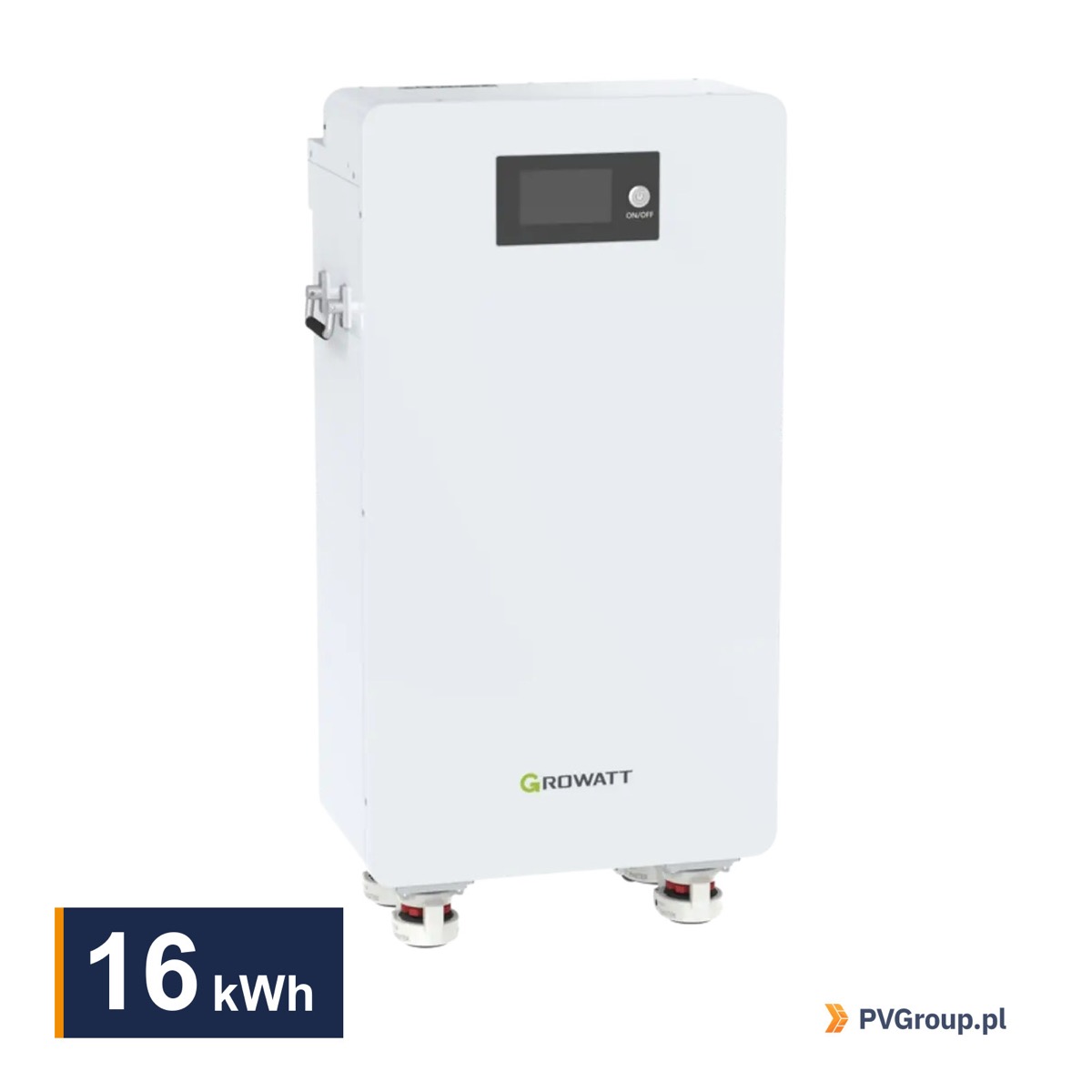
A weight of less than 120 kg with dimensions of 440/812/265 mm means the load is concentrated on a small wall surface. A load-bearing brick or concrete wall will easily accommodate this weight. A plasterboard partition wall is out of the question – in such a case, you must choose a freestanding module or build a supporting structure resting on the floor.
The IP20 protection class precludes installation outdoors or in dusty or humid rooms. Growatt HOPE The 14.3L-A1 requires a dry technical room, boiler room, or garage with heating. Convection cooling requires a certain amount of free space around the housing so that heat can flow upward.
The temperature range separates charging from discharging: charging can occur from 0°C to 55°C, and discharging from -20°C to 60°C. An unheated garage can drop below freezing in January, and then the storage unit will release energy but not receive it from the PV system. The customer perceives this as a malfunctioning storage unit and calls to complain, even though the equipment is operating according to specifications. A simple example: at -5°C in the garage, the storage unit will release stored energy in the evening, but in the morning it won't receive any from the roof until the cell temperature returns above freezing. Therefore, in unheated rooms, plan for space in a heated section at the design stage.
Growatt HOPE 14.3L-A1 and variant 14.3L-R1
Both units have the same nominal capacity of 14,3 kWh and useful 13,3 kWh, but they differ in several parameters that influence the selection.
| Parameter | HOPE 14.3L-A1 | HOPE 14.3L-R1 |
|---|---|---|
| Charging and discharging current | 140 A | 220 A |
| Peak current | 225 A / 245 A for 3 sec | 700 A for 200 µs |
| Discharge depth | 93 % | 90 % |
| Cyclic life | over 6000 | 8000 (0,5 C, 80% DOD, 25°C) |
| Dimensions (width/height/depth) | 440 / 812 / mm 265 | 478 / 812 / mm 265 |
| Assembly | wall | wall or floor |
| Discharge temperature | -20-60 ° C | -20-55 ° C |
| Warranty | 10 years | 5 or 10 years |
The R1 version wins where high instantaneous power is needed with one module - for example, with a 12 or 15 kW inverter, where the permissible battery current reaches 250-290 A. The A1 variant works well with 4-10 kW units, where the inverter current does not exceed 220 A anyway, and the higher depth of discharge gives slightly more usable energy.
Expansion and parallel operation
The manufacturer allows the connection of up to 48 modules, which gives a maximum of 686,4 kWhIn a single-family home, the practical limit is two, or less often three, modules—after that, the limit is not the battery, but the permissible inverter current. Model WIT 15K-HU accepts up to 290 A, so two modules Growatt HOPE The 14.3L-A1 at 140A uses this limit almost exactly.
For parallel operation, modules must be from the same series. Combining the A1 variant with the R1 or with modules of different capacity leads to uneven loading and shortens the life of the smaller unit. If the customer plans to expand in two years, record the exact model and software version in the as-built documentation so that a compatible module can be purchased.
Adding a new module to a working system requires equalizing the charge level. A brand-new module typically arrives charged to about half its capacity, while a set that has been in operation for two years has a different charge level. Practice shows that the modules must be brought to a similar charge level before their first combined cycle—otherwise, the system will trigger an alarm at the first deeper discharge.
With two modules, the current also increases. The combined 280 A fully covers the model's 250 A limit. WIT 12K-HU and almost exactly the 290A limit of the 15K-HU model. Before adding a third module, check the inverter card to see if the device can accept this current - the inverter simply won't use anything above the limit.
Growatt HOPE 14.3L-A1 in monitoring and operation
Once activated, the storage reports the state of charge, cell temperature, and current power to the manufacturer's app—in the ecosystem Growatt it is ShinePhone, to which the installation is connected via the inverter's communication module. Data from the battery module is sent to the inverter via CAN or RS485, and only then does the inverter transmit it. A lack of communication with the server does not stop the warehouse's operation, but it does remove the possibility of remote diagnostics.
Monitoring the installation is part of the acceptance process, not an add-on. The customer receives an overview of production and warehouse status, and the installer can verify the report without leaving the building. In the case of a capacity complaint, the historical record is the only reliable evidence, as Growatt HOPE 14.3L-A1 worked in the following months.
Growatt HOPE 14.3L-A1 belongs to the low voltage 51,2 V family. How this architecture differs from high voltage towers and when which one wins, we explain in the comparison high voltage or low voltage inverter.
In winter operation, separating temperature thresholds is more important than it may seem at the bid stage. Charging is permitted from 0°C, and discharging from -20°C. In an unheated room, the storage facility will therefore release energy in the evening but will not accept any surplus from the PV system in the morning. This symptom appears to be a malfunction, but it is in line with the specifications. The manufacturer recommends storage between -10°C and 40°C, which also provides a good indication of reasonable operating conditions.
A warehouse of this size works well with dynamic tariffs. A 140A charging current can handle about 7 kW, so a full charge takes about two hours—which is within the typical cheapest price window. We described how to set up a charging schedule for hourly pricing in our article about mode Growatt Smart Scheduling.
The claimed 6000+ cycles and 10-year warranty are two different parameters that should not be confused. Cycles describe the wear and tear of the cells during full charge and discharge, while the warranty period is calculated on a calendar basis. With a typical home battery profile, where the storage facility performs one cycle per day, the calendar warranty will expire first. The equipment is covered by a European service warranty.
From the installer's practice
Plan the wall for the target number of modules. Growatt HOPE 14.3L-A1 allows for up to 48 units to be connected, but customers typically start with just one. Leave a free space next to it, the width of the next module, and run the cable route with extra space, rather than having to break down the walls after two years.
Don't place the storage unit close to the floor in a flooded room. Boiler rooms with a drain can be flooded if the water system fails. Wall mounting at the appropriate height protects IP20-rated equipment from the most common cause of damage.
In practice, we often find ourselves ordering just the battery without checking whether the inverter has a free DC input and the correct software version. WIT-HU has one battery input, so expansion is done by connecting modules in parallel, not through another port.
Agree with the client on a realistic maintenance time. At 13,3 kWh At a useful load of 2 kW, the storage capacity lasts for approximately 6-7 hours. With the heat pump operating in winter, this time is reduced to 2-3 hours. A specific number at the offer stage prevents disappointment after the first extended network outage.
Catalog card and related documents
The data in this article comes directly from the catalog card, which we keep together with the documentation of related variants:
- HOPE 14.3L-A1 - datasheet with a full table of parameters.
- HOPE 14.3L-R1 — variant with a current of 220 A and a higher cyclic life.
- HOPE 16.0LM-A1 — freestanding unit 16 kWhwhen a wall is not an option.
When ordering, it is worth comparing the revision date of the card with the year of the delivered module - the manufacturer updates the parameters between versions, and the differences most often concern the currents and the declared number of cycles.
FAQ
Which inverters is it suitable for? Growatt HOPE 14.3L-A1?
For low voltage devices 51,2 V - three phase series WIT-HU and inverters SPF, SPM and SPE. Does not work with high-voltage systems that use batteries of the series APX and/ or AXE 5.0H-E1.
How much energy will this module actually produce?
The usable capacity is 13,3 kWh at a depth of discharge of 93%. With a typical home consumption profile, this covers the entire night and morning in a home without electric heating.
Can the module be installed in an unheated garage?
Discharging works from -20°C, but charging only from 0°C. In an unheated room, the storage system will stop charging from the PV system in winter. A room with a positive temperature year-round is a better choice.
How long is the warranty?
The manufacturer promises a 10-year European service warranty. The declared cycle life exceeds 6000 cycles.
When to choose this module
- The house needs 10-14 kWh evening-night energy and does not plan to charge the car from the warehouse.
- A load-bearing wall is available in a dry, heated room.
- The inverter belongs to the series WIT-HU or to the family SPF, SPM or SPE.
- The peak power does not exceed about 7 kW with one module, otherwise anticipate a second module or variant R1.
- The customer expects one device instead of a set of smaller units connected by cables.
If the capacity needed is beyond 14,3 kWh, in the same family is available free-standing module 16 kWhWe have collected a full selection of low voltage storage units in energy storage department, and the selection for a specific inverter will be handled by the team PVGroup.pl.