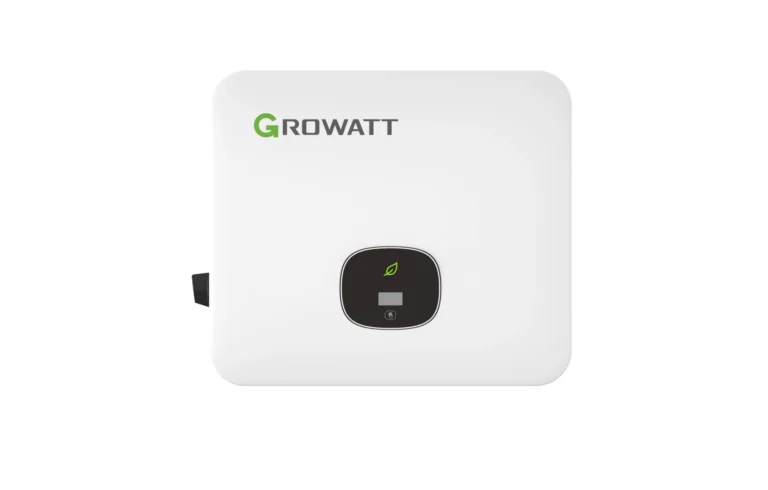
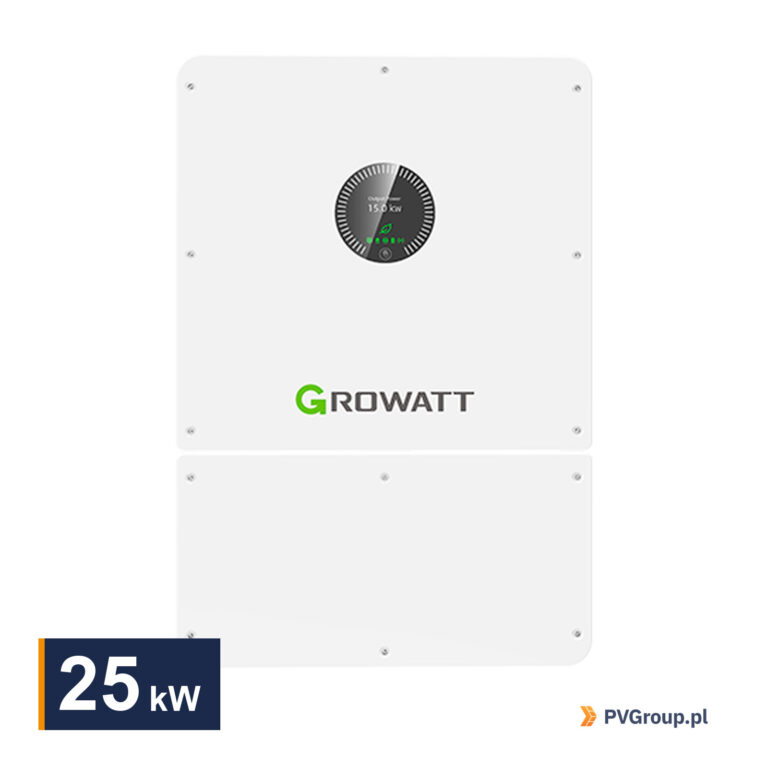
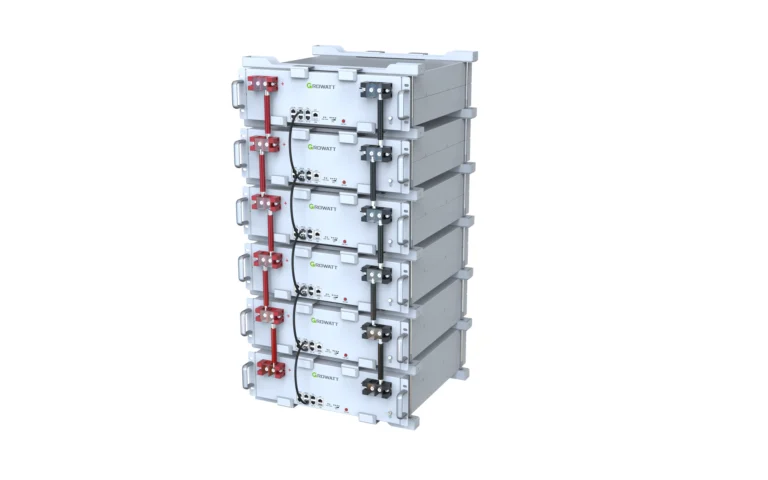
Growatt APX HV 2.0 is the second generation of high-voltage energy storage Growatta, designated in the catalogue as APX 5.0-30.0M-S3. The biggest change isn't in the cells or capacity, but in what's gone from the shopping list: a separate box. BMS and cables between modules. This post shows what exactly has changed and how to select modules.
Three changes that you can see in your order
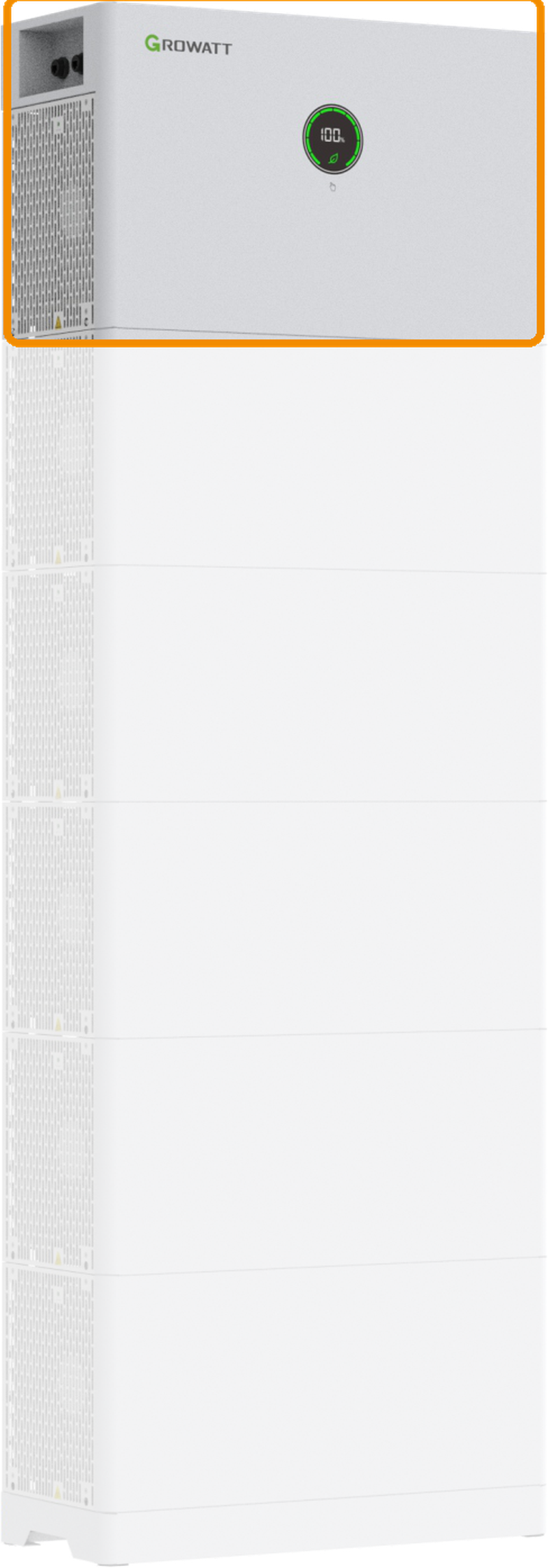
Growatt APX HV 2.0 is built from two types of items: master module APX 5.0M-B3 and battery modules APX 5.0P-B3The previous generation required three: modules APX 5.0P-B1, separate control unit APX 98034-P2 and a set of cascading cables. The difference comes from the electronics being moved inside one of the modules.
| System element | APX first generation | Growatt APX HV 2.0 |
|---|---|---|
| Module with capacity | APX 5.0P-B1 | APX 5.0P-B3 |
| Control and BMS | separate module APX 98034-P2 | in the master module APX 5.0M-B3 |
| The basis of the system | separate item | complete with master module |
| Wiring between modules | cascade cables | contact connection, no cables |
| Number of items in the order | three kinds | two kinds |
The practical consequence is simpler than it looks: Growatt APX HV 2.0 doesn't allow you to just order battery modules and expect the system to boot. Master Module APX The 5.0M-B3 is mandatory because it houses the battery management system, DC disconnect switch, start button, and inverter communication. It also stores 5 kWh, so it's not just a driver.
One master module for single- and three-phase installations
The second change is less visible, but more important for wholesalers: the same master module supports both single-phase and three-phase installations. Until recently, warehouse selection began with a question about the number of phases, as this determined the catalog number. Growatt APX HV 2.0 the difference comes down to operating parameters, not to another product.
In a single-phase system, the nominal system voltage is 400 V with an operating range of 350-550 V, and the maximum system power reaches 10 kW. In a three-phase system, the corresponding voltage is 750 V, with an operating range of 660-980 V, and 15 kW. For the installer, this means one thing: a storage unit purchased for a single-phase home does not become unusable after the installation is expanded to three-phase.
How many modules and what power does it produce?
The system consists of one master module and zero to five battery modules in a single column. Each module is 5 kWh capacity and 2,5 kW of charging and discharging power, up to the ceiling set by the master electronics.
| Configuration | Capacity | Three-phase power | Height | Mass |
|---|---|---|---|---|
| the master himself | 5 kWh | 2,5 kW | 425 mm | 53,2 kg |
| master + 1 module | 10 kWh | 5 kW | 690 mm | 98,2 kg |
| master + 2 modules | 15 kWh | 7,5 kW | 955 mm | 143,2 kg |
| master + 3 modules | 20 kWh | 10 kW | 1220 mm | 188,2 kg |
| master + 4 modules | 25 kWh | 12,5 kW | 1485 mm | 233,2 kg |
| master + 5 modules | 30 kWh | 15 kW | 1750 mm | 278,2 kg |
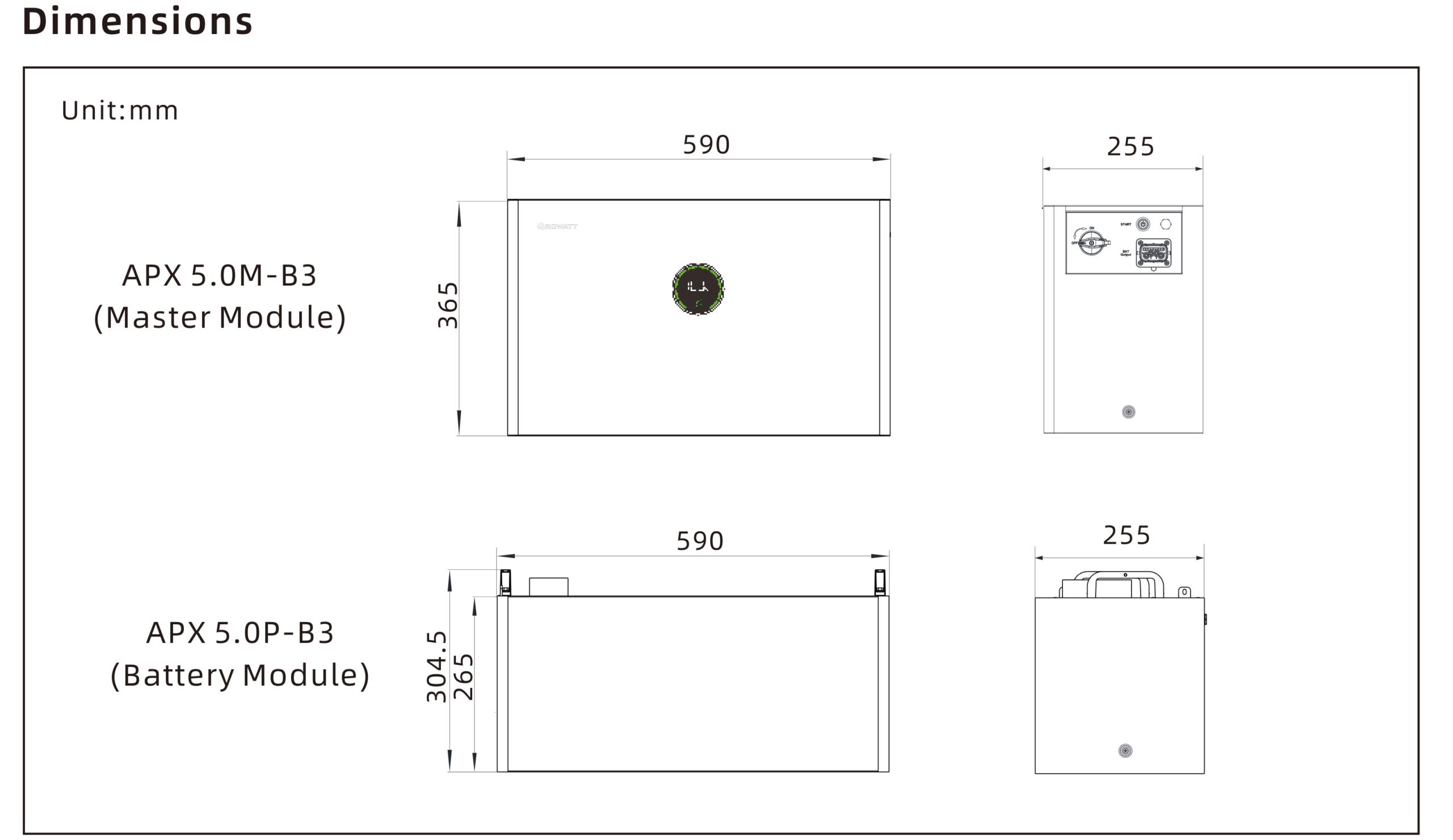
The width and depth are fixed at 590 mm and 255 mm, regardless of the number of modules. The dimensions in the table include the base. Above 30 kWh a second column is built with its own master module — Growatt APX HV 2.0 supports cascade of up to three systems communicating via CAN bus.
A selection rule worth remembering: power and capacity are one factor in this architecture. You can't buy a small storage unit with high backup power. If you want 10 kW in emergency mode, you need at least 20 kWh capacity.
Which inverters is it suitable for? Growatt APX HV 2.0
The installation manual lists three families of inverters Growatt: three-phase MOD 3-15KTL3-HU, three-phase MID 29.9-50K-HU and single-phase MIN-XH2 in the version with an RJ45 port. Communication with the inverter is via the RS485 or CAN bus.
This is where the trap lies, and it costs the most. Older series with the XH ending — MOD TL3-XH BP and MID 17-30KTL3-XH - work with modules APX 5.0P-B1 and require a separate control module APX 98034-P2. The B3 module added to such an installation will not work, because there is simply no control in the module. The letter after the dash in the inverter name determines the battery generation: HU means Growatt APX HV 2.0, XH first generation.
From the installer's practice
Two things you won't find in the manufacturer's documentation that will change the labor quote.
The latches close without tools, and assembling the speaker is quick and intuitive. This is our observation from the hardware, not the manufacturer's claim. The modules are stacked and screwed together sideways, without running any cables between them. In the B1 generation, the same installation required cascading cables and a separate box—three places where confusion was possible.
Weight is a separate issue from the difficulty of assembly. The battery module weighs 45 kg, the master 51 kg – both positions are two-person, although the module itself is quick to attach. With a full column, 30 kWh We're talking about 278,2 kg, and this figure must be compared with the load-bearing capacity of the ceiling or wall before deciding on the installation location. For wall installation, the manufacturer requires confirmation of the wall's load-bearing capacity for the weight of the entire system and recommends floor installation.
There's also a detail that surprises upon initial assembly: the master module sits at the very top of the speaker, even though it arrives factory-assembled to the base. For the first upgrade, the base is unscrewed from the master module with three screws and placed at the bottom.
Working conditions and assembly
The system has an IP66 protection rating and operates in a temperature range of -20°C to +55°C thanks to the standard heating foil. Cooling is natural, without fans. Despite its tightness rating, outdoor installation requires a roof to protect against direct sunlight and rain.
The battery should be mounted below the inverter or near its air intake—mounting near the air outlet is prohibited as it reduces the storage's power output. Service clearances are at least 300 mm from the sides. The manufacturer also recommends against installing a DC disconnect switch between the battery and the inverter; if required by facility regulations, the rated current must exceed 40 A, and switching under voltage is prohibited.
The cells are cobalt-free lithium iron phosphate cells, described in the datasheet as Cobalt Free Lithium Iron Phosphate. The manufacturer's warranty is 10 years.
What the catalog card doesn't say
To be fair: the revision 202607 datasheet doesn't include depth of discharge, round-trip efficiency, or declared cycle count. Nor does it provide the nominal voltage of an individual module or its charge and discharge currents—these values are for the system, not the brick.
If any of these numbers are a tender criterion, you must request them from the manufacturer. Transcription of these numbers from the first generation APX would be guesswork, and in energy storage, guesswork ends at construction.
Who is affected by this change?
For the installer who builds a warehouse from scratch, Growatt APX HV 2.0 primarily means a shorter shopping list and fewer opportunities for picking errors. Two items instead of three also means simpler pricing for the end customer.
For the owner of an existing installation, the situation is different, and it's worth stating this clearly: if you have an XH series inverter and a storage system based on B1 modules, the new generation is not an upgrade path for you. You add modules of the same generation as the existing ones, not newer ones. The new architecture comes into play with a new inverter with the HU suffix.
For wholesalers and integrators, phase versatility is paramount – one warehouse index instead of two reduces tied-up capital and simplifies turnover.
Most frequently asked questions
What Growatt APX How is HV 2.0 different from the previous generation?
Control and layout BMS moved from a separate box to the master module APX 5.0M-B3, the modules connect directly without cables, and the base is included with the master. Instead of three catalog item types, order two.
Is the module APX Will 5.0P-B3 work without master?
No. The battery module does not have its own control, DC disconnect, or communication with the inverter. Each installation must contain exactly one master module. APX 5.0M-B3.
What is the maximum kilowatt-hour capacity I can build?
One column is a maximum of 30 kWh, i.e. master plus five battery modules. Growatt APX HV 2.0 supports cascading up to three such systems, so the upper limit with three columns is 90 kWh.
Is the old module APX Will 5.0P-B1 be included in the new system?
The datasheet mentions support for mixing new and older battery modules within a single system, but it doesn't specify the extent of this compatibility. Before upgrading, it's worth verifying the nameplate markings of the installed modules.
Where to buy modules
Growatt APX HV 2.0 consists of two catalog items: master module Growatt APX 5.0M-B3 and battery module Growatt APX 5.0P-B3You can find other magazines in the category energy storage. Source documentation is provided by download center Growatt.