The subsidy for the energy storage facility in 2026 is the second call for applications for the program home energy storage (PME2), financed from the Modernization Fund, with a budget of up to PLN 1 billion. WitMy Electricity market refers to it as a new program "following the My Electricity program"—with the difference that this time the money goes solely to storage, not panels. This is a signal for installers to reconsider their offers, as the program's terms explicitly reward specific configurations: minimum capacity 10 kWh and a requirement that the storage facility must be at least twice the peak capacity of the PV installation. This article organizes the rules according to the program website (accessed October 2, 2026) and according to the priority program and application regulations published in October 2026. The application period opens on October 20, 2026, at 9:00 AM.
Energy Storage Subsidy 2026 (PME2) — Who, How Much, and What for?
This year's energy storage subsidy has a clear sponsor: the PME2 program is managed by the National Fund for Environmental Protection and Water Management, with funding from the EU Modernization Fund. Applicants must be individuals with a grid-connected renewable energy micro-installation and have entered into a comprehensive agreement or an energy sales agreement (not for commercial purposes) at the installation's address. The program covers both net-billed prosumers and "old" net-metered prosumers (installations submitted for connection by March 31, 2022), with varying limits. The application period opens on October 20, 2026, at 9:00 AM and will continue until October 1, 2027, at 20:00 PM, or until the budget is exhausted. Application status and program terms are regularly updated on our PME2 program website.
| Position | The limit is given on the program website |
|---|---|
| Electricity storage - cost share | up to 30% of eligible costs, not more than PLN 800 per 1 kWh nominal capacity |
| Electricity storage - quota limit | PLN 16,000 (net-billing) or PLN 8,000 (net-metering) |
| Heat storage | up to 30% of eligible costs, not more than PLN 1,000 |
| Supplement for a hybrid inverter or energy storage device manufactured in the EU | up to PLN 2,000, not more than 50% of the cost of the eligible energy storage facility, once |
| Maximum per point of energy (PPE) | 19 000 zł |
| Purchase and installation price of energy storage (without inverter and EMS) | at most PLN 3,000 for 1 kWh nominal capacity |
Two numbers from this table set the entire math for the offers. First, the limit of 800 PLN/kWh: the subsidy for the energy storage increases with the capacity, so the full PLN 16 is "selected" only for the storage 20 kWh (800 PLN × 20 kWh). Secondly, 30% of the costs: PLN 16,000 requires an eligible cost of approximately PLN 53,333 (PLN 16,000 ÷ 0,30). Below approximately PLN 2,667 cost per 1 kWh (800 PLN ÷ 0,30) the capacity rate does not limit the subsidy – the 30% threshold or the quota limit is decisive. It is worth considering all three conditions for each configuration, as the result can be non-intuitive; the full formula with a table for 10–50 kWh we wrote about it in the guide subsidy for energy storage.
Technical conditions: 10 kWh minimum and twice the PV power
The most important factor for selection is the capacity requirement: the warehouse must have at least 10 kWh nominal capacity AND at least twice the peak power of the photovoltaic installation. For example (editorial arithmetic): a house with a 6,5 kWp installation needs a storage of at least 13 kWhto even enter the program - just "programmatic" 10 kWh is not enough. This reverses the previous sales logic, in which the energy bank was selected "based on the needs in kilowatt hours"; now the starting point is the PV power on the roof, and the selection methodology is based on actual consumption (we described it in the guide kWh energy storage) is imposed on this hard threshold.
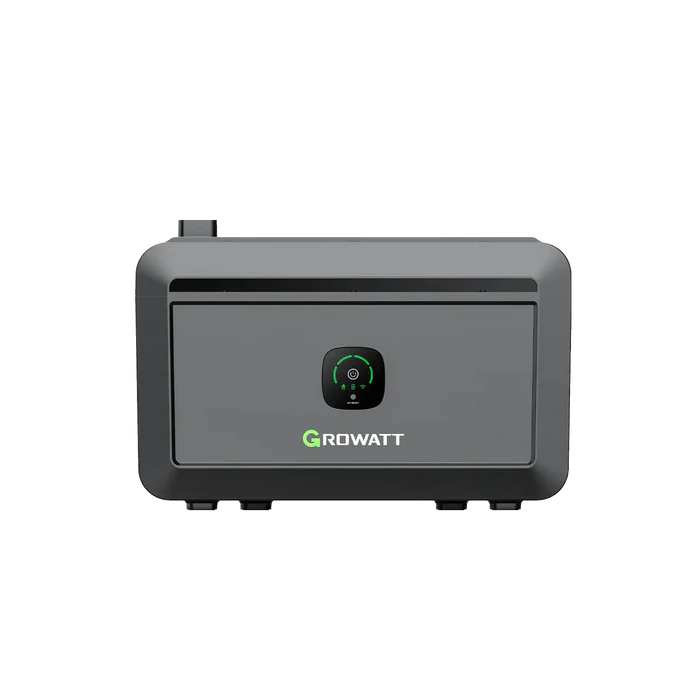
In modular families Growatt the condition translates directly into the number of modules: ARK HV increases in steps of 2,56 kWh (module ARK 2.5H-A2 — 10,24/12,8/15,36 kWh…), and APX HV Battery 2.0 in steps of 5 kWh (main module APX 5.0M-B3 and modules APX 5.0P-B3 — 10/15/20 kWh; in the store as ready-made sets APX 10–30 kWh). HOPE 16.0LM-A1 (16 kWh) catches the threshold with a single device. Models from 10 kWh with the current price and the inverters they work with, are listed on the website home energy storage models.
The program only subsidizes hybrid inverters in conjunction with energy storage—when the purchase and replacement of an inverter with a hybrid one is necessary for the storage to work with a renewable energy installation. The PLN 2 supplement applies only to inverters or storage devices manufactured in the EU; Growatt are made in China, so do not assume this allowance for them. The program includes the inverter in eligible costs only if it was manufactured in the EU (point 6.1 item 3 with footnote; FAQ, question 10) - details in grant guideThe next three conditions filter out the offers: the purchase price and installation of the warehouse up to PLN 3,000 per 1 kWh (without inverter and EMS), demonstration of island operation, i.e. emergency power supply, and an energy management system (EMS) with decision-making functions. Details and manufacturer's EMS declaration Growatt we discuss in the guide Energy storage subsidy - conditions.
Costs from November 2025 and complete set of documents
The program website provides the date of purchase (expenses incurred), installation, and operator notification "from November 1, 2025"—so the program will also cover investments completed before the start of the application period. For customers who decide to "get started," this eliminates the dilemma of waiting: installation today doesn't invalidate the application tomorrow, provided documentation is maintained from day one. The program website already publishes a list of attachments: invoices, payment confirmation (transfer or KP document, and in the case of a loan, bank payment confirmation—program, point 9.2, subpoint 8), a certificate from the grid operator confirming the connection of the micro-installation with the energy storage unit using the current template, a work acceptance protocol, photographic documentation, product cards for the storage unit and inverter, bank account confirmation, DNSH statement, and, if necessary, a power of attorney and a document confirming net billing.
This list defines the practical standard for managing investments for future applications: invoices bearing the beneficiary's name (an individual, unrelated to the business activity covered by the funding), photos taken during installation immediately and without editing—the program website states that the photos "will be automatically verified to determine whether they have been edited"—and catalog cards with nominal capacity archived with the project. The "paid" note on the invoice or the loan agreement do not constitute confirmation of payment. The program website warns: if the required attachment is not attached to the application, the application "WILL BE REJECTED WITHOUT THE POSSIBILITY OF CORRECTION."
Grant and other sources of support – can they be combined?
In addition to the subsidy, there is a thermal modernization tax relief: the Ministry of Climate and Environment states that from January 1, 2025, it covers the purchase and installation of energy storage units, with a deduction limit of PLN 53,000 per person (PLN 106,000 for a married couple). Combining the relief with the subsidy is determined by the PME 2 program: the deductible amount is reduced by the amount of the subsidy received (section 7.3, item 20). Confirm your settlement with the National Tax Information Office or a tax advisor. My Electricity is no longer an alternative: the last applications for My Electricity 6 were accepted on September 12, 2025 (2,605 applications were submitted on that day), and according to mojprad.gov.pl , "My Electricity 7.0" will not be launched "in its current formula." We have not verified municipal and regional programs.
The second limit of the merger is at the farm itself: the PLN 19 limit applies to the energy consumption point, so the subsidy for the energy storage, heat storage, and EU production allowance are cumulative within a single PPE, not per device. The program allows for only one energy storage, one inverter, and one heat storage to be submitted for a single micro-installation connected to a single connection point (point 7.3, item 9). The FAQ allows for multiple applications, but "only one device of a given type per PPE number" (question 6). The documents don't explicitly state whether a property with multiple meters will receive a subsidy for each PPE—and we won't be making this determination on behalf of the Fund. One thing is certain: a consumption point with a business activity agreement is out of the question (point 7.4).
What does this change in offers - three conclusions for the installer
Conclusion one: no more "token" magazines. Configurations under 10 kWh are dropped out of the program, and the requirement of twice the PV power raises the threshold even higher for larger roofs - the center of gravity of the offers is shifting towards 10-20 kWh, where modular towers feel most at home. Conclusion two: the nominal capacity on the product card becomes the formal value—this is where the program threshold is based, so in the offer, provide it alongside the usable capacity, precisely, and with the card as the source. Conclusion three: net-billing and net-metering differ twice in terms of the amount limit (PLN 16 or PLN 8), so the first question in the offer is "which system do you use for billing?"—before any number is mentioned.
There's also the zero-submission application, the least convenient: since October 2026, a priority program with recruitment regulations has been in effect, and grant awards are based on an assessment of the application by the National Fund for Environmental Protection and Water Management (NFOŚiGW). Offers should be written conditionally ("compliance with the PME 2 program criteria, final eligibility according to the NFOŚiGW assessment"), not guaranteed. Include transportation and shipping separately on the invoice—the program does not include them as eligible costs (section 7.3, item 10).
From the installer's practice
- In practice: create a "grant folder" for your clients today—an invoice, transfer confirmation, a report, photos, and a product card—even if they submit their application several months later. Photos of the installation can't be taken after the deadline.
- From practice: before October 20, ask the client for a new DSO certificate on the current template, with the energy storage data - a certificate on the old template means that the application has been supplemented (FAQ, question 16).
- In practice, if the installation is performed by the client's spouse who runs a business and the spouses are bound by statutory joint property, their invoice will not be accepted (program, section 9.2, item 10). After submitting the application, the client must monitor their email inbox, including the "SPAM" folder—messages arrive from pme_2@nfosigw.gov.pl, and sometimes from the address of a NFOŚiGW employee (§1, sections 6-7, §4, section 1 of the recruitment regulations). Documents should not be returned by email, but via the GWD.
- From practice: for installations above 5 kWp, calculate the capacity threshold from the PV power, not from consumption - and show the customer both numbers so that he understands why the storage is larger than "the neighbor has".
- From practice: in the quote, break down the items as they will be read in the application (warehouse / hybrid inverter / works) - with a collective invoice, the program page requires a specification with a breakdown of costs by device, and the limit is PLN 3,000 for 1 kWh counts without inverter.
- From practice: tell net-metered customers directly about the lower limit of PLN 8 and calculate whether switching to net-billing changes their bill overall – it's a financial decision, not a formality to be checked off.
Frequently asked questions (FAQ)
Can I get a grant if I already have a warehouse?
If the purchase, installation, and notification to the operator occurred on or after November 1, 2025, and you meet the program's terms, the program website covers such expenses. The devices must be new, manufactured within 24 months of installation (program, section 7.3, item 15), and the warehouse cannot have previously received a subsidy from another program (FAQ, question 15). Complete documentation from the purchase and installation period is crucial.
Will photovoltaics also receive support?
Not in this program—it finances energy storage, heat storage, and, only in conjunction with the energy storage, a hybrid inverter (only the inverter manufactured in the EU— details ). Mój Prąd, which subsidized the panels, is not accepting new applications. The micro-installation is a condition of the subsidy, not its subject.
I have 4 kW on my roof - what is the minimum storage?
The twofold condition gives 8 kWh, but the program requires at least 10 at a time kWh nominal capacity - the higher of the thresholds applies, so the minimum is 10 kWhAt 6 kWp the minimum increases to 12 kWh (editorial calculations based on criteria from the program website).
When exactly does recruitment start?
October 20, 2026, at 9:00 AM — as of October 2, 2026. Applications are open on an ongoing basis: they will continue until October 1, 2027, at 20:00 PM, or until the budget is exhausted. The application form in the Funding Application Generator is only available once the application period has been launched.
As of October 2, 2026, based on the program website przydomowemagazyny.gov.pl and the PME 2 priority program - please verify details before applying. Warehouses Growatt from 10 kWh with the current price and basket we compare on model list, you will find the full offer in the category Energy storage, and you can calculate the selection for your inverter in configurator GrowattProduct cards with nominal capacities are published download center Growatt.